

Pregnant women urged to get Covid jab as data from England shows it is safe
Health leaders are urging thousands of unvaccinated pregnant women to get vaccinated after the first official data from England found Covid jabs are safe and effective.
The analysis of more than 350,000 deliveries by the UK Health Security Agency (UKHSA) shows women who have had a Covid vaccine are no more likely than unvaccinated women to suffer stillbirth, premature birth or have babies with low birthweight. It reinforces international evidence that the jabs have a good safety record in pregnant women.
Health leaders hope the fresh data will spur pregnant women who are still unvaccinated to take up the offer of a jab. Of all pregnant women in hospital with symptomatic Covid, 98% are unvaccinated. Only 22% of women who gave birth in August were vaccinated, official figures show. One in five of the most critically ill Covid patients in hospital since July have been pregnant women who have not been vaccinated.
“If you haven’t already been vaccinated, this new information should add to the reassuring safety data,” said Dr Mary Ramsay, the head of immunisation at UKHSA. “Every pregnant woman who has not yet been vaccinated should feel confident to go and get the jab, and that this will help to prevent the serious consequences of catching Covid-19 in pregnancy.”
The data shows good birth outcomes in vaccinated women who had their babies up to August this year – with no consistent differences between vaccinated women and all women in the figures for stillbirths, low baby birthweights and premature births.
Dr June Raine, the chief executive of the Medicines and Healthcare products Regulatory Agency, said: “We want to reassure all pregnant women that the Covid-19 vaccines are safe and effective for them to use at all stages of pregnancy.
“Our rigorous safety monitoring of these vaccines in pregnancy shows that the vaccines are safe and that there is no increased risk of pregnancy complications, miscarriage or stillbirth.”
In the eight months between January and August 2021, 355,299 women gave birth, of whom 24,759 had received at least one dose of the Covid vaccine prior to delivery, according to the UKHSA analysis.
Preliminary figures released by the UKHSA show the stillbirth rate for vaccinated women who gave birth was 3.35 per 1,000, a similar rate to unvaccinated women (3.60 per 1,000), between January and August.
In the same period, the proportion of vaccinated women giving birth to babies with low birthweight (5.28%) was almost exactly the same as the proportion for unvaccinated women (5.36%). The proportion of premature births was 6.51% for vaccinated and 5.99% for unvaccinated women.
UKHSA said the small differences between groups may be explained by differences in the women eligible for and taking up the vaccine.
Prof Lucy Chappell, the Department of Health and Social Care’s chief scientific adviser, said: “This pandemic has created a lot of fear and uncertainty for those who are thinking about pregnancy or expecting a baby, with Covid-19 being very dangerous for pregnant women in particular.
“It is therefore really important that they get their Covid-19 vaccine – which has now protected hundreds of thousands of pregnant women around the world. Today’s data is hugely reassuring and further shows the vaccines continue to be the best way pregnant women can keep themselves and their babies safe from this virus.”
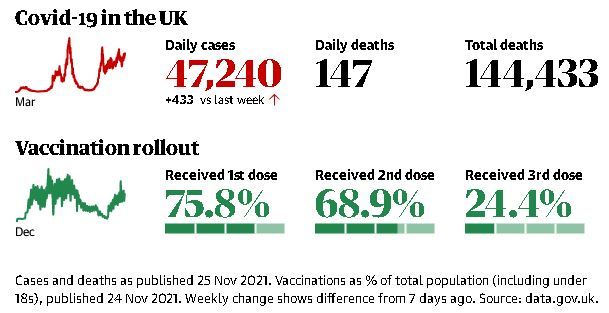
About 84,000 pregnant women have had the jab in the UK. Pregnant women aged 40 and over, who are health or social care workers or are in an at-risk group are now also eligible for booster vaccines, six months after their second dose.
Dr Nikki Kanani, a GP and deputy lead for the NHS Covid-19 vaccination programme, said: “This new and encouraging research shows there are no significant concerns about the safety of Covid-19 vaccines in pregnancy, so we will continue to advise midwives and clinicians to give expectant mums the information and support they need to make the right decision for them and their babies.”
Figures also show uptake in the most deprived areas and for those from certain minority ethnic communities is lower than for other areas or ethnicities. It follows a similar pattern to the uptake figures for these groups in the general population. This includes 5.5% of black pregnant women and 7.8% of pregnant women from the most deprived areas being vaccinated.
“We are concerned that women of black ethnicity and those living in the most deprived areas in England were least likely to have been vaccinated before they gave birth,” said Dr Edward Morris, the president of the Royal College of Obstetricians and Gynaecologists. “Efforts must be strengthened to support and encourage these groups – who are already at the highest risk of adverse pregnancy outcomes – to accept the offer of vaccination.”

