London Daily

Focus on the big picture.
Sunday, Jul 19, 2026

Pope Francis warns pets must not replace children in Italy

Pope Francis warns pets must not replace children in Italy

Starting a family in Italy is becoming a "titanic effort" that only the rich can afford, Pope Francis has warned.

Addressing a conference on Italy's demographic crisis, he said pets were replacing children in many households.

Also on stage were dozens of young people, wearing t-shirts saying "we can do this" - alluding to convincing people to have more children.

Italy has one of the lowest fertility rates in the EU and births dropped below 400,000 last year - a new low.

In his speech in Rome, the Pope said the declining birth rate signalled a lack of hope in the future, with younger generations weighed down by a sense of uncertainty, fragility and precariousness.

"Difficulty in finding a stable job, sky-high rents and insufficient wages are real problems," he said.

Warning that pets were replacing children in some households, the Pope recounted how a woman had opened her bag and asked him to "bless her baby".

Except it was not a baby, but a small dog.

"I lost my patience and told her off: there are many children who are hungry, and you bring me a dog?" he added, triggering a round of applause from the crowd.

Birth rates are slowing in many places - such as Japan, South Korea, Puerto Rico and Portugal.

But a shrinking population is a major worry for Italy - the third-largest country in the eurozone.

The country could lose almost a fifth of its residents by 2050. At the same time, the population is ageing quickly - the number of centenarians in Italy has tripled over the last 20 years.

Italy is often dubbed "The country of empty cribs". Even Elon Musk tweeted last month: "Italy is disappearing!"

Experts warn the population crisis will lead to the impoverishment of the nation. Economy Minister Giancarlo Giorgetti said that by 2042, Italy's declining birthrate would end up reducing its gross domestic product (GDP) by 18%.

There are many reasons why women in Italy are having fewer babies.

Young people struggle to find stable jobs and the childcare support system is often inadequate, which makes it hard for mothers to juggle work and family life.

Six out of 10 mothers don't have access to nurseries, according to the charity Save the Children.

Many pregnant women are forced to resign, and some get sacked when they get pregnant.
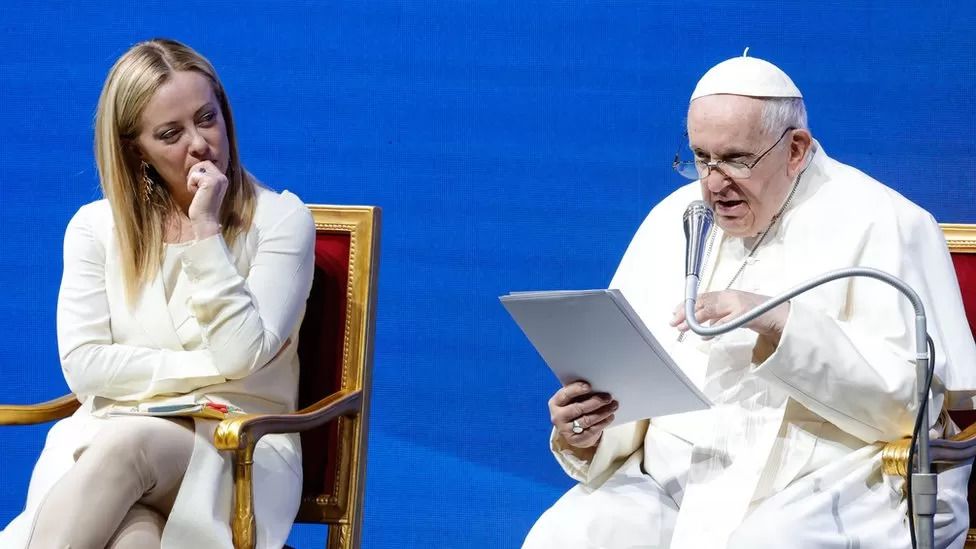
The Pope appeared on stage with Italian Prime Minister Georgia Meloni


Italy's plummeting birth rate "is a national emergency" said Prime Minister Giorgia Meloni, who was speaking alongside Pope Francis.

The image of the two leaders - both dressed in white head to toe - speaking together was very symbolic in Italy, as to show that the issue is so urgent, that it goes beyond politics or religion.

"Fixing the problem is an absolute priority. We want Italy to go back to having a bright future," she said.

Mrs Meloni, who won the largest share of the women's vote in September elections but does not consider herself a feminist, has made mothers and families a central part of her discourse.

She has created an ad hoc ministry to address the issue of declining birth rates and her government has hinted at encouraging people to have children by exempting them from paying income tax.

Pope Francis called for politicians to find "forward-looking solutions to avoid Italy degenerating into sadness".

At the end of his speech, several pregnant women queued on stage to have him touch their belly and give them a blessing.

Shortly after, a flock of children encircled the Pontiff in a group hug - something likely to have been orchestrated by the organisers of the event.


Newsletter

Related Articles

0:00
0:00
Close
Iran Claims It Destroyed Bahrain’s Main Artificial Intelligence Center in Missile and Drone Strike
Brothers Andrew and Tristan Tate Who Turned "Toxic Masculinity" Into a Brand Arrested in Miami as Britain Seeks Their Extradition
Trump Administration Pressures Banks to Restrict Financial Access for Undocumented Immigrants
Passenger Bound for Germany Refused to Sit Beside a Woman on a Plane — Then Slapped a Flight Attendant
Ukraine’s Leadership Rift Spills Into the Streets as Protesters Target Army Chief
Ukrainian Drone Barrage Kills Eight and Strikes Russian Logistics Network
Key Trends to Watch
Financial Conduct Authority Warns Cloud and Digital Risks Are Becoming a Financial Priority
Jeffrey Donaldson Appeals Sexual Abuse Conviction as Democratic Unionist Party Opens Review
Welsh Health Authorities Launch Emergency Meningitis Vaccination Programme for Students
Scottish Business Activity Falls for Third Month as Companies Face Rising Costs
Bank of England Regulators Demand Better Access to Digital Banking Services
United Kingdom Cuts Bilateral Aid to Several African Countries by Up to Ninety Per Cent
United Kingdom Introduces Tougher Deportation Rules After Rochdale Exploitation Scandal
NHS England Launches Wearable Technology Plan to Reduce Sepsis Deaths
Amazon Web Services Billing Error Sends Trillion-Dollar Invoices to British Companies
Bank of England Takes Direct Regulatory Role Over Major Global Cloud Providers
Extreme Summer Heat Drives Record Fire Risk and Rising Deaths Across Britain
United Kingdom Nationalisation of British Steel Sparks Diplomatic Dispute With China
United Kingdom Economy Shows Weak Growth Ahead of Major Autumn Budget
Andy Burnham Set to Become United Kingdom Prime Minister After Labour Leadership Victory
The Ten World Cup Finals That Defined Football History
Smartphones Are Getting More Expensive, Sales Are Collapsing, and Even Apple Admits: "Prices Will Rise"
The Monaco Bombing Has Become a Test of Ukraine’s Intelligence Accountability
Leadership Change and Strategic Rivalry Redraw the Political Map
Energy Risk, Uneven Growth and the New Geography of Global Capital
The AI Race Enters Its Infrastructure Era
Security and resilience remain long-term national priorities
Britain balances growth ambitions with public finance pressures
Regional devolution becomes a defining theme of the next Labour era
Industrial strategy returns to the centre of British economic policy
Political Instability Remains a Challenge for UK Investment Confidence
Brexit Economic Debate Continues as Public Concerns Over Long-Term Impact Remain
UK Climate Risks Rise as Met Office Warns Extreme Weather Is Becoming More Common
Housing Shortages and Regional Inequality Become Key Priorities Under Incoming Labour Leadership
National Health Service Reform Remains One of Britain’s Biggest Political Challenges
Bank of England Remains at Centre of UK Economic Debate Over Inflation and Growth
UK Economy Shows Recovery Signs but Households and Businesses Remain Under Pressure
Britain Deepens European Defence Cooperation as NATO Allies Seek Stronger Security Capabilities
United Kingdom Expands Sanctions Against Russian Cyber Networks Over Security Threats
UK Industrial Strategy Faces Test After Government Takes Control of British Steel
British Businesses Seek Policy Clarity as Andy Burnham Prepares to Lead Labour Government
Andy Burnham’s Labour Leadership Signals Major Shift Toward Regional Power and Devolution
British Steel Nationalisation Creates New UK-China Tensions Over Control of Strategic Industry
For 36 Years, He Scammed About 300 Luxury Hotels — Until He Was Caught
England's World Cup Exit Expected to Cost Hospitality and Retail £334 Million
Former ICC Prosecutor Aide Speaks Publicly About Allegations Against Karim Khan
Opposition Raises Questions Over June Heatwave Power Grid Pressures
Mastercard Explores Sale of Majority Stake in UK Payments Operator Vocalink
Boeing Forecasts Global Commercial Aircraft Fleet Will Double by 2045
×