London Daily

Focus on the big picture.
Monday, Jul 13, 2026

Pelé: Why black Brazilians like me mourn the king

Pelé: Why black Brazilians like me mourn the king

Pelé, o Rei, has died.

Brazil and the world are grieving, and many of us mourn an idol we never saw on the pitch.

Being 23 years old, I was not around during the start, middle, or even the end of his glowing football career. But that does not matter. Pelé was and always will be a household name.

Growing up in Rio de Janeiro, a city of exuberance and vibrancy, football played a crucial role in our life.

Maracanã, where Pelé scored his thousandth goal, was emblematic of my day-to-day routine until I moved to the UK, aged 11.

We were always nearby. The buzz and frenzy during match days could be felt across the city. Traffic would be slower, restaurants busier, and the streets much louder.

Following the news of king Pelé's death last night, as I was writing for the BBC's tributes live page, my family group chat kept buzzing.

Four generations, all devastated in equal measure by the death of an idol. Words, emojis and GIFs expressed our shock - we are Brazilian, after all, and emotions tend to run high.

But what stuck with me was a comment from my aunt. She highlighted that Brazilian media, while discussing Pelé's life, used the phrase: "Our king is black."
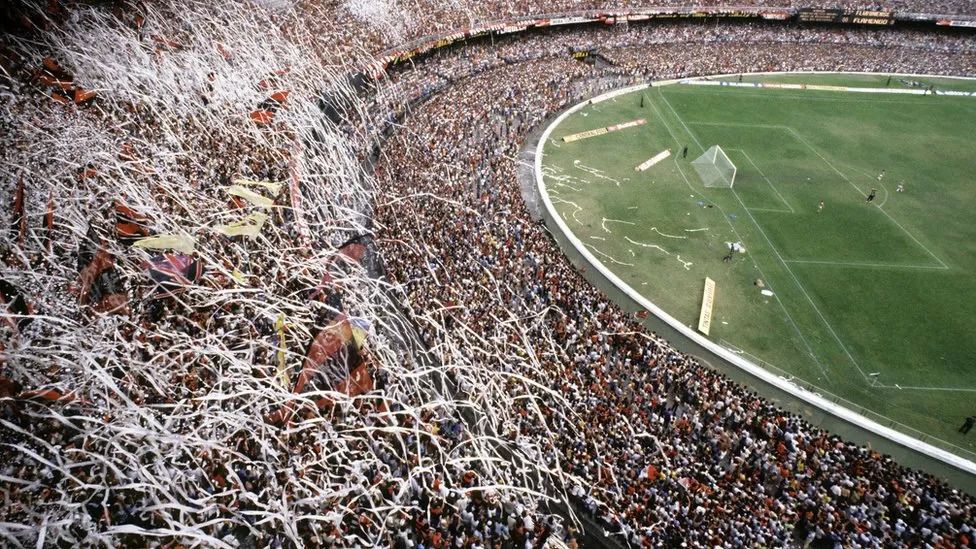

Thousands of football fans from across Brazil flock to Rio de Janeiro to watch big matches at Maracanã

His stardom is unquestionable - and his influence worldwide says much more about him than his ethnicity and background.

But for Brazil's black community, hearing those words matter. A lot. And they signify a paradigm shift we have been going through for decades - one which Pelé played a crucial role in.

Because Pelé rose to the status of national treasure in a country with a deep history of slavery, and a legacy of division.

He regularly faced monkey chants on the pitch and had several racist nicknames. He once said that if he had stopped every game after a monkey taunt, he would have had to stop them all.

He was key to carving out space and recognition for black people in Brazilian football, his biographer Angelica Basthi has said - but he was never directly involved in the fight against racism.

Speaking to my mum, she tells me that Pelé "signifies greatness and contradiction".

Contradiction, because many Brazilians struggled with his resistance to speak out against racism.

Greatness, due to the path he forged for us, black Brazilians. Pelé rose to stardom despite Brazil's deeply rooted racism.

"He allowed us, black Brazilians, to see one of our own being acclaimed by the masses, considered a King, an icon for the whole country," my mum tells me.

"Pelé won his first World Cup only 70 years after slavery was abolished [in Brazil], in a country which continued, and continues, to treat black people as third-class citizens.

"He was an icon, who made us realise that it is possible to be a black man of international prominence."

Brazil abolished slavery in 1888. It is not ancient history for us, and anti-black racism continues to be rife.

Pelé's voice and gravitas could be heard in the commentary of big games long after the end of his career - particularly during World Cups.

"Even being quiet, he was able to contribute a lot towards Brazil's image worldwide," Edward Helal, my friend and a huge football fan, tells me.

Asked about the mood in Rio, Edward says most people are taking time to pay tributes and express their gratitude to the king of football.

Even now, during my annual visits back home, I dare not suggest having anything other than our world-renowned football commentary in the background on a Wednesday evening or Sunday afternoon.

I have Pelé to thank - and blame - for it.

Newsletter

Related Articles

0:00
0:00
Close
World Cup Visitors Turn American Big-Box Stores Into Souvenir Stops
Netflix Weighs Always-On Channels, Bundles and Short-Form Video
Passenger Is Pulled Partly Outside Ryanair Jet After Window Fails Mid-Flight
Innovation-led growth strategy
Public service reform pressure
Defence and industrial security
Labour leadership transition and economic reset
Northern England Pushes for Greater Influence in Britain’s Future Economic Model
UK Technology Strategy Focuses on Life Sciences, Digital Innovation and Research Investment
Britain and United States Maintain Focus on Pharmaceuticals Cooperation and Industrial Growth
UK Public Services Face Continued Pressure as Government Promises Visible Improvements
Regional Economic Power Becomes Key Theme in Britain’s Next Political Phase
Britain Expands Support for Small Businesses as Firms Seek Better Access to Finance
UK Economy Remains Central Political Challenge as Cost of Living and Growth Concerns Persist
National Health Service Introduces New Workplace Reviews to Improve Conditions for Healthcare Staff
UK Life Sciences Sector Secures More Than Three Billion Pounds in Investment to Support Innovation
Britain Strengthens Defence Strategy as Security Concerns Reshape Military and Industrial Policy
Andy Burnham Promises Stronger UK Defence Industry and Expanded Domestic Production
UK Government Faces Difficult Spending Choices as Labour Leadership Transition Approaches
Rachel Reeves Warns Andy Burnham of Immediate Economic Challenges After Expected Leadership Change
Andy Burnham Prepares to Lead UK Government With Plans for Regional Power Shift and Economic Reset
Government Creates Emergency Support Scheme for Financially Struggling Universities
United Kingdom Replaces Traditional Farm Subsidies With Payments Linked to Environmental Performance
National Grid Reports First Week of Electricity Generation Without Fossil Fuels
United Kingdom Financial Regulator Introduces Tougher Capital Rules for Cryptocurrency Exchanges
Belfast Harbour Expands Operations to Attract Investment Through United Kingdom and European Union Market Access
Scottish Government Threatens Legal Challenge Over Westminster Cuts to North Sea Transition Funding
United Kingdom Accelerates Trans-Pennine High-Speed Rail Project Linking Northern Cities
United Kingdom Secures Ten Billion Pound Investment for Cambridge Quantum Computing Campus
Port Talbot Steelworks Wins Support for Green Hydrogen Transition and Protection of Industrial Jobs
United Kingdom Sends Royal Navy Carrier Strike Group to Indo-Pacific as Regional Security Focus Expands
National Health Service Expands Artificial Intelligence Diagnostics Across England to Reduce Screening Backlogs
United Kingdom Launches Fifty Billion Pound Infrastructure Fund to Accelerate Housing and Construction
UK Medical Chiefs Update Health Guidance to Promote Everyday Physical Activity
Office of Communications Keeps Wikipedia Under Review Under UK Online Safety Rules
UK Defence Ministry Expands Deep-Strike Capability Through Precision Missile Programme
Russell Group Universities Warn Funding Cuts Could Damage NHS Workforce Training
UK Parliament Calls for National Emergency Broadcast as Heatwave Conditions Intensify
UK and Netherlands Strengthen Naval Cooperation With New Amphibious Defence Partnership
UK Defence Ministry Joins International Missile Programme With One Hundred and Ninety Million Pound Investment
Bank of England Warns Middle East Conflict and AI Risks Could Pressure UK Economy
UK Government Introduces New Rules to Limit Foreign Influence in Political Donations
UK and France Prepare Naval Mission to Protect Shipping Through Strait of Hormuz
United States Pressures UK to Increase Defence Spending at NATO Summit
Bank of England Warns Artificial Intelligence Investment Boom Could Create Financial Stability Risks
Bank of England Begins Direct Oversight of Critical Technology Providers Supporting UK Finance
Andy Burnham Set to Become UK Prime Minister After Labour Leadership Race Clears Path to Downing Street
Scottish Fishing Industry Calls for Emergency Support Amid Rising Costs
UK Supports Stronger European Response to Russian Actions in Ukraine
Devon and Cornwall Police Release Suspect in Ann Widdecombe Murder Investigation
×