London Daily

Focus on the big picture.
Tuesday, Jul 14, 2026

Our fossil fuel addiction must end, UN chief tells World Economic Forum

Antonio Guterres, the UN secretary-general, used his address to the World Economic Forum in Davos, Switzerland, on Wednesday to urge world leaders and businesses to expand their efforts to achieve net-zero carbon emissions.

He also called on business leaders to provide “credible and transparent” plans by the end of the year on how they intend to achieve net-zero.

Guterres warned that many businesses had set their climate targets based on “dubious or murky” criteria, which can “mislead consumers, investors and regulators with false narratives.”

“It feeds a culture of climate misinformation and confusion and leaves the door open to ‘greenwashing,’” he told delegates at the WEF’s Annual Meeting.

“The transition to net-zero must be grounded in real emissions cuts and not rely essentially on carbon credits and shadow markets. That is why we (the UN) created an Expert Group on Net-Zero Emissions Commitments.”
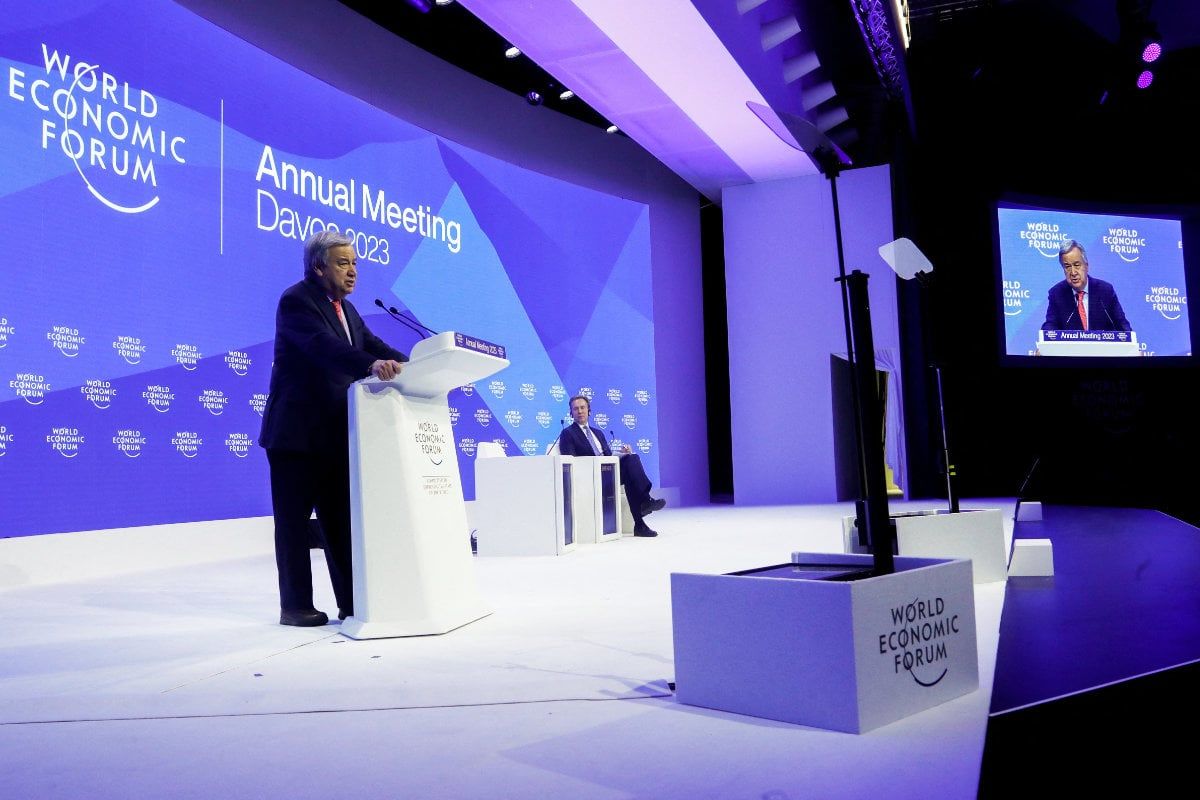
UN Secretary-General Antonio Guterres addresses the World Economic Forum (WEF) in Davos, Switzerland, on January 18, 2023.

Guterres warned that time is running out to prevent disasters linked to man-made climate from growing in scale and frequency.

“We are looking into the eye of a Category 5 storm,” he added.

To avert the worst effects of climate change, scientists say any rise in global temperatures must be limited to no more than 1.5 degrees Celsius above pre-industrial levels. The average surface temperature of the planet has already increased by about 1.8 C since the late 1800s.

Guterres urged the world to “end the addiction to fossil fuels,” warning that the aspirational goal of limiting warming to 1.5 C was “going up in smoke.”

“Fossil fuel producers and their enablers are still racing to expand production, knowing full well that this business model is inconsistent with human survival,” he said.

“This insanity belongs in science fiction, yet we know the ecosystem meltdown is cold, hard scientific fact.”

The Paris Agreement, a legally binding international treaty on climate change adopted by 196 countries at the 2015 UN Climate Change Conference, COP21, committed nations to scaling up their efforts to reduce greenhouse gas emissions by 45 percent before 2030.

It also obliged them to build resilience against the adverse effects of climate change, uphold and promote regional and international cooperation in efforts to limit global warming to the 1.5 C target, and to reach net-zero by 2050.

To date, 137 countries have committed to achieving carbon neutrality, as tracked by the Energy and Climate Intelligence Unit, an independent advisory organization in the UK. Of those, 124 have set targets for 2050.

Bhutan and Suriname are the only two nations to date that have achieved carbon neutrality and are, in fact, carbon negative. Twenty-four countries have set their climate targets as official policy. They include Brazil, China, Germany and the US, which are some of the world’s largest emitters. Five countries are preparing legislation, including Canada, South Korea and several EU member states.

However, even if the 193 parties to the Paris Agreement implement their existing commitments, it is estimated that global greenhouse gas emissions would still increase by almost 11 percent by 2030, compared with 2010.

Newsletter

Related Articles

0:00
0:00
Close
UK Prime Minister Keir Starmer Offers Condolences Following Death of Qatar’s Father Amir
UK Regional Innovation Policy Focuses on Research Clusters Across Scotland, Wales, and Northern England
UK Corporate Transparency Rules Set to Become More Strict Under Modern Slavery Reform Plans
UK Civil Service Estate Strategy Shifts Government Activity Away From London
UK Strengthens National Security Powers Through New Threat Designations
Greater Manchester Police Conduct Drink and Drug Driving Operations After Football Events
UK Government Advances Darlington Economic Campus With Construction Milestone
UK Authorities Increase Football-Related Security Operations After Tournament Fixtures
UK Invests Fifty-One Million Pounds in National Cryogenics Facility and Regional Innovation Hubs
UK Moves Toward Tougher Modern Slavery Reporting Rules With Corporate Penalties
UK Government Reports Forty-Three Million Pounds in Savings From Office Estate Reform
UK Government Expands Civil Service Regional Strategy With Manchester and Darlington Campus Projects
UK Designates Iran’s Islamic Revolutionary Guard Corps as National Security Threat
United Kingdom Financial Markets Monitor Business Response to Economic Policy Changes
Scottish Renewable Energy Expansion Highlights Need for Faster Grid Development
Wales and Regions Strengthen Focus on Economic Development Through Tourism and Investment
Retail Industry Warns High Street Businesses Remain Under Pressure
Police Chiefs Highlight Growing Challenges Managing Protests and Public Order
Agriculture Leaders Seek Clarity on Post-Brexit Farming Support and Environmental Rules
Transport Unions Warn of Further Industrial Action Over Pay and Working Conditions
Welsh Tourism Sector Reports Strong Growth Driven by Domestic and International Visitors
National Infrastructure Review Gains Support as Leaders Seek Faster Project Delivery
Financial Markets Assess Impact of United Kingdom Corporate Tax Policy Changes
Northern Ireland Assembly Debates Cross-Border Trade and Infrastructure Cooperation Plans
Government Opens Consultations on Housing Reform and Planning System Changes
Scottish Government Faces Pressure to Accelerate Offshore Wind and Grid Expansion
National Energy System Operator Warns Grid Investment Is Needed for Future Electricity Demand Growth
United Kingdom Research Council Invests in Artificial Intelligence and Biotechnology Innovation Hubs
United Kingdom Expands Oversight of Skilled Worker Visa Sponsors Amid Migration Debate
Cross-Party MPs Call for National Infrastructure Strategy Review to Accelerate Economic Growth
Prime Minister Announces One Billion Pound NHS Funding Package Ahead of Winter Pressures
Bank of England Signals Cautious Approach to Interest Rates as Inflation Remains Above Forecasts
World Cup Visitors Turn American Big-Box Stores Into Souvenir Stops
Netflix Weighs Always-On Channels, Bundles and Short-Form Video
Passenger Is Pulled Partly Outside Ryanair Jet After Window Fails Mid-Flight
Innovation-led growth strategy
Public service reform pressure
Defence and industrial security
Labour leadership transition and economic reset
Northern England Pushes for Greater Influence in Britain’s Future Economic Model
UK Technology Strategy Focuses on Life Sciences, Digital Innovation and Research Investment
Britain and United States Maintain Focus on Pharmaceuticals Cooperation and Industrial Growth
UK Public Services Face Continued Pressure as Government Promises Visible Improvements
Regional Economic Power Becomes Key Theme in Britain’s Next Political Phase
Britain Expands Support for Small Businesses as Firms Seek Better Access to Finance
UK Economy Remains Central Political Challenge as Cost of Living and Growth Concerns Persist
National Health Service Introduces New Workplace Reviews to Improve Conditions for Healthcare Staff
UK Life Sciences Sector Secures More Than Three Billion Pounds in Investment to Support Innovation
Britain Strengthens Defence Strategy as Security Concerns Reshape Military and Industrial Policy
Andy Burnham Promises Stronger UK Defence Industry and Expanded Domestic Production
×