London Daily

Focus on the big picture.
Tuesday, Jun 02, 2026

Britain's Covid-19 R rate is DOWN, SAGE says but UK not out woods

Britain's Covid-19 R rate is DOWN, SAGE says but UK not out woods

The Government's scientific advisers say the UK's current R value - the number of people each Covid-19 patient infects - is between 1.2 and 1.5. This is down slightly on last week's 1.3 and 1.6.

Britain's coronavirus R rate has fallen slightly, according to the Government's own scientific advisers.

They say the current R value - the average number of people each Covid-19 patient infects - is between 1.2 and 1.5. This is down slightly on last week's range of 1.3 and 1.6.

But SAGE's R rate estimates are three weeks behind due to a lag in the way it records its data, meaning it does not represent the virus's current trajectory.

For this reason, SAGE said it was 'almost certain that the epidemic continues to grow exponentially across the country, and confident that the transmission is not slowing'.

An R number of between 1.2 and 1.5 means that every 10 people with Covid-19 will pass the virus onto between 12 and 15 other people, on average.

Experts have repeatedly warned it is critical the R rate stays below the level of one or the outbreak will continue to grow exponentially.
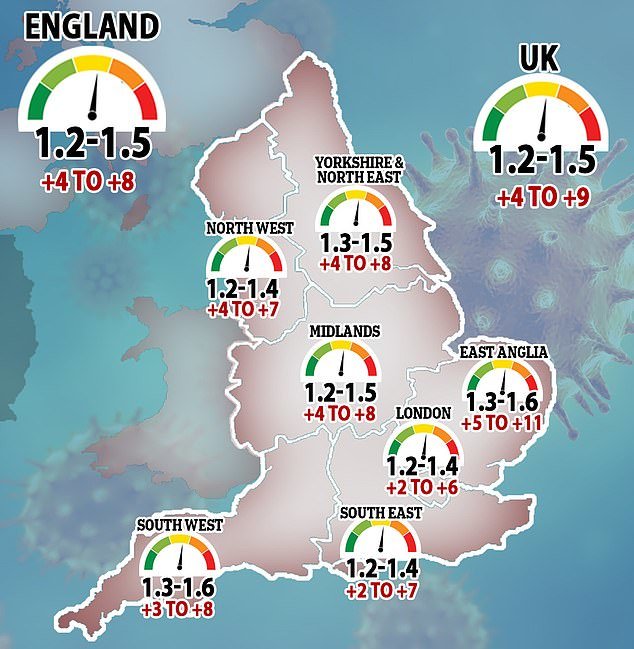
Britain's coronavirus reproduction rate has fallen slightly, according to the Government's scientific advisers. They say the current R value - the number of people each Covid-19 patient infects - is between 1.2 and 1.5. This is down slightly on last week's range of 1.3 and 1.


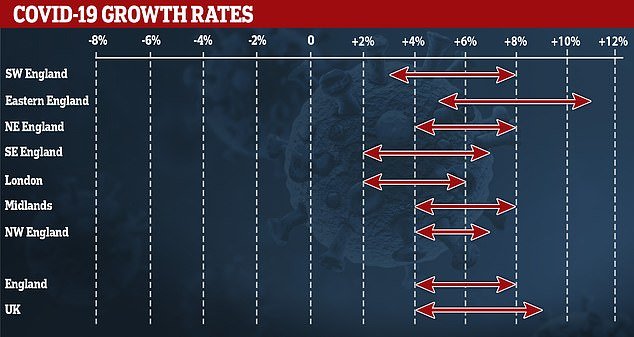
The UK's current growth rate - the speed at which the outbreak is growing every day - is between +4 per cent and +9 per cent, SAGE estimates, down slightly on last week's prediction it was in the region of +5 per cent and +9 per cent


The Imperial College London-led REACT study estimates there were 45,000 new cases of coronavirus every day in England during the week ending October 5 - almost half the predicted rate of transmission during the darkest days of the crisis in April


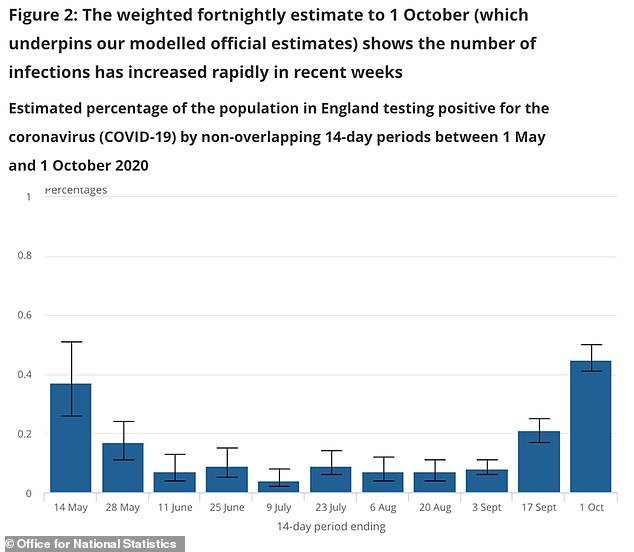
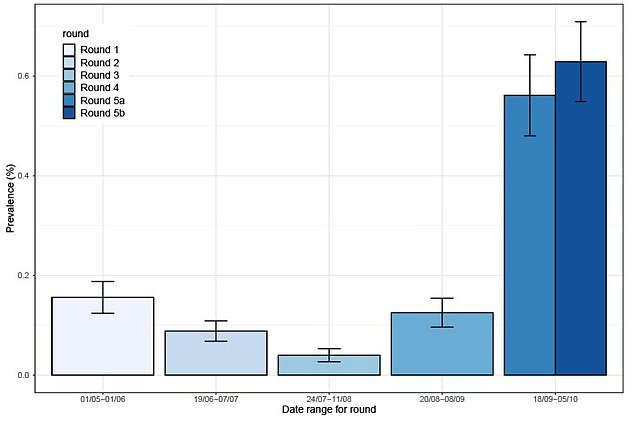
A report by the Office for National  Statistics showed that more than 0.4 per cent of people in England were thought to be infected with Covid-19 in the week up to October 1, which was the highest estimate since the data began in May. It suggests that one in every 240 people has the disease, although this varies widely according to which part of the country people are in


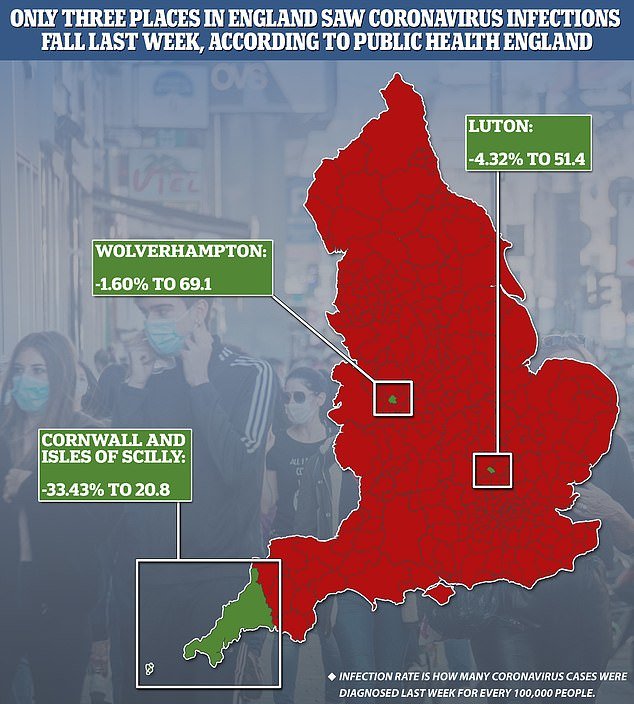
Meanwhile, a Public Health England surveillance report published yesterday showed only three places across England have not recorded a rises in their per-person Covid-19 infection rates in the past week - Luton, Wolverhampton and Cornwall and the Isles of Scilly


A spokesperson for SAGE - the Government's Scientific Advisory Group for Emergencies, said: 'SAGE is almost certain the epidemic continues to grow across the country, and is confident that the transmission is not slowing.

'While the R value remains above 1.0, infections will continue to grow at an exponential rate.

'This is currently the case for every region of England and all have positive growth rates, reflecting increases in the number of new infections across the country.'

SAGE's R figures are based on epidemiological data such as hospital admissions, ICU admissions and deaths.

Due to the lag in time it takes for patients to catch, fall ill with and die from coronavirus, it means there a delay in the data.

This means it can often taken three weeks before the virus's current trajectory is reflected in the estimates.

The UK's current growth rate - the speed at which the outbreak is growing every day - is between +4 per cent and +9 per cent, SAGE estimates, down slightly on last week's prediction it was in the region of +5 per cent and +9 per cent.

It comes as a hat-trick of reports today confirmed coronavirus cases are surging in England with as many as 45,000 people catching the virus every day.

One Government-led study estimated that the infection rate could be almost half of what it was during the darkest days of the crisis in March and April, when scientists believe there were more than 100,000 new cases per day.

Another report, by the Office for National Statistics, estimated 17,400 contracted the disease each day in England alone in the week ending October 1, which was double the number-crunching agency's prediction last week.

And statistics published yesterday by Public Health England show that all but three areas of the country have had infection rates rise since last week.

Of a total 149 local authorities, only Luton, Wolverhampton and Cornwall and the Isles of Scilly had a lower number of cases per 100,000 people than last week.

Today's ONS report, made using data from the two weeks up to October 1, warns 'the number of infections has increased rapidly in recent weeks', and official tests show cases continued to rise in the first week of October meaning next week's estimate will likely be higher again.

If its estimate is accurate it suggests the Department of Health's testing programme is now picking up most of the true number of cases, with it managing to diagnose 11,000 people on October 1 - 63 per cent of the ONS's new cases prediction.

Ministers this morning admitted the spread of the disease is 'getting out of control' as Tory MPs warned against imposing 'Hotel California' local lockdowns which never end.

Prime Minister Boris Johnson is expected on Monday to formally unveil plans to split the country into three tiers, with the worst-hit areas placed in the top tier and told to close pubs and restaurants to slow the spread of the disease. It came amid reports that experts on the Government's Scientific Advisory Group for Emergencies (SAGE) fear Mr Johnson's planned tier system does not go far enough.

According to reports, members of SAGE believe the planned closure of pubs and restaurants in hotspot areas will not be sufficient to get the virus under control and avoid a second wave. Some believe ministers should have pulled the trigger on a nationwide 'circuit breaker' lockdown in England two or three weeks ago when it was first discussed.

Scrutiny of the PM's plans has only increased after Nicola Sturgeon yesterday imposed a two-week alcohol ban inside pubs and restaurants across Scotland, while closing bars entirely in coronavirus hotspots.

The prospect of new draconian rules being imposed across England has sparked a Tory backlash, with MPs demanding the Government set out in detail how areas subject to the tightest restrictions will be able to get them lifted.

Some 609 coronavirus patients were admitted to hospital yesterday - an increase of a fifth in a day – and hospitalisations in England breached 500 for the first time since June.

A further 17,540 cases and 77 deaths were reported, with the number of people testing positive for the disease every day having nearly tripled in a fortnight.

There were 6,634 diagnoses of the disease two weeks ago, on September 24, which is the most recent point of reference after a counting blunder at Public Health England (PHE) rendered last week's data invalid.


Newsletter

Related Articles

0:00
0:00
Close
Japanese Technology Firm Fujitsu Launches Advanced Artificial Intelligence Tool for Corporate Disclosures
South Africa Officially Launches Nationwide Campaign for Highly Contested Local Government Elections
United Kingdom Commits Additional Funding for Unexploded Ordnance Clearance in Laos
Singapore Announces Stringent New Greenhouse Gas Regulations for Commercial Cooling Systems
Cambodia and Thailand Hold High-Level Border Security Talks at United Nations Headquarters
Myanmar Military Government and China Sign Major Agreement to Upgrade Media and Cultural Cooperation
Knife Attack at Swiss Train Station Leaves Three Injured in Suspected Act of Domestic Terrorism
Transnational Extortion Gang Threatens Canadian Police With Army of One Thousand Armed Operatives
Australia Imposes Forty-Two-Day Quarantine on Cruise Ship Passengers Following Deadly Hantavirus Outbreak
International Monetary Fund Unlocks Seven Hundred Million United States Dollars for Sri Lanka Following Economic Reforms
Australia Launches Record One Point Four Billion Dollar Lawsuit Against Chemical Giant 3M Over Contamination
China and Canada Foreign Ministers Meet in Ottawa in Effort to Stabilize Strained Diplomatic Ties
Indonesia Demands Urgent United Nations Security Council Reform Amid Escalating Global Conflicts
Extreme Weather Patterns Trigger Severe Drought in Madagascar and Destructive Flooding in East Africa
Indian State of Karnataka Faces Political Upheaval as Chief Minister Siddaramaiah Abruptly Resigns
Philippines and Japan Reaffirm Defense Ties as Crucial for Indo-Pacific Regional Stability
Norway Joins French Nuclear Deterrence Initiative in Major Shift for European Security Architecture
Global Critical Mineral Alliances Expand as Western Nations Move to Counter Chinese Supply Dominance
United States Imposes Fifty Percent Tariffs on Mexican Steel and Aluminum Ahead of Trade Pact Review
European Union and China Head Toward Major Trade Conflict Over Clean Technology Exports
United States Economic Growth Severely Downgraded to One Point Six Percent as Stagflation Fears Mount
World Health Organization Warns Central African Ebola Epidemic is Outpacing Containment Efforts
United States Treasury Department Conditions Sanctions Relief on Reopening of the Strait of Hormuz
Iranian Air Defenses Intercept and Destroy United States Military Drone Over Bushehr Province
Iranian Armed Forces Launch Ballistic Missiles Toward Unspecified Targets Prompting Regional Condemnation
United Nations Secretary-General Warns Global Order Facing Highest Level of Conflict Since 1945
Israel Issues Sweeping Evacuation Orders in Southern Lebanon Amid Intensified Hezbollah Conflict
Russia Announces Systemic Military Strikes Targeting Ukrainian Defense and Energy Infrastructure
United States and Iranian Negotiators Reach Draft Agreement to Extend Ceasefire and Resume Nuclear Talks
United Nations Security Council Deeply Divided Over United States Capture of Venezuelan President
US and Iran Exchange Direct Military Strikes Amid Fragile Gulf Ceasefire
World Health Organization Warns of Catastrophic Ebola Outbreak in DR Congo
Russia Threatens New Wave of Strikes on Ukrainian Infrastructure and Embassies
Scientists Warn Atlantic Ocean Currents Could Collapse Faster Than Projected
Anthropic Reaches $900 Billion Valuation in Historic AI Funding Round
Washington Imposes Crippling Sanctions on Iranian Maritime Authority
Japan and the Philippines Initiate Strategic Intelligence-Sharing Pact
Microsoft Deploys Autonomous Computer-Using AI Agents to Global Markets
Anthropic Secures $45 Billion Compute Infrastructure Agreement With SpaceX
U.S. Director of National Intelligence Resigns Amid Administration Shakeup
Micron Technology Crosses Trillion-Dollar Valuation Amid Unprecedented Hardware Demand
Canada and Germany Finalize Historic Long-Term LNG Export Agreement
China Expands International Travel Restrictions on Domestic AI Researchers
Japan Approves Sweeping Overhaul of National Intelligence Apparatus
Global Airlines Scramble Logistics as Middle East Airspace Remains Fractured
Japan's Naphtha Imports Plunge 47 Percent Amid Strait of Hormuz Closure
Global Crude Prices Retreat Below $96 as Gulf Tensions Momentarily Ease
Generative AI Outperforms Human Baselines in Landmark Global Creativity Study
NASA Partners With Private Aerospace to Unveil Permanent Lunar Base Architecture
South Korean Equity Markets Surge on Next-Generation Memory Chip Frenzy
×