

One in four Britons ‘not confident NHS can care for them’, survey reveals
One in four Britons do not believe that the NHS can care for them properly, new research into the public’s attitude to the health service reveals.
When asked “how confident are you, if at all, in the NHS’s ability to give you the care you need?”, a quarter (26%) said they were not confident.
While only 15% thought the NHS was not coping well with treating coronavirus patients, many more – 41% – believed that it was not coping well with providing other services.
Experts said that increasingly long delays for operations and GP appointments, Covid’s disruption to normal NHS services and longstanding staff shortages were likely to blame for the widespread lack of confidence in the health service’s ability to provide timely and effective medical treatment.
Sally Warren, the director of policy at the King’s Fund health thinktank, said that the pandemic had added to the pressure already being felt in the NHS and forced it to prioritise who received care.
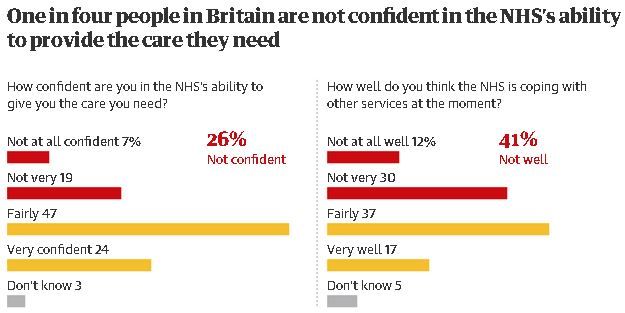 Ipsos Mori. Base: 1,032 adults aged 18-75 in Great Britain, 16-18 December 2021. Note: figures may not sum due to rounding
“The impact of this reprioritisation has been clear for all to see through regular reports of NHS services struggling to cope. Once again this is at the forefront of many people’s minds as the Omicron variant brings back the threat of services being overwhelmed,” said Warren.
“But it’s not just media reports that change people’s perceptions of the health service, and many people have personal experience of struggling to access their GP or being stuck on a hospital waiting list,” she added.
The findings by the pollsters Ipsos Mori are based on questions it asked 1,032 adults aged 18 to 75 across Britain between 16 and 18 December. When the 41% who thought the NHS was not coping well with providing non-Covid care were asked who they held responsible, 48% said the government, 18% blamed patients and 8% identified the general public as the culprits.
The survey also found that people who were on a waiting list for routine hospital care themselves or who have had a relative on one were more likely to be “not confident” in the NHS’s ability to provide care.
Labour said the findings showed the effects of persistent and unaddressed staff shortages.
“The pandemic has put enormous pressures on the NHS. But the health service went into the pandemic hugely understaffed with patients already waiting too long for care. With record waiting lists, 100,000 NHS staff shortages and 112,000 vacancies in social care in 2019, the Tories left our health service criminally ill-equipped for Covid,” said Wes Streeting, the shadow health secretary.
“None of this is the fault of our heroic health and social care workers, who are getting Britain through this pandemic. For our NHS to be able to provide the care patients expect the workforce needs to be properly valued, strengthened and provided with modern equipment and technology to ensure patients receive quality care quicker,” he added.
The pandemic – which led to the widespread suspension of normal NHS care and has seen England’s waiting list soar from 4.4 million to 5.8 million – appears to have undermined the public’s faith in its ability to give them the care they need.
In the research, 37% of those questioned said they had less confidence that the NHS could give them the care they need since the pandemic while just 21% said they had more confidence.
Chris Hopson, the chief executive of NHS Providers, which represents hospitals in England, said the huge pressures the service was under were being felt by patients.
“The NHS has just been through the toughest two years in its history, and is being severely tested on multiple fronts.
 Long waits for GP appointments were one likely cause for the lack of confidence in the NHS.
“The public know the health service is pulling out all the stops to provide the care people need. A large majority are confident in the NHS’s ability to deliver that care. It’s understandable, given the scale of the pressures, that some will be worried,” Hopson said.
He cited the Omicron variant, the record backlog of those waiting for surgery – which NHS leaders admit will take years to clear – and huge demand for A&E as examples of the growing strain.
Kate Duxbury, Ipsos Mori’s joint research director, said: “Overall, the public still think the NHS has the ability to give them the care they need, though this has been impacted by the pandemic and there are signs it will come under increasing pressure as more people find themselves waiting for NHS care.”
A Department of Health and Social care spokesperson declined to respond directly to the findings. But a spokesperson said: “While the pandemic has put enormous pressures on the NHS and caused waiting lists to grow, the NHS is delivering the biggest vaccination rollout in history and more than 32 million people have been given their vital booster jab.
“Our record investment in the NHS includes an extra £2bn this year and £8bn over the next three years to cut waiting times and deliver an extra 9m checks, scans and operations ensuring patients get the treatment they need sooner.
“The NHS is also deploying more efficient, innovative ways of working, including opening new surgical hubs and at least 100 community diagnostic centres by 2025 to make getting checked quicker and more convenient.”

