

One in 20 children missed school in England due to Covid as cases rise 66%
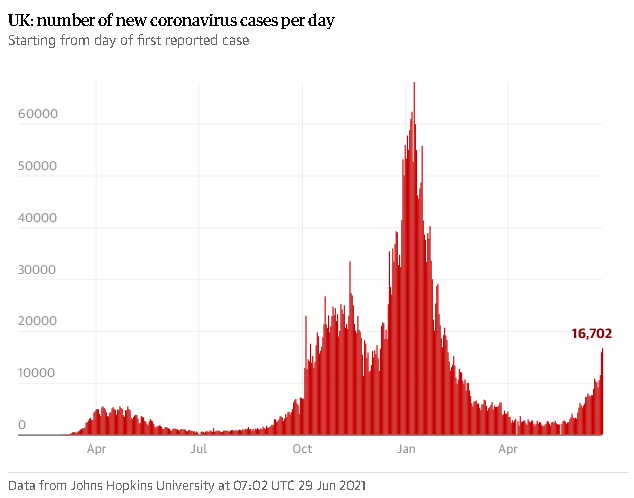
At least one in 20 children were absent from state schools in England because of Covid within the last week, as official figures reveal a 66% increase in the number of pupils with confirmed coronavirus infections.
The data, compiled by the Department for Education (DfE), means that last week there was the most disruption to education since schools fully reopened in March, with nearly 400,000 children and young people out of school for Covid-related reasons.
The statistics show that on 24 June there were 15,000 children recorded as absent with confirmed Covid-19 cases, compared with 9,000 the week before. The number of suspected cases also shot up, from 16,000 to 24,000.
The bulk of those off school, according the DfE figures, were self-isolating because of close contact with confirmed or suspected cases. A total of 279,000 were self-isolating because of contacts within school, a jump of more than 100,000 in the space of a week, while a further 57,000 were self-isolating after contacts in the community.
Overall 5% of state school pupils and students in England were absent at the end of last week, more than four times the proportion of those off just two weeks before.
Paul Whiteman, the general secretary of National Association of Head Teachers, said: “Leaders are reporting that this is having a real impact in their schools, and that the level of disruption is now very high. The government simply does not appear to have a grip on this situation and there is a real concern that we will continue to see these numbers continue to rise in the coming weeks.”
Whiteman said schools were operating under “enormous pressure”, and called for the government to review the use of face masks and increased ventilation in schools.
“We also need to remember that some younger teachers will not have had both their vaccinations yet and the mitigations in place in schools remain extremely important for the whole community,” Whiteman said.
Gavin Williamson, the education secretary for England, said he was “looking closely” at the use of self-isolation.
“The vast majority of children and young people are in school but I am aware that sadly a minority are experiencing disruption at the moment,” Williamson said after the new figures were released.
“While pupils who are self-isolating are being immediately provided with high-quality remote education, we know that the best place for children is in the classroom. That is why I am working with the health secretary, alongside scientists and public health experts, to relax Covid measures in schools in line with wider work to remove restrictions across society.”
Nick Gibb, the schools minister for England, earlier said the government was looking at replacing self-isolation for entire classes or bubbles with daily rapid testing when schools returned in September. The proposal is said to rest on a trial designed to assess the impact of using daily lateral flow tests.
Advertisement
Williamson added: “I’ll be looking closely at the issues around the need for ongoing isolation of bubbles and the outcomes of the daily contact testing trial, as we consider a new model for keeping children in education.”
However, scientists are warning that daily testing alone – with a negative lateral flow test allowing pupils to attend school – would be an inadequate response to outbreaks.
“This is a classic case of dealing with the symptoms, not the cause,” said Stephen Reicher, a participant in the Sage subcommittee advising on behavioural science. “If the government was really concerned with the disruption to schools they would do much, much more to stop infection occurring in the first place.”
Instead, the government had been removing mitigatory measures such as face masks, Reicher noted. Since 17 May, secondary pupils have not been required to wear masks in classrooms, although the DfE advises that local authorities can decide to reintroduce them in response to local outbreaks.
Prof John Edmunds, an epidemiologist at the London School of Hygiene and Tropical Medicine and a member of Sage, said that although the group self-isolation policy may have worked in the past, it was very disruptive, particularly as cases increased.
“Vaccination of schoolchildren would be a far better method for reducing transmission in school without disruption, but we need to be sure that the vaccines are safe enough to use in children before considering this option,” Edmunds said.
Earlier this month the Medicines and Healthcare products Regulatory Agency (MHRA) extended the UK approval of the Pfizer/BioNTech vaccine for 12- to 15-year-olds. However, the government is still waiting for final advice from the Joint Committee on Vaccination and Immunisation on whether to vaccinate under-18s.
Gibb said results of the daily Covid testing trials were expected imminently. But some scientists are wary these plans appear to have pre-empted the results of the trial. “It is remarkable that the government is trailing how it will respond to the trials before we have seen the results of the trials and suggests that … these are merely a fig leaf for a political decision that has already been taken,” said Reicher.
Scientists have also raised serious concerns about the lateral flow tests and the trial itself. Robert West, a participant in the behavioural science subgroup of Sage, said he hoped those running the trials “will make a public statement that the government must not use any findings as a basis for policy until they have been comprehensively reported and subjected to detailed, fully independent review by scientists”.
The authorisation of lateral flow tests by UK authorities does not extend to their use as “green light” tests, where negative results would permit certain activities. Dr Kit Yates, a senior lecturer in mathematical biology at the University of Bath, said the MHRA recommended that isolation should continue among contacts even after a negative result.