

Non-fungible tokens are revolutionising the art world – and art theft
When the virtual auction bell rang at Christie’s on Thursday, Mike Winkelmann, a digital artist better known as Beeple, made history: he had sold a “non-fungible token” representing his piece Everydays: The First 5,000 Days, for $69.4m.
But while the new cryptocurrency craze may have brought the high-end art market into the 21st century, it’s also modernising another aspect of the industry: art thieves.
At their simplest, non-fungible tokens, or NFTs, can be thought of as “bitcoin for art”. Just as bitcoin created the ability to spend and save a sort of digital money without any centralised authority, so too do NFTs allow for pictures, videos, music, or anything else that can be digitally represented, to be wrapped up in a format that can be traded, stored or authenticated without needing to turn to a gatekeeper.
Once an NFT is created, it can be digitally traced for ever. And unlike a simple image file, for instance, an NFT can’t be duplicated, giving it a similar cachet to an original artwork, and enabling the sort of transactions that have seen the field garner mainstream interest over the last month.
But while the very technology of NFTs prevents them from being duplicated without permission, there’s nothing inherent to the sector that controls who can make an NFT in the first place – a fact that has caused dismay to some artists, who have found their work ending up in the “control” of people who had nothing to do with its creation.
Simon Stålenhag, the Swedish illustrator whose Tales from the Loop has become an Amazon Prime original, is one. On Wednesday, he found that one of his artworks had been turned into a “MarbleCard”, a type of NFT that allows users to make and trade tokens representing web pages. “I guess we must do a daily google if we’ve been NFT:d from now on,” he said. “Thanks Silicon Valley!”
MarbleCard isn’t the only NFT service that makes it trivial to “tokenise” other people’s content. Another, Tokenized Tweets, lets users turn any tweet into a tradable digital asset simply by sending a message on the social network, and artworks posted to the site have been a popular target for tokenisation. “Now people can sell your tweets all without your permission,” warned the artist RJ Palmer, whose own images were tokenised without his permission.
Emma Price, an artist and designer based in Margate, cited Palmer’s experience, as well as the enormous environmental damage of the cryptocurrency sector, in taking a stand against NFTs. “Very quickly it became clear that a lot of non-creative, often faceless, entities were jumping in to exploit all manner of ways to create and distribute NFTs, with little care afforded to an originator’s ownership of a digital item.
“There’s no oversight here, and seemingly no understanding of or respect for copyright. The unscrupulous way that it allows artists to be ripped off is maddening.”
While NFT systems that encourage users to tokenise web pages or tweets they do not own were always likely to invite trouble, even more conventional systems that allow for artists to tokenise their own works have caused controversy. The Wu Tang Clan’s foray into the area last week was aborted after the artist Kevin Alexander objected that the animation was similar to an artwork he had posted online in 2013.
Sometimes, the boundary blurring is deliberate, as with the Burned Banksy NFT. This token, which sold for around £300,000, is an image of a Banksy print titled Morons, which was sold in an edition of 500. But the specific print that has been tokenised, number 325, was publicly burned as the token was minted, a move the anonymous creators argue “moved the value of the physical piece on to the NFT”.
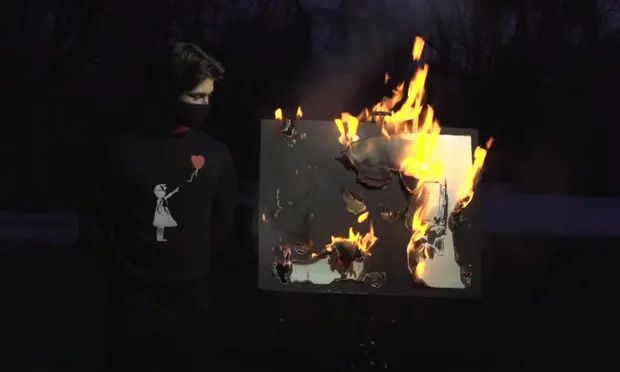 The burning of the Banksy print Morons. Photograph: Burnt Banksy
Even for those digital artists who view 20th-century copyright norms as outdated, though, the trend is raising concern. “In a sense, the NFT sector should be more attentive to what is offending and upsetting people – especially the artists whose work is attracting interest to their field – than strictly what is technically or legally possible,” says Parker Higgins, a New-York-based artist and activist who has campaigned for copyright reform.
“In many other creative areas, norms and customs are more influential than the specific contours of copyright law, where the price of transgression is not necessarily a lawsuit but still very real. Sure, people in the NFT space can choose to ‘move fast and break things’ through those considerations, but they risk coming across as antisocial weirdos that nobody wants to associate with.”