

No 10 cautious over declaring Covid turning point despite fall in cases
Downing Street and scientists remained cautious about declaring a turning point in the outbreak on Monday night despite a huge drop in Covid case numbers for the sixth day in a row.
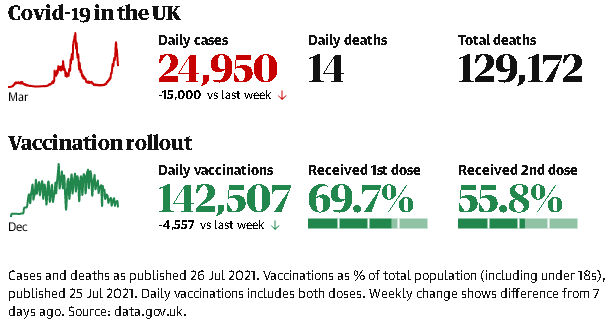
No 10 said it was “encouraging” that infections had fallen to their lowest level in three weeks at 24,950 confirmed cases, with Boris Johnson taking the decision to allow more double-vaccinated key workers to avoid isolation with a daily testing programme.
But the prime minister’s official spokesman said he still believed the UK was “not out of the woods yet” and highlighted the fact that the full impact of the 19 July unlocking has not yet been reflected in case numbers.
Several Whitehall health sources said the government was still extremely cautious about the implications of the falling case data, which cannot yet be fully explained by scientists.
Experts also pointed to the number of Covid-19 patients in hospital in England, which passed 5,000 for the first time since mid-March, as a sign that the pandemic was not over. Hospitalisations tend to reflect the Covid rates around two weeks earlier.
The seven-day average for hospital admissions, which smooths out irregularities in reporting over the weekend, has risen by 26% in the last week. Meanwhile, hospital bed occupancy for coronavirus patients has also increased significantly in the last week, with occupancy of mechanical ventilation beds rising by 31% and other bed occupancy up by 33%.
“We don’t think this is necessarily the point [at which] there’s no chance cases will go back up again,” one Whitehall health source said. “The 100,000-a-day figure that [the health secretary] Sajid [Javid] gave was based on modelling – it wasn’t picked out of nowhere. So we are trying to stay cautious. We want to keep an eye on the data and not hypothesise too much.”
But two sources at the department said they did not believe the falling case numbers could be entirely explained by a drop in testing, as there was “still a huge amount of testing being done”.
Ministers want the messaging to remain one of vigilance and caution to avoid people thinking the threat of Covid is over.
The move to release a huge extra list of key workers from quarantine requirements, however, marked a significant shift from the government’s insistence last week that only a very small number of critical staff would be exempt.
The government’s Covid-O committee decided on Monday afternoon to raise the number of workplace testing sites by 1,200 to 2,000. Staff permitted to take a test rather than isolate will now include refuse collectors, Prison Service staff, communications, water, chemicals and energy workers, members of the armed forces, vets, fish industry, HMRC staff and those working in pharmaceuticals.
The scheme was rolled out last week and was originally intended only for food industry workers but was expanded to police, fire and border staff. It has been hugely widened after Monday’s meeting of cabinet ministers.
“It’s all about ensuring there’s minimal disruption to people’s lives whilst at the same time remaining vigilant against the virus,” a No 10 source said.
Ministers decided to act after days of disruption to services, pockets of food shortages and damaging headlines, with industry and local councils warning of worse to come in the so-called “pingdemic” without more action to deal with the issue of isolating staff.
It is understood more than 25 workplace test sites are up and running at key food industry facilities, with the aim of there being 500 by the end of the week.
Despite the news about falling cases, however, No 10 was also resisting pressure from Tory MPs for more general relaxation of quarantine rules for the double-vaccinated in the population. A No 10 source said there was no inclination to bring forward the 16 August date when all those who have been fully jabbed will be exempt.
Dr Paul Donaldson, general secretary of the HCSA, the hospital doctors’ union, said Covid patients occupying hospital beds were “at levels close to the start of October despite case levels now three times higher”.
“However, we are beginning to see a faster pickup in this figure than last autumn, reflecting the rapid increase in case numbers over recent weeks. The connection between case numbers to more serious cases requiring hospitalisations has been weakened, it has not been eliminated,” he said.
An HCSA spokesperson confirmed some recent reports of people being asked to work their annual leave because of staff shortages.
Scientists are unclear about whether the recent fall in daily cases means the infections have passed their third-wave peak.
Sir Jeremy Farrar, head of the Wellcome foundation and a member of Sage, said it was too early to know if the peak had passed but “you can only celebrate a reduction in the caseload”. He also suggested that people are acting “much more cautiously than perhaps anybody could have imagined 10 days ago”.
“I think the big change, in terms of lifting restrictions, was actually, the prior change [step 3] rather than 19 July,” he told an audience at an event for the Institute for Government.
Writing for the Guardian, Prof Graham Medley, professor at London School of Hygiene and Tropical Medicine, who chairs the Sage subgroup on pandemic modelling, said it was still “uncharted territory” and there was “considerable uncertainty about what the next two months hold”.
“Unfortunately, we will not be able to know if we are at a peak until we have passed it, probably by a few weeks,” he said.
Nearly nine out of 10 adults in the UK (88.1%) have had a first dose of a Covid-19 vaccine, while 70.5% of the adult population are fully vaccinated. Monday’s figures show that a further 24,551 people received their first dose, and 117,956 had their second.