London Daily

Focus on the big picture.
Wednesday, Jun 17, 2026

Nigeria restricts ATM withdrawals to $45 per day in push to digital currency

Nigeria restricts ATM withdrawals to $45 per day in push to digital currency

Nigeria's economy is heavily dependent on the so-called informal sector

Nigeria will soon begin restricting ATM withdrawals to just $45 per day as part of a push to move the country toward a cashless economy. 

The policy – which will also apply to banks and cashback from purchases – follows the launch of the West African nation's newly designed currency notes to control the money supply.

The Central Bank of Nigeria limited weekly over-the-counter cash withdrawals to 100,000 naira ($225) for individuals and 500,000 naira ($1,124) for corporations, with a processing fee required to access more. 

When the policy takes effect in January, ATMs will no longer dispense Nigeria's high denominations of 1,000 naira ($2.25) and 500 naira ($1.10) while withdrawals from ATMs and point-of-sale terminals also will be limited to 20,000 naira ($45) daily.

Haruna Mustafa, the bank's director of banking supervision, said cash withdrawals may be permitted in "compelling circumstances, not exceeding once a month." 

Policymakers say the withdrawal limits and recent monetary initiatives from the central bank would bring more people into the banking system and curb currency hoarding, illicit flows, and inflation.
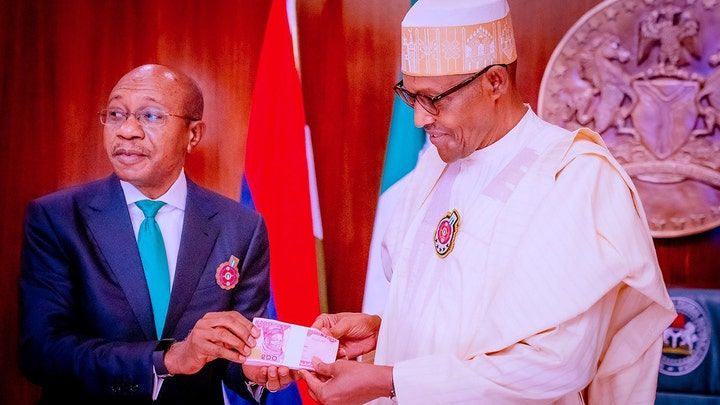

FILE: Godwin Emefiele, left, chairman of the Central Bank of Nigeria (CBN), attends the presentation of new banknotes after Nigerian President Mohammed Buhari, right, unveils newly designed banknotes due to counterfeiting and increasing security problems on Nov. 23, 2022, in Abuja, Nigeria.

But other analysts worry that the initiative could hurt daily transactions that people and businesses make, given the unreliability of digital payments in Nigeria.

Nigeria’s economy heavily depends on the "informal sector" – activities outside the legal framework and government regulation such as farming, street and market trade, and public transport. In this sector, where most Nigerians work, cash is usually preferred for transactions because many lack bank accounts.

Only 45% of adults in Nigeria have accounts with regulated financial institutions, according to the World Bank. In the absence of bank accounts, point-of-sale terminals have emerged as one of the fastest-growing areas of financial inclusion in the country.


Comments

Dr Shawn Pourgol 4 year ago
It is so bad that people cannot take out their own money. This is so sad.
Oh ya 4 year ago
And idiots in the western world will welcome digital currency with open arms because they are too stupid to see that it is a form of control over them. Same as they now use yappy and credit cards. When the government has control over your money they have control over you. When i look around i see so many stupid people.

Newsletter

Related Articles

0:00
0:00
Close
Government Advances New Airport Slot Rules to Ease Airline Operating Constraints
BBC Opens Flagship Science-Fiction Franchise to Competitive Production Bids
Chancellor Meets City Leaders Amid Concerns Over Gilt Market Liquidity
Rathbones Shares Fall Seventeen Percent After Regulatory Review Reveals Compliance Failings
United Kingdom Joins Group of Seven Initiative Using Artificial Intelligence and Quantum Computing for Cancer Research
Parliament Debates Doubling Tax Allowance for Pensioners After Major Public Petition
Measles Cases Exceed Seven Hundred in London and the West Midlands
British Military Leadership Faces Parliamentary Scrutiny After Defence Secretary's Sudden Resignation
House of Lords Begins Debate on Steel Industry Nationalisation Legislation
Parliament Advances Bill to Abolish NHS England and Create Single Patient Records
Parliament Fast-Tracks National Security Bill to Expand Powers Against Foreign Threats
United Kingdom and European Union Set July Summit to Deepen Post-Brexit Cooperation
United Kingdom Imposes Seventy New Sanctions on Russia and Expands Support for Ukraine's Nuclear Sector
United Kingdom Announces Social Media Ban for Children Under Sixteen
0British Government Investigates Reports of Russian Warship Firing Warning Shots Near Isle of Wight
UK Supreme Court Revises Legal Definition of Deprivation of Liberty
King’s Birthday Honours Recognise Contributions Across Science, Culture and Public Service
UK Ministry of Defence Reports Interdiction of Russian Shadow Fleet Vessel
UK and US Launch Joint Regulatory Programme for Medicines and Healthcare Products
Solicitor General Refers Murder Sentence to Court of Appeal Under Unduly Lenient Scheme
UK Launches £1.6 Million Mobile Museum Initiative to Expand Cultural Access
Judicial Pay Structure Undergoes Government Review Following Senior Recommendations
Government Confirms Nearly 180 New Youth Hubs Across the United Kingdom
UK Government Expands Careers Support Through Partnership with LinkedIn
Digital News Report Highlights Growing Global Concern Over AI and Information Overload
UK Chancellor Reaffirms Fiscal Discipline and Borrowing Reduction Strategy
UK Government Invests £219 Million in Sustainable Aviation Fuel Development
Rolls-Royce Small Modular Reactors Secures Major Swedish Export Contract
Government Confirms Locations for Nearly 180 Youth Hubs Across Great Britain
UK Government Partners with LinkedIn to Expand Employment Support Services
Reuters Institute Report Flags Rising Public Anxiety Over News and Information Overload
UK Government Commits £219 Million to Expand Sustainable Aviation Fuel Industry
Chancellor Convenes Market Engagement Group to Assess UK Economic Outlook and Productivity Risks
Rolls-Royce Wins Multibillion-Pound Swedish Contract for Small Modular Nuclear Reactors
Government to Ban Social Media Access for Under-Sixteens Across the United Kingdom
Government Approves Fast-Tracked Broadcast Merger Reshaping UK's Media Landscape
Resignation of Defence Secretary John Healey Triggers Debate Over UK Military Strategy
Britain Intensifies Diplomatic Efforts to Support US-Iran Ceasefire
Bank of England Faces Tough Interest Rate Choices After Economic Contraction
Belfast Sees Second Day of Anti-Migrant Riots as Police Deploy Water Cannons
UK Economy Shrinks in April as Energy Price Shocks Weigh on Growth
UK to Ban Social Media Access for Children Under 16 From 2027
UK Parliament Opens Week of Fast-Tracked Security and Infrastructure Legislation
Northern Ireland Projects £21 Million Boost From Major Cultural and Sporting Events
UK and Japan Sign Technology Security Pact to Strengthen AI and Supply Chain Cooperation
UK Welcomes US-Iran Peace Breakthrough Aimed at Restoring Strait of Hormuz Shipping
British Forces Intercept Russian Shadow Fleet Oil Tanker in English Channel Sanctions Operation
UK to Ban Social Media for Under-16s Under Landmark Online Safety Expansion
Anti-Immigrant Riots Spread Across Belfast, Raising Security Concerns
Ministry of Defence Opens Europe's Largest Drone Testing Facility in Swindon
×