

NHS 1% pay rise is 'as much as we can give' - Boris Johnson
The government is giving workers "as much as we can" in the "tough times" of the Covid pandemic, Mr Johnson said.
The rise, which is being considered by an independent panel, would cover most hospital staff.
Labour says the proposal goes against a government "promise" made last year to give NHS workers a 2.1% pay rise.
Shadow health secretary Jonathan Ashworth said Chancellor Rishi Sunak had been "cowardly" when he "sneaked" out the announcement a day after his Budget.
The Department of Health and Social Care has been under pressure to reconsider its pay proposal since last week, when it officially recommended the 1% rise to the independent panel that advises the government on NHS salaries.
Nurses have described the proposed pay rise as "insulting", with unions threatening strike action and warning that the "pitiful" rise may lead staff to quit their jobs - worsening staffing issues in the health service.
Ministers will make their final decision in May after the independent panel makes its own pay recommendations.
Asked about the proposed pay rise on a visit to a coronavirus vaccination centre in Brent in north London, Mr Johnson said: "What we have done is try to give them as much as we can at the present time.
"Don't forget that there has been a public sector pay freeze, we're in pretty tough times."
He added he was "massively grateful" to "heroic" health and social care workers during the pandemic.
But the Royal College of Nursing reiterated its calls for the government to make a U-turn on the 1% offer.
The union's general secretary, Dame Donna Kinnair, said: "More of these warm words for nurses are not going to cut it."

The PM's comments are not the last word on pay.
An independent review body will make its recommendations on NHS salaries in May. If it's worried about retention and recruitment of staff, it could say that pay should rise above 1%.
The government would then have a dilemma - either to ignore the recommendation, or make cuts elsewhere to fund a bigger increase.
But the review body could equally present a challenge to the opposition.
The shadow health secretary Jon Ashworth condemned a 1% rise as "a disgrace" but said Labour would "honour whatever that review body recommends".
During the years of austerity, it wasn't uncommon for pay review bodies to act within constraints set by government.
So if the independent panel were to support a 1% rise after all, the Labour leadership would need to rethink its position, or face a backlash from the unions.
Labour's Mr Jonathan Ashworth said Conservative MPs had already voted for a pay rise of 2.1% for NHS workers when a long-term spending plan for the health service passed through the House of Commons in January 2020.
"Not only was it promised, it was budgeted for and it was legislated for - this is the law of the land," he said.
"That should be the basis for which negotiations and discussions are now entered into with the trade unions."
The Department of Health maintains that the assumption of a 2.1% pay rise was not enshrined in law, and the financial pressures from the pandemic could not have been foreseen.
The prime minister said the government had "tried to give the NHS as much as we possibly can" to tackle Covid, and had provided £62bn to the health service on top of its usual annual allocation of £140bn.
Pressed by the BBC's Andrew Marr on whether there could be a rethink on the pay rise, Education Secretary Gavin Williamson said: "What the government has put forward has been passed to an independent review.
"We've put forward what we believe we can afford and [it] is part of a process and that [is] what will be looked at," he added.
"But really, our focus is on making sure we recover from this pandemic."
What do NHS workers in England earn?
* The lowest minimum full-time salary - for newly-employed drivers, housekeeping assistants, nursery assistants and domestic support workers - is £18,005 per year
* The starting salary for most newly-qualified nurses is £24,907
* Staff in "high-cost areas", such as London, get extra payments
A government spokesperson has previously said a 1% pay rise would be a "real-terms increase", as the latest official inflation figure was 0.9%.
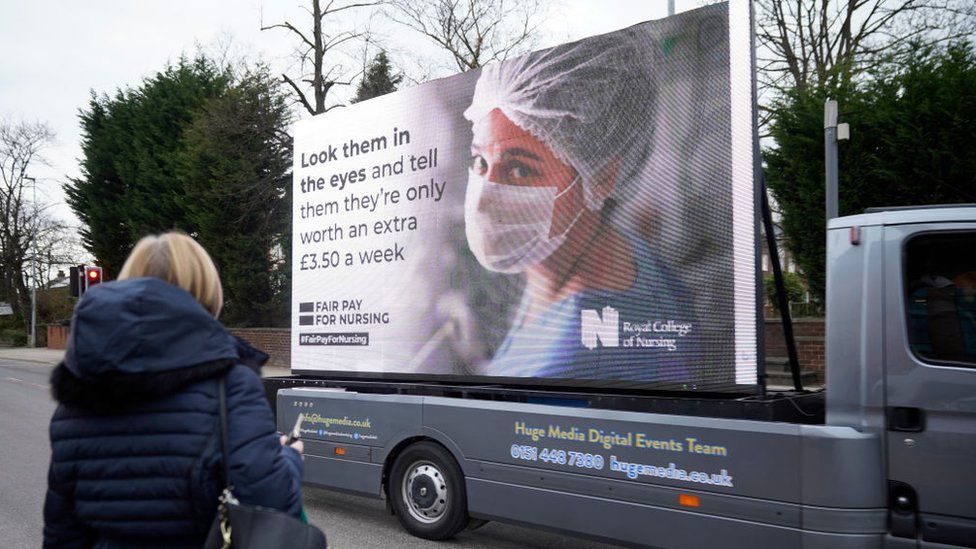
Dame Donna has warned the rise would mean just £3.50 more per week in take-home pay for an experienced nurse.
At least 1.3 million other public sector staff - including teachers, the armed forces, firefighters and police officers - are about to have their pay frozen for a year.
The NHS in Scotland, Wales and Northern Ireland is run by the devolved administrations.
The Scottish government has announced that 2021-22 pay negotiations will be delayed until the summer because of the disruption caused by Covid. Staff have been given an "interim" pay rise of 1%, which will form part of the new settlement.
NHS workers in Northern Ireland were promised a one-off £500 "special recognition" payment in January, following a similar announcement in Scotland.
The Welsh government has said it will not set a "ceiling" of 1% on NHS pay rises for 2021-22.