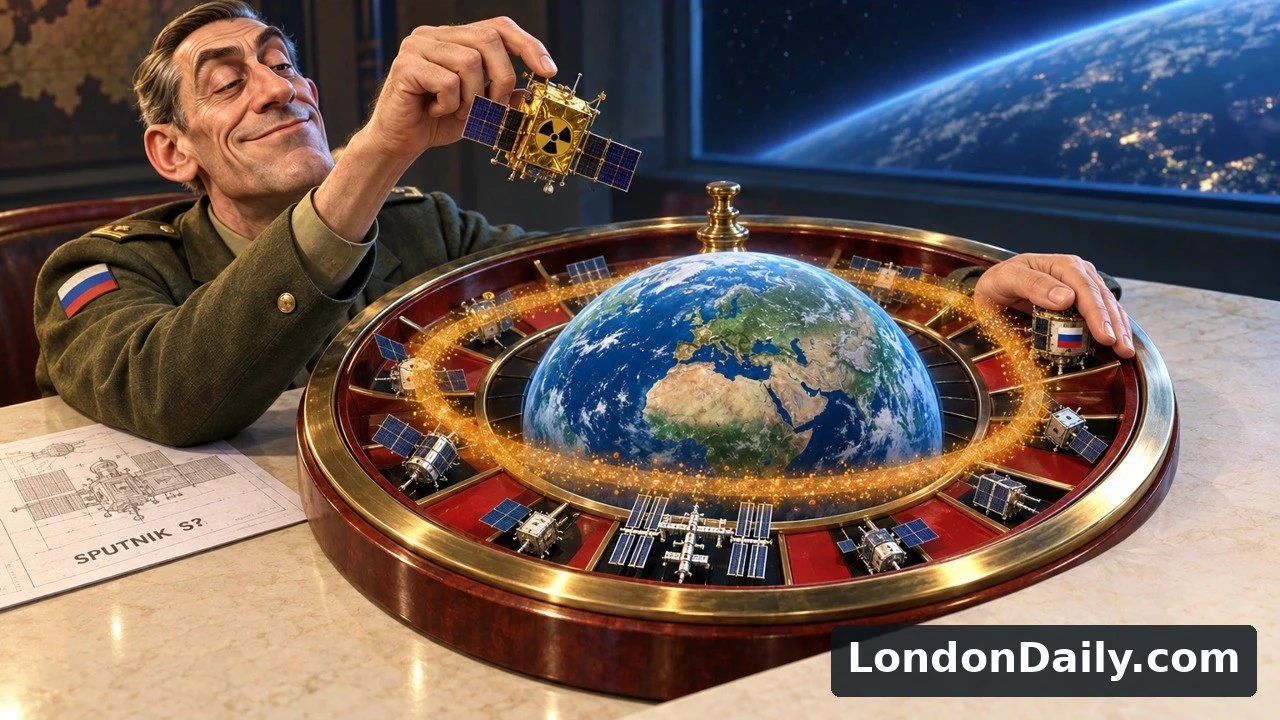
Russia could launch a nuclear-armed satellite called Sputnik S by the end of the year, according to reported Western intelligence assessments, creating a threat whose effects could extend far beyond any intended target.
The US Defence Intelligence Agency has warned that there are no effective countermeasures. Launching a warhead into orbit is distinct from detonating it, however, and the weapon’s intended operation remains unclear. Destroying satellites is its presumed purpose, not an established account of how it would be used.
The danger is not confined to the initial explosion. A nuclear blast could trap charged particles in Earth’s magnetic field, creating a radiation belt that continues damaging spacecraft long afterwards. Tens of thousands of satellites could be at risk, although the scale of any losses remains uncertain.
There is a historical precedent. On 8 July 1962, the United States conducted Starfish Prime, detonating a 1.4-megaton nuclear device roughly 250 miles above Earth after launching it from Johnston Atoll in the Pacific. The resulting ‘Starfish belt’ lasted a decade and damaged satellites, including Britain’s first satellite, Ariel-1, and Telstar 1, the first to broadcast a live television signal.
One proposed remedy offers a narrower prospect than protection against an explosion. Geoff Reeves, a scientist at Los Alamos National Laboratory, designed a satellite-mounted transmitter that would use radio waves to push trapped particles into the atmosphere, where they could be absorbed. He said suitable technology could clear such a belt within a couple of weeks. That is a proposed means of reducing persistent radiation, rather than preventing the detonation or its immediate effects.
The International Space Station operates at approximately the altitude of the Starfish Prime blast. Russia agreed in 2023 to remain in the partnership until at least 2028, meaning Russian cosmonauts and equipment could share the danger.
Disruption could also reach communications and electronics on Earth. Nasa scientist David Sibeck has warned that greater dependence on computer chips and power would make the consequences worse than in 1962. The extent of any blackout remains uncertain, but neither damaged satellites nor lingering radiation would respect national ownership. Russia’s own systems could be among the casualties.








Join the conversation