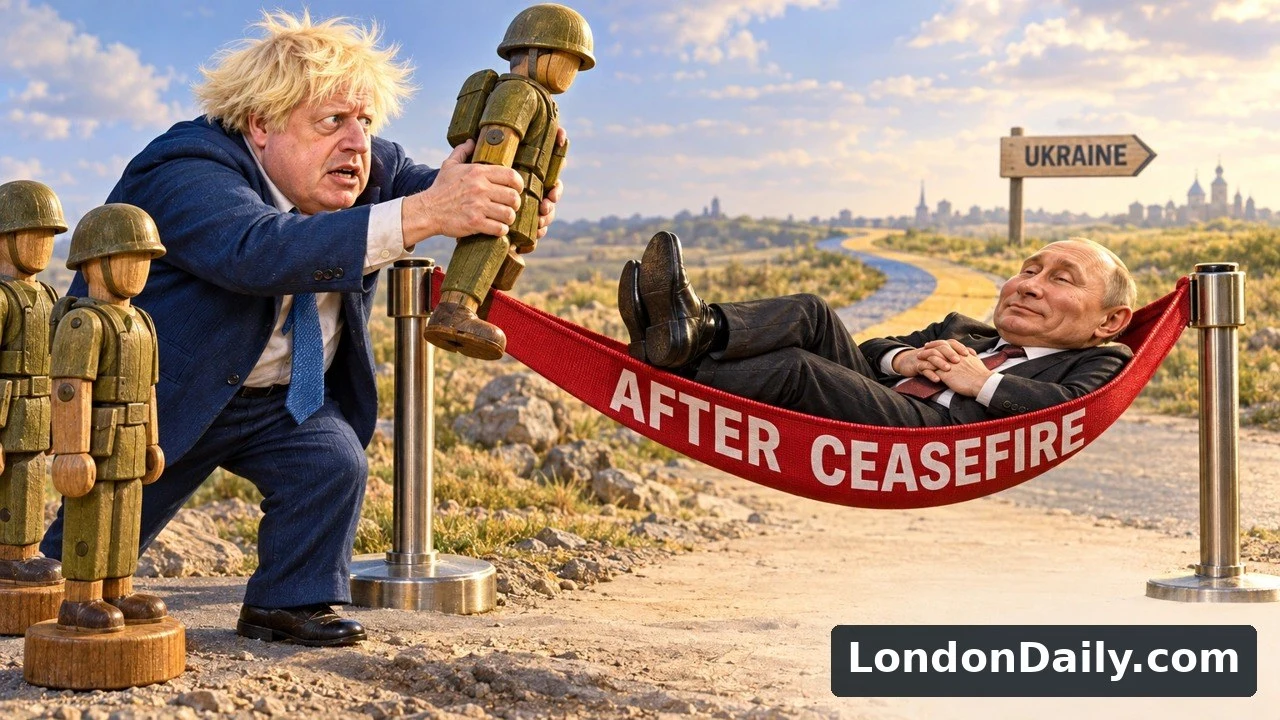
Boris Johnson has renewed his call for Britain and its allies to send troops to Ukraine before a ceasefire, arguing that Western hesitation is giving Vladimir Putin an incentive to prolong the war.
Speaking at the Royal United Services Institute on Tuesday night, the former prime minister urged the Government to provide Kyiv with more missiles and greater satellite coverage for deep strikes into Russia. He also demanded an explicit commitment to allow Ukraine into Nato if it wanted to join.
“We have to end the half-heartedness and irresolution. We have to show Putin that we mean it,” Johnson said.
His argument links Ukraine’s immediate military needs to its long-term place in Western alliances. Unless Moscow believes that Ukraine’s future lies beyond its influence, he contends, Putin will retain a reason to keep fighting. Deploying troops now, rather than after a ceasefire, would bring forward the commitment Johnson has advocated since earlier this year.
He warned that tens of thousands of Ukrainians would continue to die every week unless Nato countries strengthened their backing. That was his warning about future losses, not an established casualty figure.
Johnson also described the propaganda opportunity he believed Western hesitation could offer Putin. He imagined the Russian president telling Ukrainians that their allies had abandoned them, that Polish farmers and others would block European Union accession, and that objections from Nato members would prevent entry into the alliance.
In Johnson’s account, Putin would invoke shared Slavic identity and origins in Kievan Rus to argue that Ukraine should have remained aligned with Russia. Johnson warned there was a risk that Western failures would give that argument substance, leaving Ukraine vulnerable to corruption and renewed Russian influence.
His appeal contrasts with Donald Trump’s call for European countries to scale back support for Ukraine. The US president called Putin “my friend” after meeting him at a summit in China last week. Johnson said he had told Trump he could end the war before leaving the White House, but that his message “falls on deaf ears”.
Johnson has maintained close ties with Ukraine and continued visiting since leaving Downing Street. In September, a Russian drone struck a train shortly after he and his security detail had travelled along the same rail route.
For Johnson, the decisive commitment is political as well as military: ending what he called the “fatal ambiguity” over Ukraine’s future.








Join the conversation