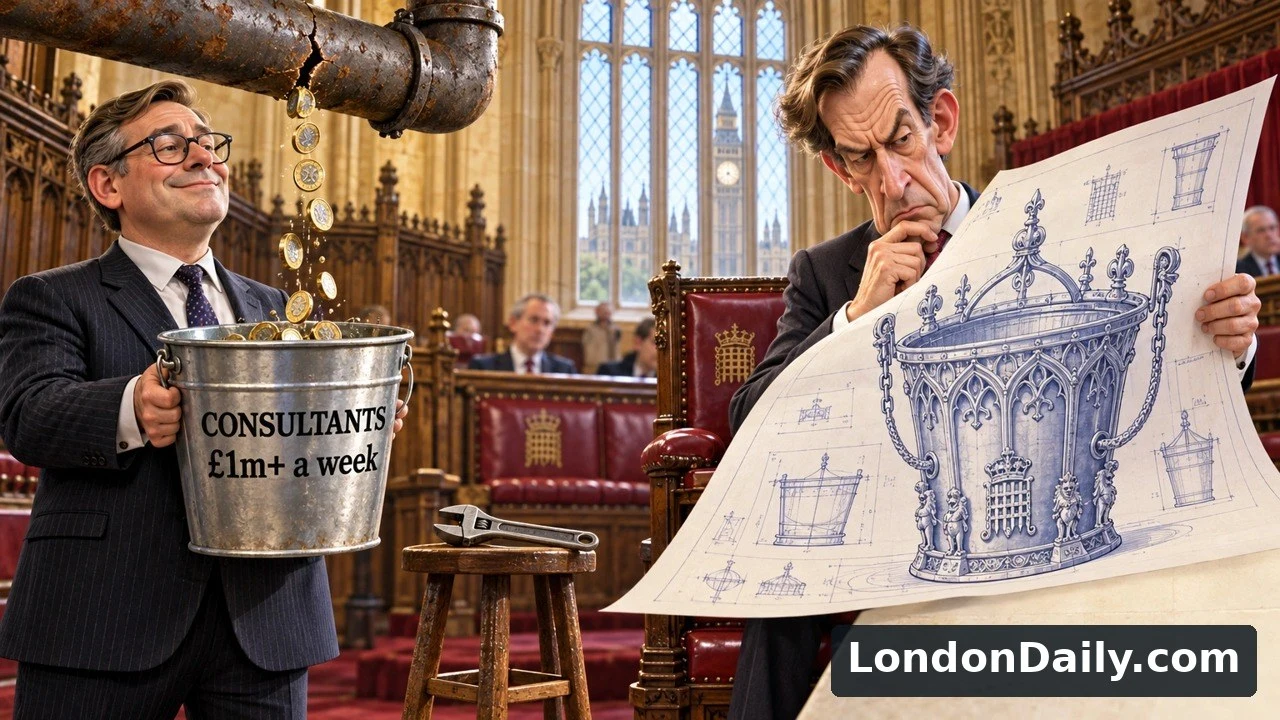
Lord Speaker Michael Forsyth has challenged whether parliamentary restoration proposals costing up to £39.2 billion distinguish essential repairs from improvements that could wait, as consultant fees continue to mount without a decision on how to proceed.
In a letter to all peers, copied to the Prime Minister and others, Forsyth questioned the scope of the Houses of Parliament’s Restoration and Renewal programme. Established in January 2013, it produced its first appraisal in 2015. Parliament has yet to settle its approach.
The programme’s client board presented options in its February report, Costed Proposals, with estimates reaching £39.2 billion. That figure is the upper end of the proposals, not an approved budget or expenditure already incurred.
Forsyth, a former Conservative Scottish secretary elected Lord Speaker this year, asked whether upgraded accommodation, environmental measures, enhanced security and catering improvements had been adequately separated from essential restoration. He had previously described the almost £10 million cost of a new door at the Peers’ entrance as “a complete white elephant and a disaster”.
Nicholas Boys-Smith, a former Historic England commissioner, argues that necessary asbestos removal, pipe replacement and stonework repairs have become entangled with discretionary improvements and the ambition to make a Victorian building net zero. He says this happened despite instructions in 2021 to restrict the works to what was necessary.
Boys-Smith also noted that the delivery authority considered six levels of ambition, from zero, the minimum, to five, the most ambitious, and chose level four. Proposals include a tunnel beneath Westminster’s Great Hall to facilitate a visitors’ centre.
The criticism crosses party lines. Former Labour minister Lord Jeff Rooker called the spending plans “absolutely barmy” and argued that safe, secure working conditions should be the sole objective. His case for revisiting earlier plans rests on changed fiscal circumstances: public debt has reached £3 trillion following, among other pressures, pandemic-related spending.
Jesse Norman, the Conservative shadow Commons leader, blamed “colossal successive failures of political leadership”. In a Hansard Society interview the day after Forsyth’s letter, he alleged that lobbying pressure had expanded the brief.
Several consultants working on the programme were also involved in HS2, although that overlap alone does not establish that Westminster will experience the same cost overruns.
A Commons debate is expected shortly before Parliament rises for recess on 17 December. Meanwhile, every week without a decision adds more than £1 million in consultant fees. The unresolved choice is which works Parliament regards as indispensable, which it can defer, and what each option would actually save.








Join the conversation