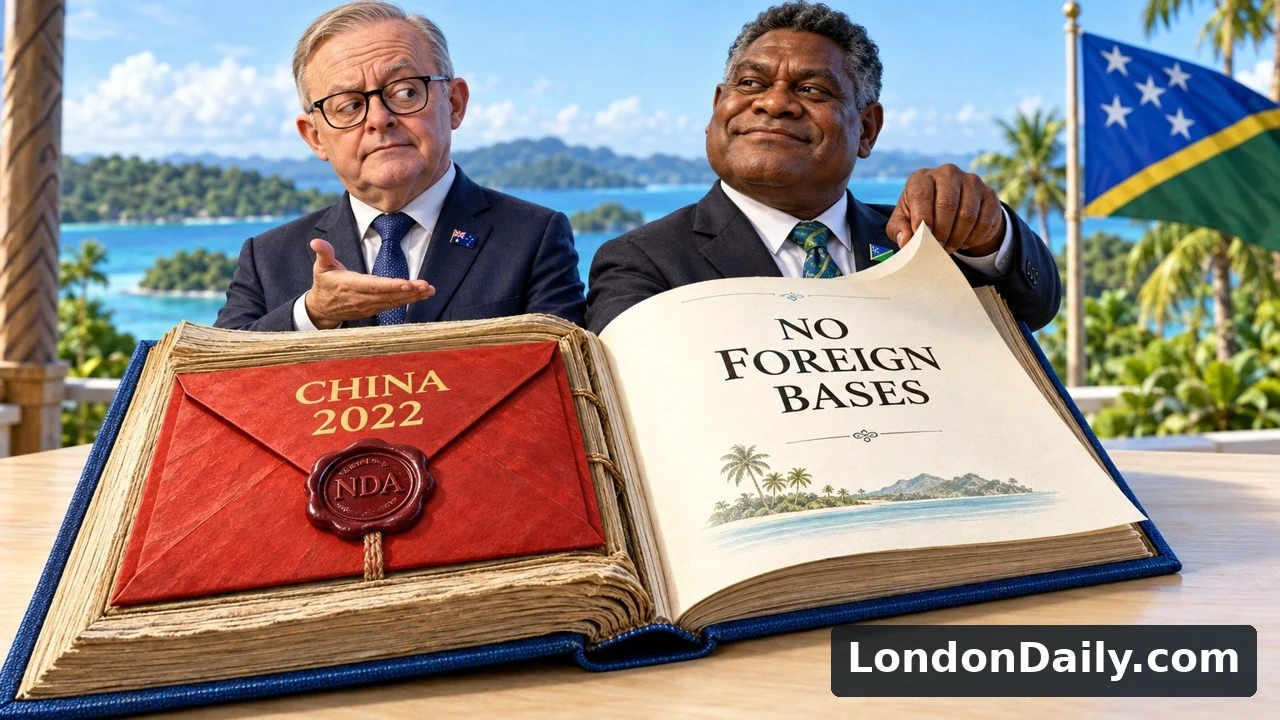
The Solomon Islands has signed a treaty with Australia ruling out foreign military or security bases on its territory and making Canberra its primary security partner, a significant constraint on the prospect of a Chinese military foothold in the country.
The agreement affirms the islands’ sovereign decision against foreign bases. It requires consultation with Australia before security or critical infrastructure agreements with countries outside the Pacific Islands Forum; it does not establish an Australian veto.
Airports, ports, energy and telecommunications infrastructure must remain free from militarisation, foreign interference and unauthorised access. That provision is not retrospective, an important qualification where China has financed infrastructure through loans since the islands switched diplomatic recognition from Taiwan in 2019.
Prime Minister Matthew Wale travelled to Canberra with 15 ministers. Speaking alongside Australian Prime Minister Anthony Albanese on Wednesday, he said the islands had been “a source of uncertainty and doubt in the region”, adding: “Those days are gone.” Albanese called the treaty a “new chapter in our partnership to strengthen our shared prosperity and our security”.
Yet the fate of the secretive 2022 security pact with Beijing remains unsettled. Asked whether he had ended it, Wale said discussions with China were “ongoing” and cited a non-disclosure clause preventing further comment.
Chinese police have operated in the islands; Australia feared the pact could also accommodate China’s navy. Mihai Sora, a former Australian diplomat now at the Lowy Institute, said it made a persistent Chinese military presence about 1,600 kilometres from Australia a real prospect, prompting four years of intensive diplomacy. Canberra subsequently struck agreements with five other Pacific island countries. China’s foreign ministry said on Tuesday that relations with Pacific nations were not matters of “geopolitical contests”.
Australia will provide A$740 million (£370 million) over ten years: A$670 million in grants and A$70 million in concessional loans. Support covers free education, health, policing, resources, climate resilience, roads and bridges, including construction fields dominated by China’s Belt and Road Initiative. A third of Solomon Islands children never start school; only 19 per cent finish because of costs.
Wale, elected in May, has sought stronger ties with Canberra and Washington. After resisting a no-confidence attempt that forced his early departure from a summit in Palau, he adjourned parliament indefinitely in September. Officials say it will return in January for reforms, including free education, with Australian funding available by then.
Wale says his whole cabinet approved the treaty. Opposition leader and predecessor Manasseh Sogavare criticised its “fast-tracking” while China’s security arrangement remained “unclear”: the new Australian partnership is signed, but its relationship with the earlier pact remains unresolved.








Join the conversation