

Millions of jobs and a shortage of applicants. Welcome to the new economy
P.D. Hook, a hatchery that supplies one third of the chickens sold in the United Kingdom, should be humming along as the economy roars back to life. But the company is short about 40 farm workers, double the usual number of vacancies.
At the same time, there's a severe deficit of truck drivers, making it difficult for P.D. Hook to transport its birds to the factories where they are cut, portioned and packed. And when the chickens do arrive, there's a shortage of staff at the processing plants, too.
"It's all come together at a time when everybody wants more of everything," said Hook, the company's managing director. "It's a perfect storm."
The troubles aren't unique to P.D. Hook, its industry or the United Kingdom. Around the world, airlines, restaurants and hotels can't fill open jobs, stymieing efforts to capitalize on resurgent consumer demand. Many workers that went home when the pandemic hit haven't returned to shipyards, factories or construction sites, hitting production and stalling projects. Even Michelin-starred eateries and Wall Street banks say they can't hire enough people to meet their needs.
 A waiter cleans a restaurant table ahead of reopening in Berlin, Germany, on May 21, 2021.
In the United States, Republican lawmakers have blamed enhanced unemployment benefits for fueling the problem, while left-leaning economists propose a simple solution: pay higher wages. In the United Kingdom, lobby groups are urging Prime Minister Boris Johnson's government to revise post-Brexit immigration rules so Europeans can fill vacancies, while Singapore and Australia's leaders are under pressure to relax travel restrictions so migrant workers can return.
What's increasingly clear is that after the coronavirus pandemic delivered an unprecedented shock to the global economy, putting tens of millions of people out of work and displacing many others, the job market will never be the same. Trained workers are stuck in the wrong places. Others have retired early, are skeptical about going back to work in the face of lingering health concerns, or are having difficulty securing reliable child care.
The economy emerging from the crisis also looks different from the one that preceded it. Demand is higher in some sectors and lower in others. Workers have left front-line jobs in some industries for roles that are less exposed to the coronavirus, won't be affected by fresh lockdowns, or offer better work-life balance. In the United States, a record 4 million people quit their jobs in April, including 649,000 retail workers. A recent EY survey of more than 16,200 employees globally found that more than half would consider ditching their job after the pandemic if they weren't offered enough flexibility on where and when they work.
"This is a time of flux," said Erica Groshen, who served as commissioner of the US Bureau of Labor Statistics from 2013 to 2017. "[It's] not so much that it's an overall labor shortage, as a time of structural changes [for the economy]."
'The challenges are huge'
Around the world, businesses are naming a similar concern: They need workers. They need them fast. And they can't always find them.
The United States reported a record 9.3 million job openings in April. The United Kingdom saw advertised job vacancies spike 45% between the end of March and the middle of June, according to Adzuna, a job search engine. Research group IHS Markit reports that firms across the European Union are suffering staff shortages as business activity grows at the fastest pace in 15 years.
"There definitely is a job seeker shortage," said Andrew Hunter, Adzuna's co-founder. "You've got all these jobs in the market, but nobody really applying for them."
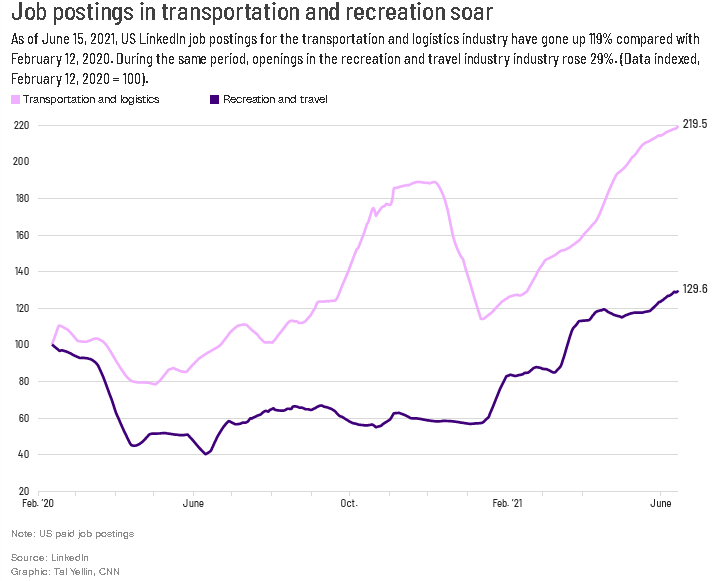
The problem is particularly acute in the hospitality industry. Jack Kennedy, UK economist at job site Indeed, said that jobs postings in food preparation and services skyrocketed 507% between late February and early June, and that "candidate availability hasn't kept up."
Darden Restaurants (DRI), which owns the Olive Garden chain, Chipotle (CMG) and McDonald's (MCD) are boosting wages in an attempt to attract new employees. Laura Harper-Hinton is trying a different approach to fill 150 vacancies. Her London restaurant chain Caravan has started offering referral bonuses to customers.
"The challenges are huge," Harper-Hinton said.
It's not just restaurants and cafés. The United Kingdom, for example, also needs tens of thousands more truck drivers, as well as butchers at meat processing plants and laborers at construction sites.
 Truck drivers cross a haulage truck parking lot at the Port of Dover on
June 1, 2021. Almost a third of UK logistics companies expect to face
trucker shortages this year, and 10% say recruitment issues pose an
"extreme barrier" to the recovery from the pandemic.
Truck drivers cross a haulage truck parking lot at the Port of Dover on
June 1, 2021. Almost a third of UK logistics companies expect to face
trucker shortages this year, and 10% say recruitment issues pose an
"extreme barrier" to the recovery from the pandemic.
Iain McIlwee, head of the trade group that represents British businesses involved in installing ceilings, walls and cladding, said that more than 60% of members are worried about staffing during a busy summer.
Where are the workers?
There are many reasons businesses can't find enough workers to fill open jobs. But one element is fairly straightforward: There's a location mismatch.
The pandemic triggered a mass movement of people, who left cities as jobs were cut and the perks of urban living evaporated. Not everyone has returned.
Many students who would typically be hired for hospitality jobs in cities like New York or London are still living at home, while others are weighing permanently moving outside urban centers.
The uneven pace of easing coronavirus restrictions has encouraged some workers to move to new places. Sandra Warden, managing director at Dehoga, which represents Germany's hospitality sector, said the industry lost workers to Austria or Switzerland, where restaurants reopened much earlier.
Strict limits on international movement are also hurting places like Singapore, where migrant workers account for about 38% of the workforce, according to Nilim Baruah, a migration specialist focusing on southeast Asia at the International Labor Organization.
Last month, Singapore's Ministry of Manpower acknowledged that the city state has "not been able to adequately replace those who have left Singapore" because of border controls aimed at stopping the spread of Covid-19. Entry from South Asia was completely halted in May.
 A migrant worker works at a building construction site on May 29, 2021 in Singapore.
Sembcorp Marine, a Singapore-based firm that operates shipyards, said earlier this month it's looking at new recruiting strategies. It said tighter border controls have "impacted the execution and scheduled completion" of some projects.
"Employers have been taking in workers on an annual basis," Baruah said. "That deployment has not been able to take place because of movement restrictions."
Australian businesses are also complaining of shortages, attributable in part to tough border controls. The Australian Bureau of Statistics said last week that 27% of Australian businesses "are having difficulty finding suitable staff." According to its survey, 74% cite a lack of applicants, while 32% point to border closures.
Some of the strain may prove temporary. Migrant workers faced with limited employment opportunities at home are expected to return to magnets like Singapore as vaccination rates pick up and restrictions eventually ease. The same goes for higher skilled workers who may be postponing moves.
But in some places, the worker shortfalls could prove more intractable. In late 2019, there were at least 2.3 million EU nationals working in the United Kingdom, according estimates from the Office for National Statistics. But when the pandemic hit, many went home — and since then, the UK government has introduced new visa rules that make it harder for these workers to enter the country. (Plus, fresh data indicates the actual number of EU citizens working in Britain may have been much higher.)
"Since Brexit, a lot of people have gone on [back] to their home countries and we're not getting the new people back across," said Hook, who runs the hatchery business. He said that P.D. Hook has had to cut production by 10% to help meat processors cope.
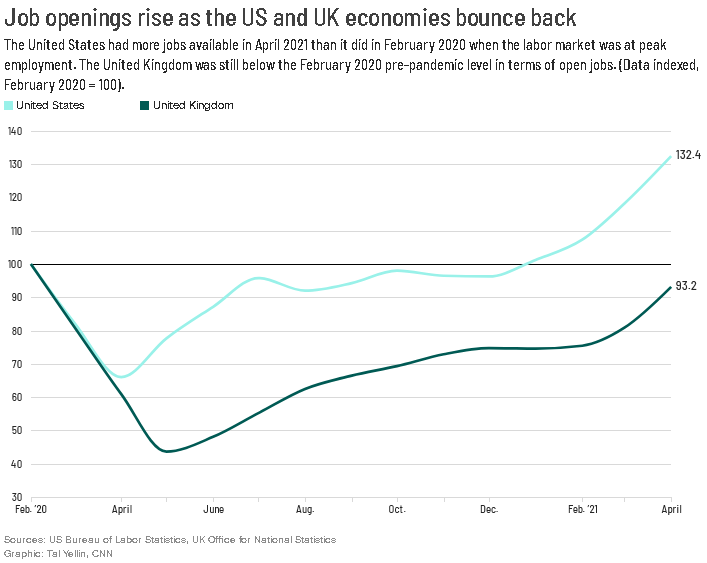
Workers recruited closer to home could theoretically fill some of the empty positions. But training won't happen overnight, especially after on-the-job learning was disrupted by Covid-19. The Organization for Economic Cooperation and Development estimated in a recent report that workplace training opportunities across member countries declined by an average of 18% "during widespread shutdowns." The UK's Road Haulage Association, which says the industry has lost 15,000 EU drivers since January, had to cancel 30,000 driver tests last year due to social distancing.
Bigger changes afoot
The effects of dislocation should fade over time, as should other factors contributing to the dearth of workers, including pandemic-era benefits that may be keeping some on the sidelines, struggles finding child care and concerns about exposing vulnerable family members to Covid-19.
But the pandemic has fostered bigger shifts in the labor market, as people reconsider what types of jobs they want to hold — and on what terms. That's triggering a reallocation of workers across industries that could have long-term consequences.
According to Warden of Dehoga, many hospitality workers in Germany have switched to employers less likely to have to close in future, such as grocery stores like Aldi and Lidl. Others have taken up jobs at delivery fulfillment centers, which have needed more workers thanks to the explosion of online shopping.
"We know from our members and also from the employees that many of them are waiting to come [back to work] — that they will be glad to work again in the restaurants and the hotels — but we also think there are employees who will not come back," Warden said. "They found other jobs."
 A woman vacuums a hallway in a hotel on May 31, 2021, in Hamburg. Since
June 1, hotels in Hamburg have been allowed to receive guests again at
60% capacity.
A woman vacuums a hallway in a hotel on May 31, 2021, in Hamburg. Since
June 1, hotels in Hamburg have been allowed to receive guests again at
60% capacity.
A January survey of more than 31,000 global employees commissioned by Microsoft (MSFT) found that over 40% were considering leaving their employer this year. People are also starting their own businesses. In the United States, 2.5 million new business applications were filed in 2021 as of May. Top of mind, for many people, are working conditions.
"Right up there with money is ... the working situation and dynamic," said Allison Hemming, CEO of New York-based recruiting firm The Hired Guns. "What is their return to work strategy?"
Some people that left or were forced out of the job market when coronavirus lockdowns hit may never come back. An estimated 1.1 million older workers exited America's labor force between August 2020 and January 2021, according to The New School's Schwartz Center for Economic Policy Analysis.
Even before the pandemic, economists and policymakers were concerned about demographic shifts in the coming decades, noting there wouldn't be enough younger workers to replace older retirees. Last month, China said it will allow couples to have up to three children, an attempt to address falling birth rates that could eat into its rapid economic growth.
In a report earlier this month, the Center for Global Development said there will be 95 million fewer working-age people in Europe in 2050 than in 2015, and that neither automation nor increasing the participation of women or older workers in the labor force will close the gap. Instead, the region should focus on boosting immigration, potentially from Africa.
Key to the recovery
How quickly people return to the workforce, and what jobs they choose to fill, will determine how the broader recovery plays out.
That's because shortages of employees could lead to a strong rise in wages, which took a hit in 2020. The Humanitarian Organization for Migration Economics, an advocacy group in Singapore, said that migrant workers there generally aren't seeing higher pay, and are working 14-to-16 hour days to complete tasks with fewer people. In countries like the United States, however, demand for workers is giving some employees the upper hand, allowing them to negotiate for better salaries, benefits and conditions.
"It's a job seeker's market," said Joe Doiron, director of workforce development at New Hampshire's Office of Workforce Opportunity. "There are incentives private companies are offering for sign-on bonuses, referral bonuses. They're offering flexible hours."
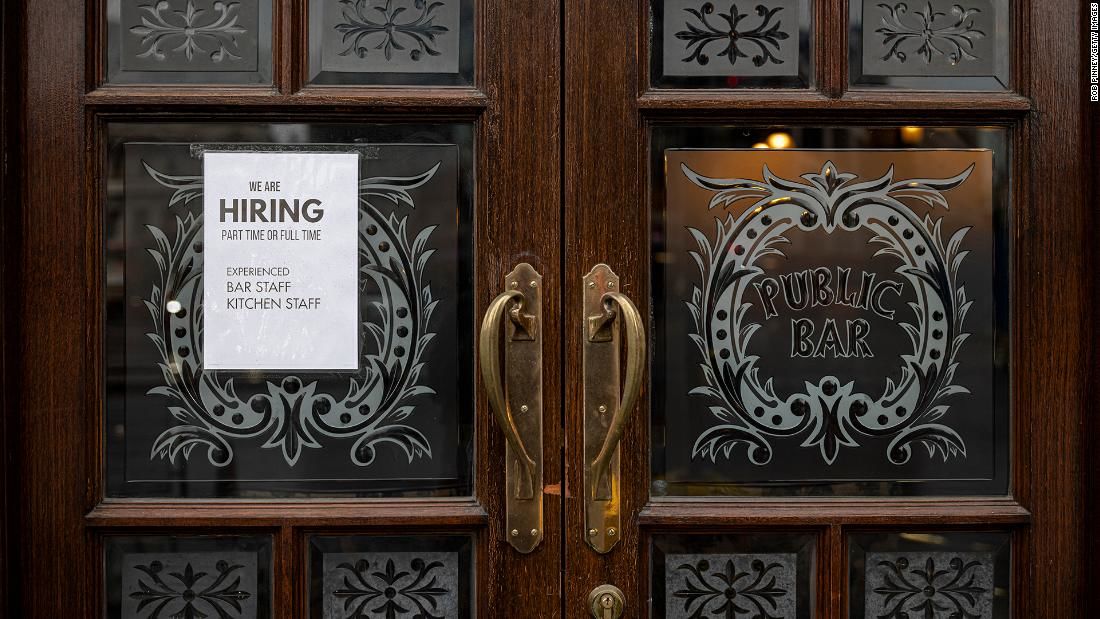 A hiring sign is seen in the window of a pub in Westminster on June 4,
2021 in London, England. Demand for workers in the hospitality sector
has increased significantly following the easing of coronavirus
restrictions, but many businesses are struggling to find staff.
A hiring sign is seen in the window of a pub in Westminster on June 4,
2021 in London, England. Demand for workers in the hospitality sector
has increased significantly following the easing of coronavirus
restrictions, but many businesses are struggling to find staff.
But wage growth is also a key component of inflation, which is being closely monitored by central banks around the world. If prices increase too quickly, policymakers will feel compelled to pull back crisis-era support for the economy sooner than expected.
"If these labor shortages persist for a long time, or become widespread across the economy, you would expect wage growth to pick up, which would prompt inflation to pick up," said Paul Dales, chief UK economist at Capital Economics.
That could force the Bank of England — along with its peers at the Federal Reserve, the European Central Bank and the Reserve Bank of Australia — to raise interest rates.
Some employers are reporting that they're increasing pay to fill vacancies. Nick Allen, CEO of the British Meat Processors Association, said companies in his sector are paying at least 10% more. Kennedy, the UK economist at Indeed, said wage bumps in the food prep sector have been more modest.
The latest big-picture data on pay growth looks "generally subdued," according to a Capital Economics analysis of the 19 countries that use the euro, the United Kingdom and the United States. But Goldman Sachs predicts pressure will increase slightly "in the near term."
"It's absolutely crucial and it will really define how the economy performs over the next two to three years," Dales said.