London Daily

Focus on the big picture.
Sunday, May 31, 2026

Matt Hancock warns vaccine may be 50% less effective against South Africa strain

Matt Hancock warns vaccine may be 50% less effective against South Africa strain

Matt Hancock has warned the South African coronavirus variant could reduce vaccine effectiveness by 50% – putting the UK ‘back to square one’ if it took hold and became the dominant strain.

The health secretary said ‘there is evidence in the public domain’ that the variant may be more resistant to current jabs in use, but cautioned that ‘we are not sure of this data’ yet.

He added that the variant is being tested at the Government’s Porton Down research facility as well as in a clinical trial in South Africa to check the efficacy of the Oxford/AstraZeneca vaccine.

Mr Hancock’s comments came from a recording of an online webinar with travel agents this week, leaked to MailOnline.

He said: ‘There is evidence in the public domain, although we are not sure of this data so I wouldn’t say this in public, but that the South African variant reduces by about 50% the vaccine efficacy.’

The health secretary added: ‘We’re testing that and we’ve got some of the South African variant in Porton Down, and we’re testing it.

‘We’ve got a clinical trial in South Africa to check that the AstraZeneca vaccine works.

‘Nevertheless, if we vaccinated the population, and then you got in a new variant that evaded the vaccine, then we’d be back to square one.’
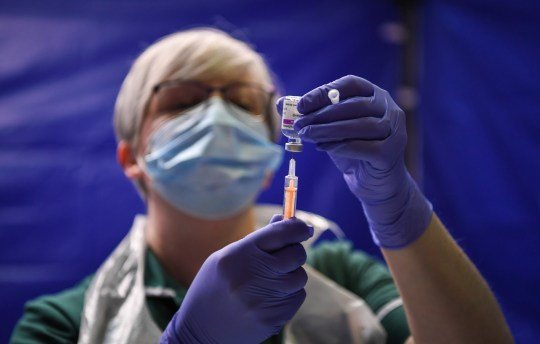
Staff prepare to give AstraZeneca vaccinations to patients at a Covid-19 vaccination centre


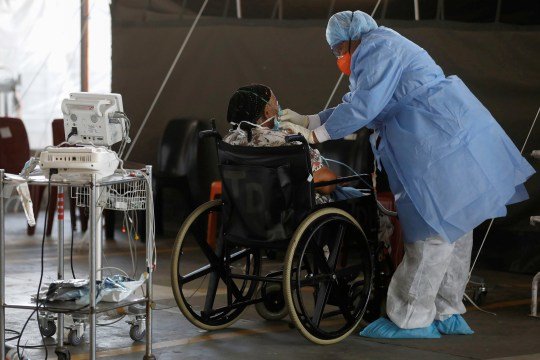
Healthcare workers tend to a patient at a temporary ward at Steve Biko Academic Hospital in Pretoria, South Africa


Asked about the clip at Friday’s Downing Street briefing, the Government’s chief scientific adviser Sir Patrick Vallance said: ‘I’m going to be a bore about this because these are difficult laboratory studies and people are trying to look at how effectively antibodies neutralise various forms of the virus or various parts of viruses.

‘They will get different results in different laboratories, and not all of the immune response is an antibody response.

‘So taking a result from a laboratory and saying ‘therefore the vaccine will be 50% less effective’ – you just can’t do it.


‘We are going to see different results coming up in all of these. Ultimately it is going to be clinical data that is going to tell us, and we are going to get clinical data because there is vaccination occurring in South Africa, there is vaccination occurring in Brazil – we will find out how effective vaccines are against this.

‘It is the case that both the South African and Brazilian identified variants have more differences in shape which might mean they are recognised differently by antibodies.

‘But I think it is too early to know the effect that will have on the vaccination in people and it is worth remembering that the response of the vaccine is very, very high antibody levels, so that may overcome some of this.

‘We don’t know the answer but there’s obviously a cause for concern.’

Professor Chris Whitty said it is possible that even if the current vaccines had reduced efficacy they could still be able to protect against severe disease.

He told the press conference: ‘It is possible, we don’t know this, that what we could end up with is that the current vaccines still protect to a large degree against severe disease and dying, even if they are less effective against infection.’

Newsletter

Related Articles

0:00
0:00
Close
Japanese Technology Firm Fujitsu Launches Advanced Artificial Intelligence Tool for Corporate Disclosures
South Africa Officially Launches Nationwide Campaign for Highly Contested Local Government Elections
United Kingdom Commits Additional Funding for Unexploded Ordnance Clearance in Laos
Singapore Announces Stringent New Greenhouse Gas Regulations for Commercial Cooling Systems
Cambodia and Thailand Hold High-Level Border Security Talks at United Nations Headquarters
Myanmar Military Government and China Sign Major Agreement to Upgrade Media and Cultural Cooperation
Knife Attack at Swiss Train Station Leaves Three Injured in Suspected Act of Domestic Terrorism
Transnational Extortion Gang Threatens Canadian Police With Army of One Thousand Armed Operatives
Australia Imposes Forty-Two-Day Quarantine on Cruise Ship Passengers Following Deadly Hantavirus Outbreak
International Monetary Fund Unlocks Seven Hundred Million United States Dollars for Sri Lanka Following Economic Reforms
Australia Launches Record One Point Four Billion Dollar Lawsuit Against Chemical Giant 3M Over Contamination
China and Canada Foreign Ministers Meet in Ottawa in Effort to Stabilize Strained Diplomatic Ties
Indonesia Demands Urgent United Nations Security Council Reform Amid Escalating Global Conflicts
Extreme Weather Patterns Trigger Severe Drought in Madagascar and Destructive Flooding in East Africa
Indian State of Karnataka Faces Political Upheaval as Chief Minister Siddaramaiah Abruptly Resigns
Philippines and Japan Reaffirm Defense Ties as Crucial for Indo-Pacific Regional Stability
Norway Joins French Nuclear Deterrence Initiative in Major Shift for European Security Architecture
Global Critical Mineral Alliances Expand as Western Nations Move to Counter Chinese Supply Dominance
United States Imposes Fifty Percent Tariffs on Mexican Steel and Aluminum Ahead of Trade Pact Review
European Union and China Head Toward Major Trade Conflict Over Clean Technology Exports
United States Economic Growth Severely Downgraded to One Point Six Percent as Stagflation Fears Mount
World Health Organization Warns Central African Ebola Epidemic is Outpacing Containment Efforts
United States Treasury Department Conditions Sanctions Relief on Reopening of the Strait of Hormuz
Iranian Air Defenses Intercept and Destroy United States Military Drone Over Bushehr Province
Iranian Armed Forces Launch Ballistic Missiles Toward Unspecified Targets Prompting Regional Condemnation
United Nations Secretary-General Warns Global Order Facing Highest Level of Conflict Since 1945
Israel Issues Sweeping Evacuation Orders in Southern Lebanon Amid Intensified Hezbollah Conflict
Russia Announces Systemic Military Strikes Targeting Ukrainian Defense and Energy Infrastructure
United States and Iranian Negotiators Reach Draft Agreement to Extend Ceasefire and Resume Nuclear Talks
United Nations Security Council Deeply Divided Over United States Capture of Venezuelan President
US and Iran Exchange Direct Military Strikes Amid Fragile Gulf Ceasefire
World Health Organization Warns of Catastrophic Ebola Outbreak in DR Congo
Russia Threatens New Wave of Strikes on Ukrainian Infrastructure and Embassies
Scientists Warn Atlantic Ocean Currents Could Collapse Faster Than Projected
Anthropic Reaches $900 Billion Valuation in Historic AI Funding Round
Washington Imposes Crippling Sanctions on Iranian Maritime Authority
Japan and the Philippines Initiate Strategic Intelligence-Sharing Pact
Microsoft Deploys Autonomous Computer-Using AI Agents to Global Markets
Anthropic Secures $45 Billion Compute Infrastructure Agreement With SpaceX
U.S. Director of National Intelligence Resigns Amid Administration Shakeup
Micron Technology Crosses Trillion-Dollar Valuation Amid Unprecedented Hardware Demand
Canada and Germany Finalize Historic Long-Term LNG Export Agreement
China Expands International Travel Restrictions on Domestic AI Researchers
Japan Approves Sweeping Overhaul of National Intelligence Apparatus
Global Airlines Scramble Logistics as Middle East Airspace Remains Fractured
Japan's Naphtha Imports Plunge 47 Percent Amid Strait of Hormuz Closure
Global Crude Prices Retreat Below $96 as Gulf Tensions Momentarily Ease
Generative AI Outperforms Human Baselines in Landmark Global Creativity Study
NASA Partners With Private Aerospace to Unveil Permanent Lunar Base Architecture
South Korean Equity Markets Surge on Next-Generation Memory Chip Frenzy
×