London Daily

Focus on the big picture.
Sunday, Jul 19, 2026

Kill the Bill protests: More than 100 arrested in London

Kill the Bill protests: More than 100 arrested in London

More than 100 people were arrested at a Kill the Bill protest in central London on Saturday, the Met Police have said.

The 107 arrests were for offences including breach of the peace, violent disorder, assault on police and breaches of Covid legislation.

One woman was arrested on suspicion of possession of an offensive weapon after a knife was found.

The Met said the vast majority of people socially distanced and left the rally peacefully.

Commander Ade Adelekan, who led the policing operation for the protest, said most people worked with and listened to police officers.

"However, as the afternoon wore on it became clear that a small number of people were intent on remaining to cause disruption to law-abiding Londoners," he said.

"Despite repeated instructions from officers to leave, they did not and, amid increasing levels of disorder, arrests were made.

"We should not allow the behaviour of a few individuals who attend these events with the purpose of committing criminal acts to taint the good behaviour of the majority who attended yesterday."

The protests were prompted by the Police, Crime, Sentencing and Courts Bill, which proposes to give police in England and Wales more power to impose conditions on non-violent protests, including those which are deemed too noisy or a nuisance.
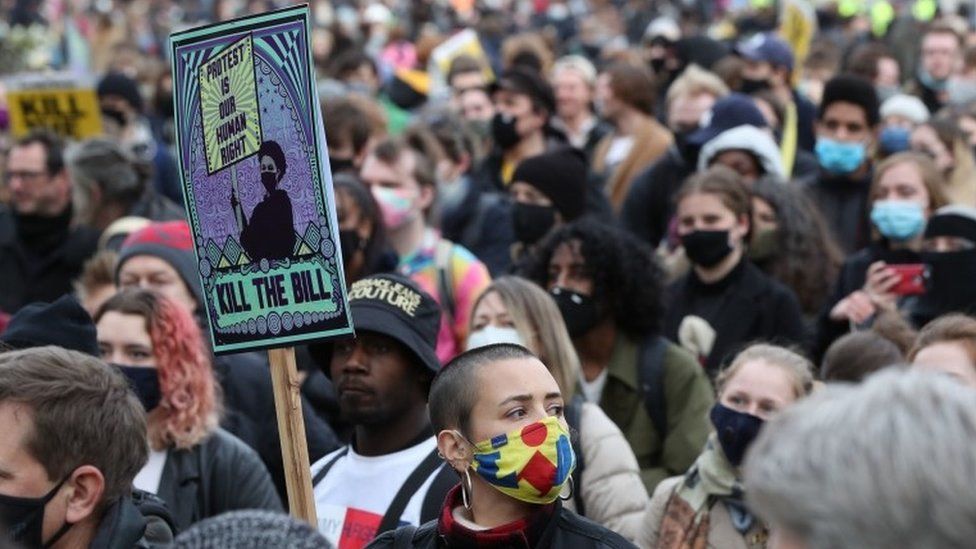
The protest in London was attended by several hundred people

Ministers and police have defended the proposals, saying they were needed to tackle demonstrations such the ones by Extinction Rebellion in 2019, where mass occupations of roads and bridges in London and elsewhere stretched police resources to the limit.

Former Labour leader Jeremy Corbyn, who had earlier addressed crowds in London's Parliament Square, said the bill was a "very dangerous, slippery slope".

Seven people were arrested at a Kill the Bill protest in Bristol, which was attended by about 1,500 people.

Protests were also held in Birmingham, Liverpool, Newcastle, Weymouth and Bournemouth, amongst other places.


Several hundred people marched in London chanting "Kill the Bill"


Newsletter

Related Articles

0:00
0:00
Close
Germany’s Economic Malaise Reopens the Sunday Shopping Debate
Singapore Considers Lower Taxes for Fund Managers as Hong Kong Intensifies Talent Contest
US Retaliates Against Iran After Two American Troops Killed in Jordan
Bank of Asia BVI Enters Court-Supervised Liquidation After Regulators Find It Insolvent
Proposed U.S.-Saudi Nuclear Pact Could Permit Limited Uranium Enrichment Under International Safeguards
Netherlands Declares Water Shortage Emergency After Drought Pushes Rivers to Historic Lows
Iran Claims It Destroyed Bahrain’s Main Artificial Intelligence Center in Missile and Drone Strike
Brothers Andrew and Tristan Tate Who Turned "Toxic Masculinity" Into a Brand Arrested in Miami as Britain Seeks Their Extradition
Reported CIA Mission Helped Clear the UAE’s Path to Advanced US AI Chips
Artificial Intelligence Capital Fuels Markets While Governments and Regulators Face Mounting Strategic Tests
China’s Moonshot’s Kimi K3 Narrows the Gap With Anthropic Through Scale, Openness and Lower Cost
Gold and Cash Seizure Puts Indonesia’s Senior Anti-Corruption Prosecutor Under Investigation
The Ledger Will Not Trust on Faith
Bank of England Warns Climate Shocks Could Trigger Sudden Asset Repricing
UK Treasury Places Microsoft, Google, AWS and Oracle Under New Financial Resilience Rules
Scottish Government Faces Pressure Over Delays in Vulnerable Group Background Checks
Crown Prosecution Service Authorises Additional Charges Against Andrew and Tristan Tate
NHS Approves At-Home Cancer Treatments for Rare Blood Disorders
Bank of England Gains Oversight of Major Cloud Providers Supporting UK Financial System
UK Government Plans Major Overhaul of English Local Councils Through New Unitary Authorities
British Steel Nationalisation Dispute Escalates as Chinese Owner Jingye Seeks Compensation
Bank of England Signals Interest Rates Will Stay High as It Warns of Financial Risks From Climate and AI
Trump Administration Pressures Banks to Restrict Financial Access for Undocumented Immigrants
Passenger Bound for Germany Refused to Sit Beside a Woman on a Plane — Then Slapped a Flight Attendant
Ukraine’s Leadership Rift Spills Into the Streets as Protesters Target Army Chief
Ukrainian Drone Barrage Kills Eight and Strikes Russian Logistics Network
Key Trends to Watch
Financial Conduct Authority Warns Cloud and Digital Risks Are Becoming a Financial Priority
Jeffrey Donaldson Appeals Sexual Abuse Conviction as Democratic Unionist Party Opens Review
Welsh Health Authorities Launch Emergency Meningitis Vaccination Programme for Students
Scottish Business Activity Falls for Third Month as Companies Face Rising Costs
Bank of England Regulators Demand Better Access to Digital Banking Services
United Kingdom Cuts Bilateral Aid to Several African Countries by Up to Ninety Per Cent
United Kingdom Introduces Tougher Deportation Rules After Rochdale Exploitation Scandal
NHS England Launches Wearable Technology Plan to Reduce Sepsis Deaths
Amazon Web Services Billing Error Sends Trillion-Dollar Invoices to British Companies
Bank of England Takes Direct Regulatory Role Over Major Global Cloud Providers
Extreme Summer Heat Drives Record Fire Risk and Rising Deaths Across Britain
United Kingdom Nationalisation of British Steel Sparks Diplomatic Dispute With China
United Kingdom Economy Shows Weak Growth Ahead of Major Autumn Budget
Andy Burnham Set to Become United Kingdom Prime Minister After Labour Leadership Victory
The Ten World Cup Finals That Defined Football History
Smartphones Are Getting More Expensive, Sales Are Collapsing, and Even Apple Admits: "Prices Will Rise"
The Monaco Bombing Has Become a Test of Ukraine’s Intelligence Accountability
Leadership Change and Strategic Rivalry Redraw the Political Map
Energy Risk, Uneven Growth and the New Geography of Global Capital
The AI Race Enters Its Infrastructure Era
Security and resilience remain long-term national priorities
Britain balances growth ambitions with public finance pressures
Regional devolution becomes a defining theme of the next Labour era
×