

Johnson extends England's pandemic restrictions amid variant concerns
Despite the UK's successful vaccine rollout, which has given two doses to more than half of the adult population, the prevalence of the Delta variant -- first identified in India -- has convinced the Prime Minister and his government that "freedom day" for English citizens, as some have called it, must be delayed by four weeks to July 19.
"Now is the time to ease off the accelerator because by being cautious now, we have the chance in the next four weeks to save many thousands of lives by vaccinating millions more people," Johnson said at a press conference in Downing Street.
The variant is growing in the UK at 7% week on week and the government fears that if restrictions were to be fully lifted next Monday, then hospitalizations could rise to the levels seen in the country's first wave.
The four-week gap will allow the government to accelerate giving second vaccinations to those most vulnerable.
"Vaccination greatly reduces transmission and two doses provides a very high level of protection against serious illness and death, but there are still millions of younger adults who have not been vaccinated and sadly a proportion of the elderly and vulnerable may still succumb even if they have had two jabs," Johnson said.
Public Health England (PHE) reported on Monday that the two main vaccines used in the UK are highly effective against the variant.
PHE says that the Oxford/AstraZeneca vaccine is 92% effective against the variant after two doses, while the Pfizer-BioNTech shot offers 96% protection after two doses. Their research has found that while one dose is 17% less effective at protecting people from the Delta variant compared to the Alpha variant, there is a much smaller difference after two.
This means the UK is in a race against time to get jabs in arms over the next four weeks.
The government believes it will achieve this by reducing the gap between doses from 12 weeks to eight for people over the age of 40. Everyone over the age of 40 who had a dose in mid-May will be offered a second by July 19, while all over 18s will have been offered their first shot by that date.
Public opinion divided
Johnson firmly believes this will be the last delay and that there will be no reason for it to last longer than four weeks. There is a chance the country could be unlocked earlier -- on July 5 -- if the data supports it, though this is not seen as likely.
The delay will almost certainly divide opinion.
While most of the public has been largely supportive of the UK's tough Covid restrictions throughout the pandemic, Johnson's habit of U-turning could go down badly as citizens and businesses have been busy making plans for their summer of freedom.
British citizens have been living under some form of Covid-19 restrictions since March 23, 2020, when Prime Minister Boris Johnson somberly told the nation that, with immediate effect, they must stay at home in order to suppress the virus.
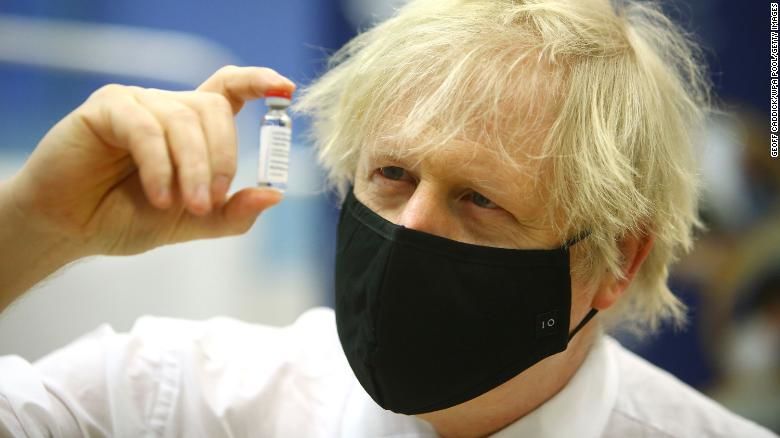 British Prime Minister Boris Johnson poses with a vial of the
Oxford/AstraZeneca vaccine during a visit to the vaccination centre at
Cwmbran Stadium on February 17, 2021 in Cwmbran, Wales.
British Prime Minister Boris Johnson poses with a vial of the
Oxford/AstraZeneca vaccine during a visit to the vaccination centre at
Cwmbran Stadium on February 17, 2021 in Cwmbran, Wales.
Since that date, the UK's Covid story has been through numerous ups and downs, from failed testing systems to thousands of daily deaths and the canceling of Christmas.
Lawmakers in Johnson's Conservative Party are keeping tight-lipped in public, but are deeply uncomfortable with the delay in lifting restrictions -- precisely because of the success of the vaccine.
One veteran member of parliament told CNN that while "it's true that this variant is spreading," death rates and hospitalizations are relatively low enough that the "damages that restrictions do to the economy and quality of life" are simply not justifiable.
Another senior Conservative MP expressed fury that Johnson opted to announce the measures to the country "before bothering to tell us in parliament," a criticism that has been levelled at the PM throughout the crisis. "If he's going to do this without consulting us, he's going to have to offer us some kind of flexibility. There has to be some carrot, it cannot be all stick."
Johnson is offering a carrot of some sort.
Thousands of Brits have had to delay their weddings over the past 15 months. As of Monday, rules around weddings will be relaxed, lifting the 30-person limit on those attending and instead relying on venues to obey social distancing rules, meaning tables of six and no dancing or singing.
Anti-lockdown voices growing
It's likely that the majority of the public will back Johnson, if previous patterns are anything to go by.
"Since the beginning of the first lockdown, two long-term [trends] have emerged: The government moving too slowly and not doing enough," says Joe
Twyman, director of public opinion consultancy Deltapoll.
However, he also notes that as more people have been vaccinated and are increasingly confident with getting back to normal, that might shift: "There are a sizable minority of people who are now anti-lockdown and they are getting louder, disproportionate to their size."
Twyman says the best way to quieten that noise will be to sell this as "the final stage of a popular and successful vaccine regime," rather than "protecting hospitals again, making it feel like Groundhog Day."
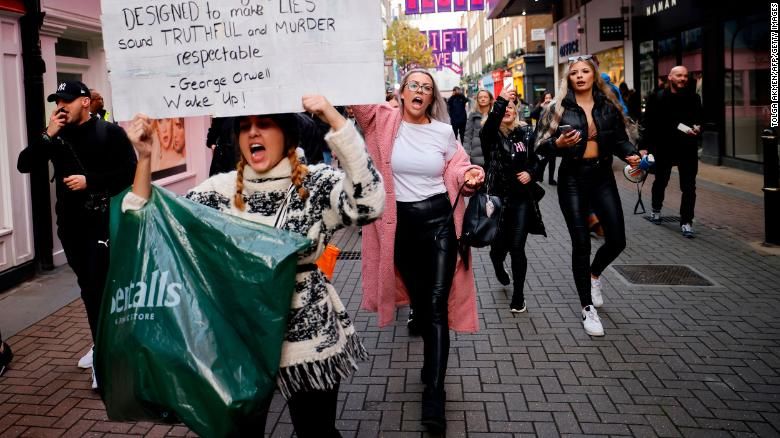 Protesters hold up placards as they take part in an anti-lockdown
protest against government restrictions designed to control or mitigate
the spread of the novel coronavirus, including the wearing of masks and
lockdowns, in London on November 28, 2020.
Protesters hold up placards as they take part in an anti-lockdown
protest against government restrictions designed to control or mitigate
the spread of the novel coronavirus, including the wearing of masks and
lockdowns, in London on November 28, 2020.
Simon Clarke, associate professor in cellular microbiology at the University of Reading, thinks that extending the measures even by four weeks to vaccinate more people could have a big impact.
"When a virus is swilling around the population, it can mutate," he says. "Every time it replicates (infects) there is the possibility of a mutation. While most of those are neutral or even damage the virus, every so often a mutation gives the virus a 'fitness advantage,' which makes it more transmissible. Bluntly, the more people with a second dose, the less this thing can mutate in dangerous ways."
Whether Johnson's delay goes down well with the public and lawmakers or not, it is something that Johnson had been desperate to avoid. His personal politics have always leaned away from central government telling citizens want to do. The fact he's had to lecture the public so often over the past 15 months is something the PM is acutely aware might define his legacy as leader.
And even if the public is broadly in favor of Johnson's draconian measures over the course of this crisis, it's impossible to deny that it sits uncomfortably with a man whose biggest political victory was based on the premise of Britons taking back control.