

How rich is Saudi Arabia?
Saudi Arabia wants to demystify its finances.
The kingdom is working on creating a consolidated balance sheet of its assets and liabilities which will include items currently kept off the oil-rich economy’s books, including the investments and debts of its powerful sovereign wealth fund.
“The main purpose of this programme is to have a financial equivalent of an MRI of the government balance sheet,” a Finance Ministry spokesman told Reuters, adding that it would include assets and liabilities that are currently “off-balance sheet”.
Saudi Arabia’s Crown Prince and de facto ruler Mohammed bin Salman has put Public Investment Fund (PIF), Saudi Arabia’s main sovereign wealth fund, at the center of reforms aimed at diversifying the economy of the world’s top oil exporter away from fossil fuel.
Under the prince’s chairmanship, PIF has transformed from a sleepy sovereign wealth fund into a global investment vehicle making multi-billion dollar bets on hi-tech companies such as Uber as well as other equity investments and pledging tens of billions of dollars to funds run by Japan’s Softbank.
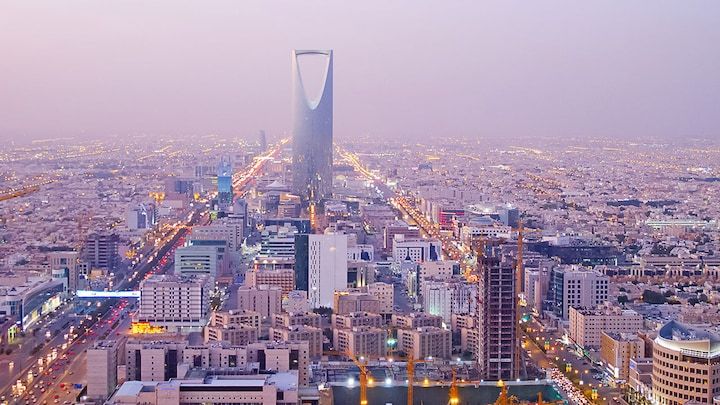 Kingdom tower on Dec. 22, 2009 in Riyadh, Saudi Arabia.
Its financial statements are not published and it does not feature in the kingdom’s budget, which is publicly available.
Gulf countries don’t typically publish information about their overall debts and assets but the PIF’s riskier investment profile and infusion of state funding have made its opacity an issue for some investors.
“Transfers of wealth from liquid pools of assets like central bank reserves into PIF’s less liquid (and less transparent) investments increases the overall risk profile of the public sector balance sheet,” said Kirjanis Krustins, a director in Fitch’s sovereign team.
“Debt investors would tend to see the government and its key government related entities such as PIF as representing substantially the same risk. Thus the levering up of the broader Saudi complex could at some point impact the government’s own borrowing costs,” he said.
The government media office did not respond to a request for comment.
ARAMCO BILLIONS
The government started working in the second half of last year on the so-called Sovereign Asset and Liability Management (SALM) framework and the spokesman said it was a ‘long-term project’ with no decision yet made on when and how its results would be disclosed.
“If we use benchmarks we will see countries spent a couple of years to implement the consolidation phase,” he said of the project.
The PIF’s finances are formidable.
Its assets have swelled to $400 billion as of 2020 from $150 billion in 2015, with the fund bolstered by an expected $70 billion payday from Saudi Aramco, the state oil company, for PIF’s stake in a petrochemical giant and a $40 billion transfer from the central bank’s foreign reserves.
It was also the recipient of nearly $30 billion in proceeds from Aramco’s initial public offering in 2019.
The fund has raised $21 billion in loans between 2018 and 2019, and is finalising a new facility expected to be over $10 billion in size, sources have said.
THE ‘NORMAL’ WAY
Despite Saudi’s oil wealth, creating enough jobs for the kingdom’s young population is one of the biggest challenges facing Prince Mohammed, known in the West as MbS.
The government has been pushing through economic policies since 2016 aiming to create millions of jobs and reduce unemployment to 7% by 2030. But fiscal austerity to contain a yawning deficit has slowed investment, and the coronavirus crisis last year pushed unemployment up to a record 15.4%.
To get the deficit down from an eye-watering 12% of GDP last year to a shortfall of 4.9% by the end of this year, Riyadh has slashed capital spending.'
It is relying instead on the PIF to fund some of the major infrastructure projects to help boost growth, including NEOM, a $500 billion high-tech business zone, and the recently announced “The Line”, a 1 million inhabitants carbon-free city in NEOM, expected to cost between $100 billion and $200 billion.
PIF plans to inject at least 150 billion riyals ($40 billion) annually into the local economy until 2025, and to increase its assets to 4 trillion riyals ($1.07 trillion) by that date, Prince Mohammed has said.
“MBS understands that unless the economy grows at a rate above 6.5-7%, the youth unemployment rate will stagnate or grow – and that is a ticking time bomb,” said Khaled Abdel Majeed, MENA fund manager at London-based SAM Capital Partners, an investment advisory firm, commenting about transfers of state funds to PIF.
“Doing things the ‘normal’ way through ‘normal’ channels will take more time than is available.”