

Hospitals told to free up beds for ambulance strike
They said patients need to be safely discharged where possible to enable ambulance staff to hand over patients.
Ambulance staff are to walk out on 21 and 28 December in a dispute over pay.
Dr Adrian Boyle, president of the Royal College of Emergency Medicine said freeing up more beds would be very difficult for hospitals to achieve.
"We don't hold up ambulances for fun," he told Radio 4's Today. "It really is difficult. We always want ambulances to return to the front line as quickly as possible and we've been struggling to do this in the last three years."
Asked what the solution was, he said it was not just provision of social care to enable elderly people to be discharged from hospital.
"We run our hospitals very tight compared to our European comparators," he said, adding: "It's not just about social care but about making sure our hospitals are big enough to cope."
The strike by ambulance staff on 21 December comes the day after a nurses' strike.
"It's something that makes everyone who works in this sector pretty anxious," said Dr Boyle
The co-ordinated walkout in England and Wales by the three main ambulance unions - Unison, GMB and Unite - will affect non-life threatening calls only.
Unison, Unite and GMB are taking action on 21 December. GMB union members will go on strike again on 28 December.
The walkouts will involve paramedics as well as control room staff and support workers.
In a letter addressed to hospital bosses, NHS chiefs in England have called for patients who complete emergency medical care to be moved out of emergency departments as quickly as possible.
Measures, such as placing additional beds in hospitals and creating "observation areas" should be put in place to ensure that patients arriving by ambulance are handed over to A&E in less than 15 minutes, they said.
Sir David Sloman, NHS England's chief operating officer, wrote in the letter co-signed by national medical director for England Professor Sir Stephen Powis and chief nursing officer for England Dame Ruth May that plans should be in place by Monday, 19 December.
Some outpatient appointments could be cut back to allow senior medical staff to be redeployed to emergency departments. But NHS chiefs say "every effort" should be made to maintain urgent cancer diagnostics or cancer treatment, with rescheduling to be considered as a last resort.
Ambulance handover delays in England have hit a new high, according to recent NHS data. Last week, one in six patients waited for more than an hour to be passed on to A&E teams.
NHS Providers' interim chief executive Saffron Cordery also said reducing handover delays would be "incredibly difficult to implement" because of factors including staff absences and rising flu admissions.
Ms Cordery said: "We understand why ambulance staff have voted for industrial action but it's vital that the government and unions talk urgently to find a way to prevent this and further strikes from happening."
The letter sent to NHS trusts and Integrated Care Boards said bosses should create and co-ordinate plans on how to handle strike days by 19 December.
Staff have been offered an average rise of 4.75%, with a guaranteed minimum of £1,400 - but the unions have asked for above-inflation pay rises.
Business Secretary Grant Shapps said pay rises for ambulance workers and nurses were decided by independent pay review bodies.
Asked on Radio 4's Today how the government could afford to increase state pensions in line with inflation, but not NHS staff pay, Mr Shapps said: "Nurses and ambulance workers would have a pay rise that was recommended independently which I think is the right way to do this."
He said expectations for pay increases were greater since energy prices began rising and the subsequent high inflation rates, but people will "all end up much worse off" if ministers award inflation-busting pay rises.
Mr Shapps added that following the advice of the pay review bodies was "right and proper".
Following an emergency Cobra meeting on Monday, the prime minister's official spokesman said the number of ambulances available to attend calls would be reduced "significantly".
Armed forces could be deployed to hospital trusts ahead of the strikes, Downing Street has confirmed.
The Police Federation has also suggested police officers may also be called upon to drive ambulances.
Nurses took strike action on Thursday in parts of England, Wales and Northern Ireland in a dispute over pay.
Figures released by NHS trusts in England and Northern Ireland show at least 19,000 patients had their surgeries and appointments postponed because of strike.
Ministers had predicted that a larger number of around 70,000 appointments, procedures and surgeries would be lost.
Royal College of Nursing members are expected to walk out for a second time on 20 December
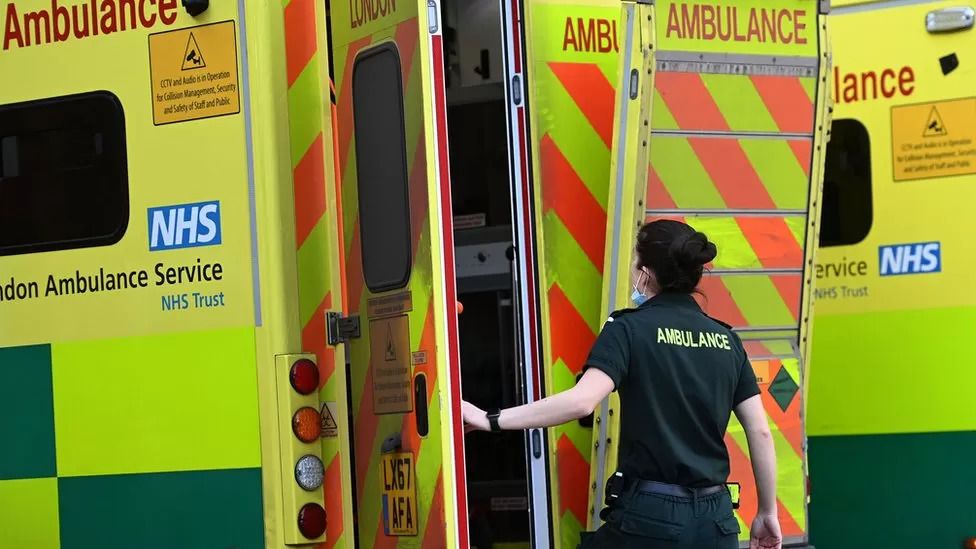 NHS England bosses have warned of "extensive disruption" ahead of ambulance strikes