

Hong Kong Covid-19 ‘vaccine bubbles’ to allow larger group dining, some travel
Hongkongers who have been vaccinated for Covid-19 will be allowed to dine out in bigger groups and enjoy other easing social-distancing measures as well as become eligible for limited travel under “vaccination bubble” incentives offered by the government to boost the city’s inoculation rate.
Chief Executive Carrie Lam Cheng Yuet-ngor announced on Monday that the government had also made progress towards establishing a “travel bubble”
with Singapore, and visitors from mainland China would be allowed to enter Hong Kong from the middle of next month without having to undergo quarantine as long as they were tested for the coronavirus in advance.
However, details of the more relaxed pandemic-control phase would have to be worked out first and existing social-distancing measures would be extended for two more weeks, she said.
The announcement came as the city confirmed 13 new coronavirus cases, 11 of which were imported. More than 10 preliminary-positive infections were also identified.
The continuing trend of easing local infections allowed most schools to resume face-to-face classes partially on Monday after the Easter holiday.
“Hong Kong has recorded no untraceable cases over the past three days, which is a good sign … the city’s fourth wave is already under control apparently,”
Lam told a press conference against a backdrop carrying the slogan “A new direction in fighting the pandemic”.
“Without major outbreaks, Hong Kong can be categorised as a low-risk area according to global standards.”
She added: “As far as the ‘vaccine bubble’ [is concerned], the way to put it is we are making use of vaccination as a basis for adjusting the social-distancing measures as well as the border control measures.”
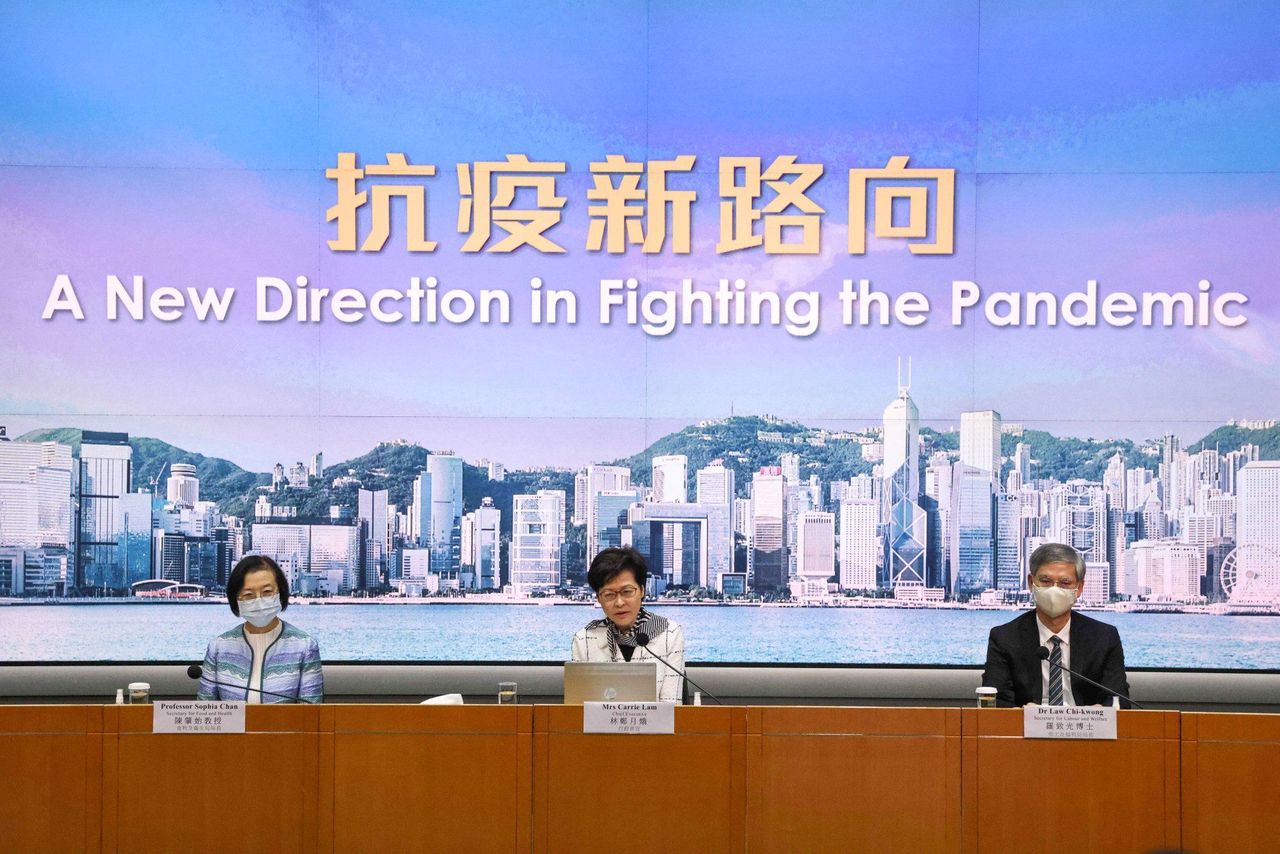 Carrie Lam (centre) outlines a ‘new direction’ for Hong Kong’s pandemic response.
Lam said current social-distancing measures, which include limiting public gatherings and restaurant tables to four people, would be extended for another two weeks to April 28 when they expired on Wednesday, given the ongoing possibility of a rebound in infections after the Easter holiday.
But she outlined a plan for easing Covid-19 restrictions on restaurants, which would take effect on April 29 at the earliest and impose different sets of conditions based on how many people were eating together, up to a maximum of 12 per table.
The first level would allow tables of six people, who would be free to stay until midnight, rather than having to leave at 10pm as existing rules demand.
All of those diners must record their visit using the risk-exposure notification app “Leave Home Safe” and staff are required to have been given at least one vaccine dose.
Restaurants serving those groups would still be subject to restrictions limiting them to operating at less than half of their original capacity, with no more than 20 diners allowed at a banquet.
The next stage – further requiring all restaurant employees to be fully vaccinated and customers to have received at least one dose – would permit diners to eat in groups of eight and banquets serving 100 people, with operating hours for dine-in services extended to 2am.
For the third phase of the plan, each table could host up to 12 people – if all employees and customers had been fully vaccinated.
Restaurants would need to designate specific zones on their premises catering only for customers who had been given at least one dose, Lam said.
“We hope to adjust the social-distancing measures based on vaccinations and give businesses a clear road map,” she added.
People are considered to be fully vaccinated 14 days after receiving their final Covid-19 vaccine dose.
Businesses can choose to opt out of the new arrangements and continue to operate under the current social-distancing measures.
Bars and pubs would also be allowed to reopen in phases, on the condition every member of staff and customer had taken their first dose of coronavirus vaccine and all customers used the Leave Home Safe app. The limitations could be further relaxed if all staff and customers had been fully vaccinated.
The pathway would further reduce the length of quarantine imposed on fully vaccinated arrivals from low-risk places, such as Singapore, Australia and New Zealand, falling from 14 days to seven or even less.
Travellers completing the vaccination process and arriving from countries in the middle category of risk could have their confinement periods cut from 21 days to 14, and possibly lower.
But Lam did not specify when the arrangements for reducing quarantine would take effect, stating only that details would be announced in due course.
The entry ban on arrivals from Britain, which has been in place since late December, will also be lifted for Hongkongers in early May, but they will still need to quarantine for 21 days on their return.
But authorities said they would continue to enforce strict border curbs to prevent coronavirus variants from penetrating the community.
On top of the existing penalties for individual carriers, all airlines running the relevant route would be banned from operating flights to Hong Kong for 14 days if any one of them brought in an unspecified number of passengers testing positive for a variant strain of Covid-19 within a seven-day window.
Meanwhile, the “Return2HK” scheme, which exempts Hongkongers arriving from Guangdong province and Macau from quarantine if they have a negative Covid-19 test result, will be extended in late April to cover people arriving from the rest of the mainland.
Similar quarantine-free arrangements would be available for non-Hong Kong residents crossing into the city from the mainland starting in mid-May.
Fully vaccinated cross-border truck drivers will also be relieved of having to get tested daily for the coronavirus, with screening only required every three days.
The government is also planning to ease quarantine requirements for aircrew who have been given both Covid-19 vaccine doses, although that will initially only apply to cargo flights, according to sources.
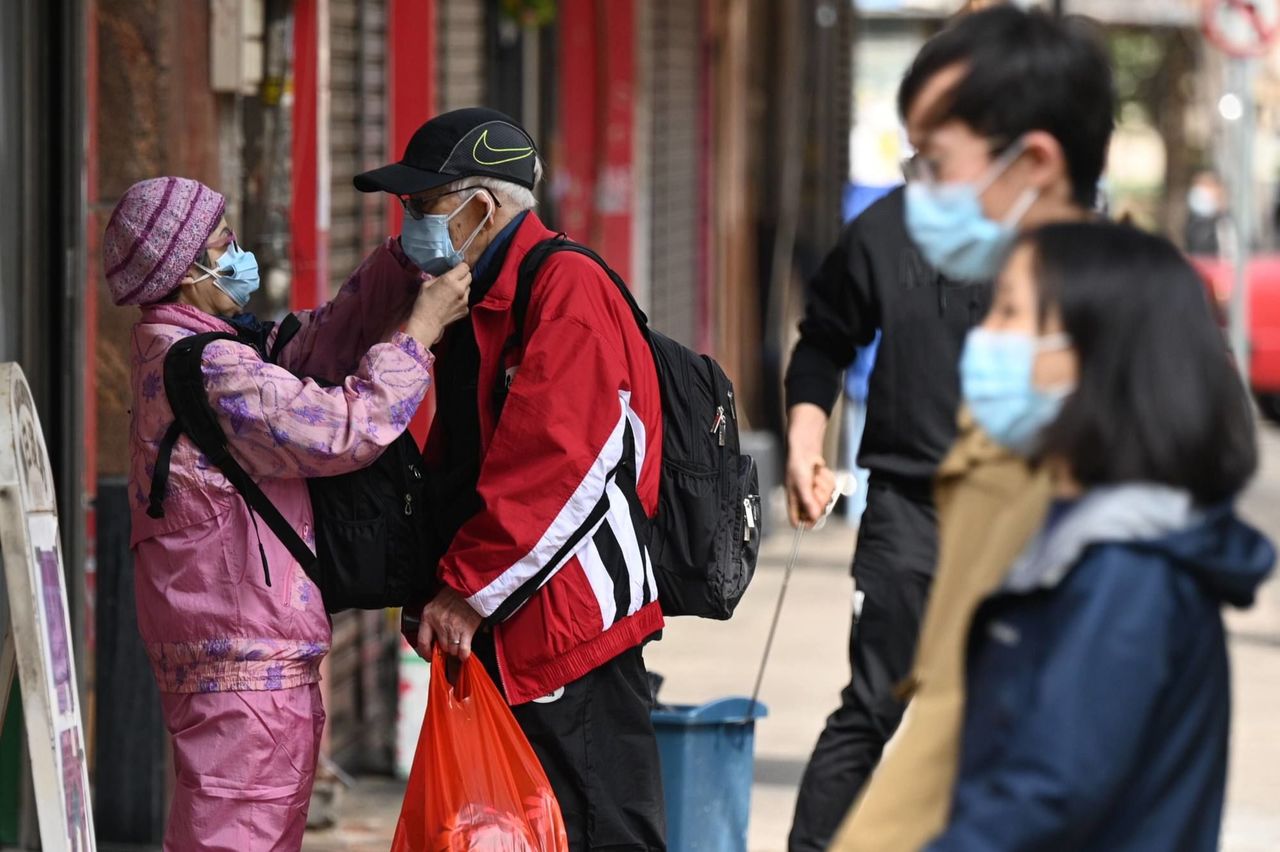 Local Covid-19 infections have been easing since late March.
Secretary for Labour and Welfare Dr Law Chi-kwong told the same press conference that those who had gone through the full Covid-19 vaccination course would be able to visit care homes after passing a rapid virus test.
Those not fully vaccinated could instead present a negative nucleic acid test obtained in the 72 hours before their visit, as well as undergoing the rapid form of screening.
Visits at the facilities have been strictly prohibited, except on compassionate grounds, since last summer, when dozens of homes were hit by coronavirus outbreaks.
Lam also revealed the government was considering ending free Covid-19 screening services for people who were not subject to a mandatory-testing order.
“The plan is not because we want to save money, which is also important, but to encourage people to use vaccination to replace regular testing,” she said.
Health minister Professor Sophia Chan Siu-chee assured that more BioNTech doses were on their way and supplies were stable after vaccinations using the German-made shots were halted over packaging defects on some vials.
The two-week suspension from late March has left 1 million doses in storage pending an investigation and question marks remain over whether they will be put to use.
Dr Siddharth Sridhar, an infectious disease expert from the University of Hong Kong, said travel measures would serve as more of an encouragement for people to get vaccinated than relaxing dining restrictions.
“[Relaxed measures on] dining is a good incentive, but many people have already changed their habits and behaviour in terms of eating out or meeting in a group in the past year,” Sridhar said.
“The main incentive should be travelling out of Hong Kong. If we could form travel bubbles with places like Japan or Taiwan after meeting certain targets, that would be a concrete incentive.”
Respiratory medicine specialist Dr Leung Chi-chiu warned there would still be transmission risks in restaurants.
“Vaccines cannot provide 100 per cent protection. If there is a gathering of crowds, the infection risks would still escalate,” Leung said.
He also questioned whether restaurants could clearly segregate patrons who were vaccinated from those who were not, or if they could prevent the mixing of staff dedicated to serving those different categories of customer.
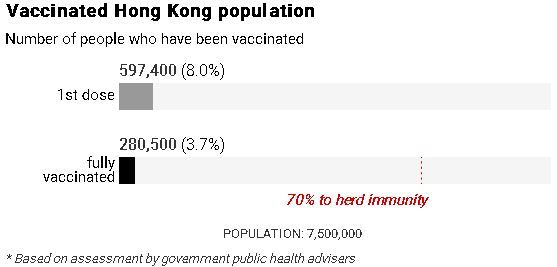
Since the launch of the local Covid-19 vaccination programme in late February, about 597,400 people, or 8 per cent of the city’s 7.5 million population, have received the first dose of vaccine. Some 280,500 people, or 3.7 per cent of the population, meanwhile, have received the second dose and are considered fully vaccinated.
The city currently offers the mainland China-produced Sinovac vaccine and the German-made BioNTech version.
Five of Monday’s imported cases came from India, with three from Pakistan, two from Indonesia, and one from the Philippines. Both local cases were traceable, with one tied to the cluster at Block 3 of Oi Fai House in Tuen Mun’s Yau Oi Estate.
The city’s tally now stands at 11,594 confirmed infections, with 207 related deaths.