

Hitting the panic button will cripple Britain
After the privations endured during lockdown — curbs on travel, work, socialising and even family gatherings — his words lifted the nation's spirits.
Freed from draconian restrictions, there would be turkey around the table with loved ones, carol singing with neighbours at the village church and festive parties with friends and family.
Today, we ask: Which Christmas, Prime Minister? For as we edge into autumn, the optimism of that summer's day has vanished. Ministers have all but surrendered to coronavirus.
Great swathes of the country have once again been shunted into the stultifying misery of new clampdowns on our cherished freedoms in an attempt to halt the disease's relentless march.
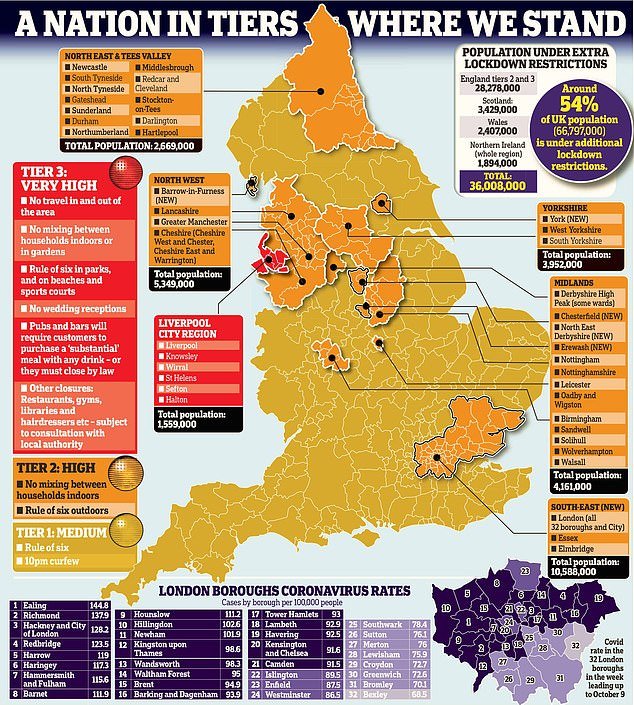
Indeed, the blanket of gruelling curtailments now covers almost half the population — 28 million people.
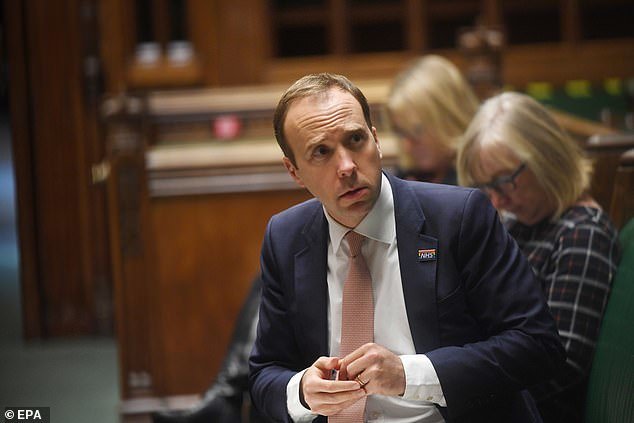
Matt Hancock, who seems to have warmed to administering the handcuffs a touch too eagerly, broke the dispiriting news to the Commons.
In funereal tones, the Health Secretary said he 'hated the fact' the Government was bringing in such severe measures. Then seconds later, he imposed fresh sanctions on an array of towns and cities, including London — the engine room of the economy.
But what exactly do they mean for the man (and woman) in the street?
Under the authoritarian crackdown, it will be illegal in high-risk areas, from tomorrow, for people to socialise in their own homes or visit pubs and restaurants with friends — on pain of huge fines.
Office workers will be urged to stay at home and, if possible, public transport must be studiously avoided.
In the worst Covid hotspots — such as Merseyside — hospitality and leisure businesses, just dusting themselves down after being battered by lockdown, will again be forced to shut. The local economies will be eviscerated.
Even during World War II, as the Luftwaffe bombed our cities, citizens had greater freedom to live their lives.
To be generous, Boris Johnson's three-tier system does avoid a 'circuit breaker' (a euphemism for a crippling and probably interminable national lockdown). For now at least. The Prime Minister, thank goodness, has kept open schools, universities and shops. And people can still attend weddings and funerals (albeit with a small guest list).
No10 insists the rules are simpler. To most people, however, they are a mish-mash of oppressive diktats: Complicated, bewildering, illogical and unfair.
For instance, you're forbidden from meeting your brother or daughter for a drink in a pub (assuming you live in different households), but you can go to the office with scores of strangers. Equally, you can work all day sitting next to someone but can't meet them in a bar afterwards. The incoherence verges on breath-taking.
Yet, even as Mr Johnson seeks to steer us away from the abyss, it appears Mr Hancock, egged on by the Government's one-eyed scientific advisers and zero-infection devotees, is trying to impose a countrywide lockdown by stealth.
With every turn of the Covid screw the country descends further into insanity.
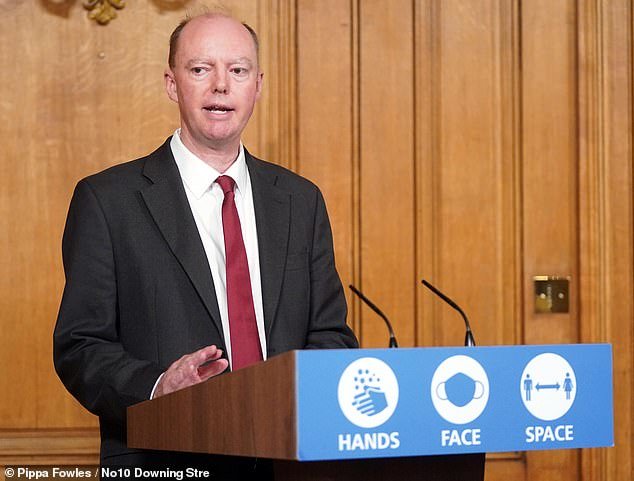
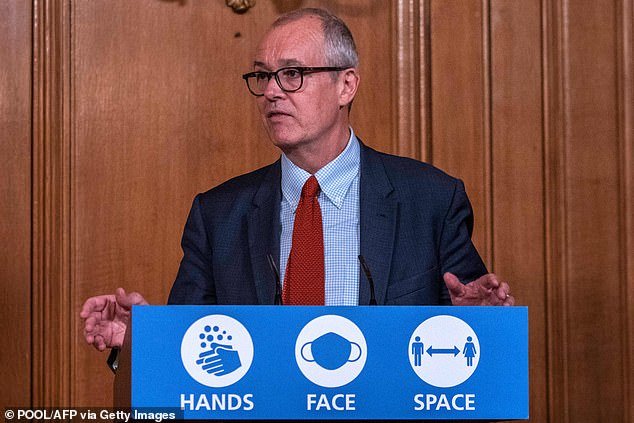
And for what? Yes, there are apocalyptic (and highly dubious) charts and graphs wheeled out by Professor Chris Whitty, the chief medical officer, and Sir Patrick Vallance, the chief scientific adviser, to silence sceptics and frighten the public into compliance.
But where is the conclusive evidence these stringent crackdowns actually work? Answer: There isn't any. Rather, there is growing evidence to the contrary.
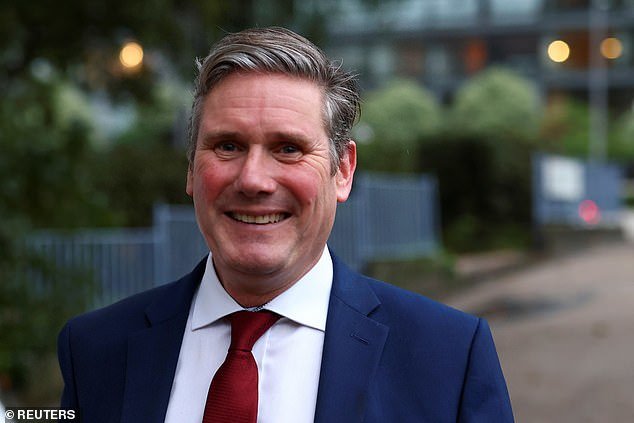
Before Sir Keir Starmer's opportunistic Damascene conversion to the benefits of placing the entire population under house arrest, he had gleefully pointed out that 19 of 20 northern towns subjected to local restrictions had seen infections soar.
Little wonder, then, that northern mayors are in open rebellion at the threat of a mini-lockdown. Clearly, the more belligerent among them are playing political games to squeeze more cash from the Treasury. Yet they offer little by way of an alternative strategy.
And by suggesting Government measures are unfair, they are encouraging their people to flout all Covid rules.
But they do have a point.
Even the full lockdown couldn't eradicate coronavirus. Why should a partial one be any more effective?
Indeed, a damning study by eminent academics — commissioned by the Government, no less — has found that they simply don't work. Severe restrictions may actually increase the death toll by prolonging the pandemic.
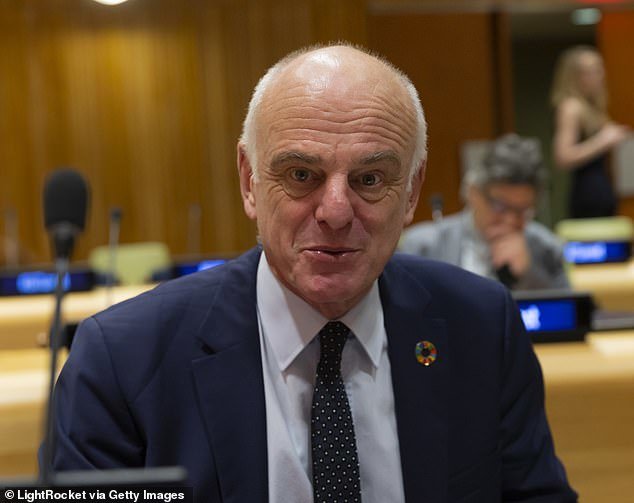
Listen, too, to Dr David Nabarro, of the World Health Organisation. 'Lockdowns,' he says, 'just have one consequence that you must never ever belittle, and that is making poor people an awful lot poorer.'
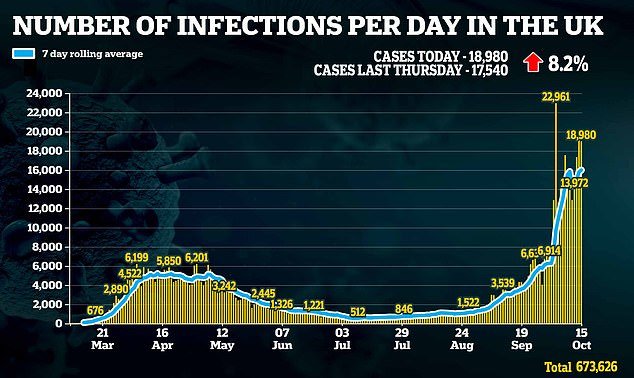
True, there has been an increase in new Covid infections, although nowhere near the 50,000 a day predicted by doom-monger-in-chief Sir Patrick. In reality, the figure is only around a third of that wild guess.
Hospitalisations have climbed — yet in London, a city of 9.3 million people, they are averaging 40 admissions a day.
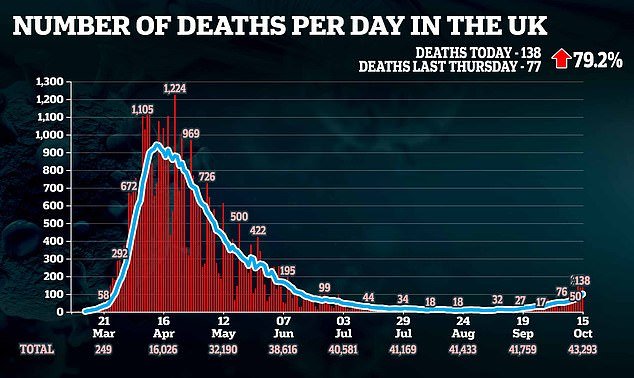
Meanwhile, while deaths from the disease have also risen, they are still one-tenth the number of people who succumbed at the peak of the pandemic.
Of course, only an irresponsible government would ignore health data and wilfully jeopardise its citizens' safety.
But through fear and dogma, ministers risk sacrificing the well-being of the nation on the altar of the battle against the pandemic. By using lockdowns, curfews and restrictions, the Government is strangling our economy and throwing society into turmoil.
Clamping down on millions who will simply shrug off the illness is killing off the embryonic recovery — just as Britain buckles under horrific debt our great-grandchildren will still be repaying.
Businesses are locking their doors for the final time. Countless pubs and restaurants will never take another order. Entire sectors of commercial life, from leisure to the aviation industry, are being wiped out.
With furlough ending this month, a jobs bloodbath looms. By spring, unemployment could top four million — worse than in the 1980s. And that will unleash a tsunami of poverty, homelessness, family breakdown, mental illness — each killing as surely as Covid.
Moreover, the economy is not some abstract concept involving men in bowler hats. Without it, society unravels.
Prosperity ensures roads are repaired, the NHS is there for the sick, the elderly are cared for and that the police can fight crime.
Meanwhile, the monomaniacal focus on the contagion has distorted health priorities, meaning other patients have been discarded.
Incredibly, there were 26 million fewer GP appointments during lockdown. Many stayed away from their doctors for fear of catching coronavirus or burdening the NHS. Others were uncomfortable with telephone- or Skype-only consultations.
It meant those finding abnormal lumps or experiencing chest pains suffered in silence. The grim ledger of death also included countless patients who were lost to cancer, heart disease and other illnesses because of treatment delays or cancelled operations.
And then there are the painful social costs. We now live in a land where grandparents are banned from hugging their grandchildren, civil liberties have been torched and neighbours are encouraged to snitch on each other.
All this damage and for what? Despite the hysteria, the danger from Covid is strictly limited. While every life is precious, the microbe targets the old or those already compromised by ill-health.
The average age of patients who die with the disease is 82 — a year longer than average life expectancy.
For the vast majority, the risks of becoming seriously ill, let alone dying, are small to infinitesimal.
No one seeks to diminish what are individual tragedies. But neither does anyone clamour to bring the country to a grinding halt for flu and pneumonia outbreaks, which kill more during the winter.
For these reasons, Mr Johnson should concentrate on making his three-tier system work.
But the Mail implores the PM: Not a step further! Not only would a full lockdown be ruinous, it would be unfair on areas with low infection rates.
And those Britons living in places enduring tougher restrictions should be told how they can escape the nightmare.
To what level must infections drop? What lowering of hospital admissions or deaths will allow curbs to be eased?
They have not been offered a glimpse of the sunlit uplands.
The PM must also stop clutching at straws: A vaccine, which has not been invented, and mass testing, which thanks to ministerial incompetence has been botched.
We may have to accept the contagion in our midst, like humans have had to do with almost all other infections down the millennia, shield the vulnerable and get on with the business of living.
Oscillating in and out of lockdown, in a grim wave of desperation, deprivation and even more death, would break the country.
In an intervention yesterday, former Whitehall homelessness tsar Dame Louise Casey warned that, post-lockdown, many women would resort to prostitution to buy food for the table and shoes for their children.
Yes, this might be a gross overreaction. But she makes a sound underlying point — and one that ministers would do well to grasp.
When Mr Hancock says piously that imposing economy-destroying restrictions is for our own good, he is blind to a truth: These are much worse than this virus.
Millions are facing mass unemployment. Personal, economic and social misery are going to be widespread.
Unless the Government devises a coherent long-term strategy, Britain will face many cold and bitter winters to come.
The Mail appreciates that tackling Covid is a monumentally difficult task. But more than the disease, we fear this turning into an epidemic of madness.