London Daily

Focus on the big picture.
Sunday, Oct 18, 2026

France orders new lockdown, Germany imposes toughest virus rules in months

France orders new lockdown, Germany imposes toughest virus rules in months

Macron seeks ‘brutal brake on infections’, while Merkel unveils one-month partial shutdown; Spain, Italy, Britain, Greece and Portugal report record new coronavirus cases.

Europe’s leaders imposed harsher pandemic measures as the coronavirus roars back across the continent. Spain, Italy, Britain, Greece and Portugal all reported record numbers of new cases on Wednesday.

French President Emmanuel Macron imposed a new nationwide lockdown for the next month, clamping down on movement as the rapid spread of the coronavirus overwhelms health services.

Meanwhile, German Chancellor Angela Merkel imposed a one-month partial shutdown starting on Monday, the toughest restrictions in the country since the end of a lockdown in the spring.

European leaders have been forced to relent and revive strict curbs, which hammered economies in the second quarter, as contagion rates soar and hospitals come under strain.

WHO chief warns against politicising coronavirus pandemic as world sees highest weekly case number


France’s shutdown of bars, restaurants, non-essential retailers and other activities will start on Friday, and comes less than a week after the country expanded a curfew to about two-thirds of the population in a bid to regain control of the pandemic.

Infections and hospitalisations are rising at such a pace that avoiding tighter measures is no longer possible, according to health care officials.

“The virus is circulating in France at a speed that even the most pessimistic forecast didn’t foresee,” Macron said in an address televised nationally on Wednesday evening. “The measures we’ve taken have turned out to be insufficient to counter a wave that’s affecting all Europe.”

France needs a “brutal brake on infections”, the president said, adding that the country could have 400,000 deaths in months if nothing is done. He said intensive-care facilities will have 9,000 patients – close to capacity – by mid-November, based on current trends.

The French leader opened the prospect of easing some curbs if there is an improvement in two weeks. The goal of the measures is to lower daily cases to 5,000 – a far cry from current rates. French authorities last week reported four consecutive days of record infections, including more than 52,000 on Sunday.

In Germany, strict new rules will see bars and restaurants closed as Europe’s largest economy attempts to regain control of the rapid spread of the coronavirus.

The one-month partial shutdown, which will go into effect on Monday, is designed to keep most businesses operating, Merkel said on Wednesday after tense talks with the leaders of the country’s 16 states. Officials will gather again in two weeks to assess the impact of the measures.

“We don’t want to fall into a national health emergency,” Merkel said at a press conference in Berlin, adding that hospitals could be overwhelmed within weeks if trends continue.

Merkel, who had vowed to avoid a repeat of the curbs that hammered the economy in the second quarter, had struggled to forge a consensus in recent weeks, and political tensions were high before the meeting, which was moved forward by two days in a sign of increased urgency.
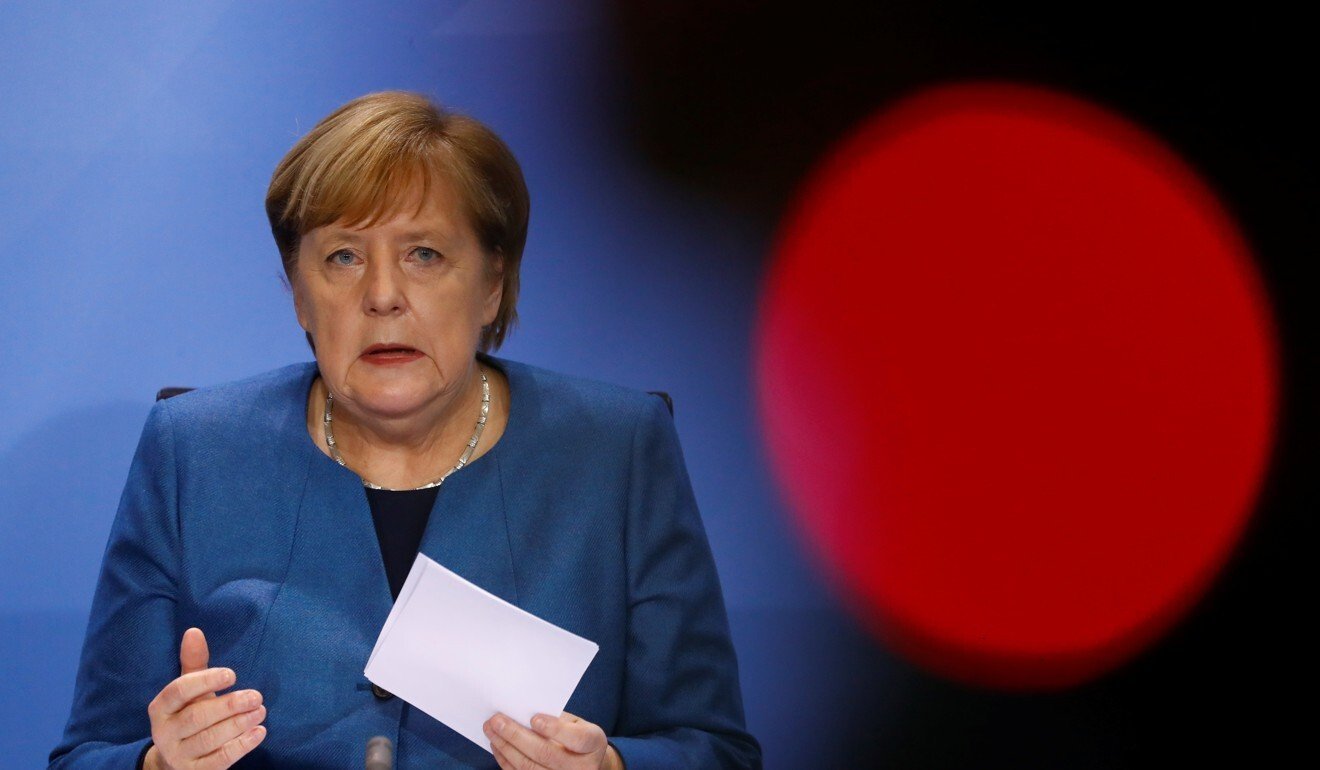

German Chancellor Angela Merkel speaks during a news conference at the Chancellery in Berlin on Wednesday.


With the public weary of pandemic measures and protests increasing, the government sought to ease pressure by making up to €10 billion (US$11.7 billion) in aid available for companies affected by the measures, including reimbursing as much as 75 per cent of lost sales.

The latest steps are less severe than the spring lockdown. Many shops will be able to stay open along with schools and company cafeterias. Germany’s professional soccer league will be able to play games, but fans will not be allowed in stadiums.

Elsewhere in Europe, Spain said 9,303 new coronavirus cases were detected over the past day, the highest number registered during the course of the pandemic. The number of deaths in the past seven days rose to 761, compared with 746 reported on Tuesday, the Spanish health ministry said on its website.

Greece reported 1,547 new coronavirus cases on Wednesday, the highest daily increase since the beginning of the pandemic and a second straight record day bringing the total to 34,229. The country recorded 10 more deaths from the virus in the past 24 hours, with the total number of dead now at 603.

Italy’s new coronavirus cases jumped 14 per cent on Wednesday to a record 24,991 as hospitalisations climbed to the highest since early May. There were 205 fatalities linked to Covid-19, while hospitalised patients rose by 1,151 to 16,517.

Portugal reported its biggest daily increase in confirmed virus cases since the start of the outbreak. There were 3,960 new cases in a day, more than the previous record of 3,669 reported on Saturday, taking the total to 128,392.

Newsletter

Related Articles

0:00
0:00
Close
Competition and Markets Authority Launches Formal Inquiry Into Corporate Artificial Intelligence Partnerships
Automotive Industry Leaders Urge Westminster to Accelerate Electric Vehicle Charging Infrastructure Rollout
Home Office Expands Digital Border Security Framework With Mandatory Electronic Travel Authorizations Across United Kingdom
Northern Ireland Executive Reaches Final Consensus on Public Sector Pay Reform and Budget Allocations
Welsh First Minister Secures Additional Funding for Rural Agricultural Transition and Sustainable Farming Schemes
Scottish Government Unveils Accelerated Regional Infrastructure Strategy to Boost Clean Energy Manufacturing
National Health Service England Launches Emergency Recruitment Drive to Alleviate Severe Acute Care Winter Backlogs
Bank of England Monetary Policy Committee Signals Cautious Approach to Interest Rate Reductions Amid Persistent Wage Growth
British Government Finalizes Emergency Energy Support Package to Protect Households From Winter Price Surges
Russell Brand Trial Begins at Southwark Crown Court
UK Parliament to Debate Climate Risks and Council Tax Following Public Petitions
Department for Transport Demands Safety Audits Following Regional Rail Disruptions
House of Lords Scrutinizes Amendments to Armed Forces Bill
Devolved Administrations in Scotland and Wales Criticize Post-Brexit Funding Framework
Prime Minister Andy Burnham Defends Middle East Military Support Under Parliamentary Scrutiny
NHS Leaders Warn of Severe Pressure on Hospitals from Winter Virus Outbreaks
Retailers and Business Groups Lobby Chancellor for Relief from Rising Employment Taxes
City of London Taskforce Urges Radical Reform to Prevent UK From Becoming "Incubator Nation"
Bank of England Officials Signal Potential November Interest Rate Hike
Institute for Fiscal Studies Warns of £35 Billion Funding Gap in Upcoming Autumn Budget
IMF Upgrades UK Growth Forecast to 1.3% for 2026
Former UUP leader Jeffrey Donaldson sentenced to 15 years in prison for historical child sex offences
UK ministers adopt independent commission blueprint to fast-track AI in the NHS
Labour leadership orders local councillors to end power-sharing deals with Green Party
UK government considers regulatory intervention in proposed Sky and ITV merger
Environment Agency declares severe drought across six English regions as reservoirs hit critical lows
NHS England issues new guidance prohibiting transgender women from female-only wards
Norwegian teenager sentenced to 20 years for part of Iran-backed assassination plot in Britain
UK government threatens complete visa ban on Eritrea over refusal to accept deportees
UK Treasury lobbies UBS to move global headquarters to London amid banking sector tax threats
MI5 Warns of Growing Russian Sabotage and Espionage Threats Across Britain
UK Prime Minister Andy Burnham Plans Brussels Talks to Renegotiate Post-Brexit Trade Deal
MI5 Warns of Rising Russian and Iranian Sabotage Threats to British Military Facilities
UK Prime Minister Andy Burnham Pledges Closer EU Ties as MI5 Reveals Russian Brexit Interference
UK Orders Security Review Following Reported Killing of Former Politician Ann Widdecombe
UK Prime Minister Andy Burnham Meets German Chancellor Merz to Strengthen European Security Ties
Nearly 100,000 NHS Patients Treated in Hospital Corridors as England Braces for Winter Pressures
UK Government Rejects US-Russia Diesel Agreement and Reaffirms Sanctions Against Moscow
UK and Germany Agree to Deepen Security and Economic Cooperation Following Berlin Talks
British Prime Minister Burnham Pledges Closer EU Ties During Visit to Germany
UK Announces New Sanctions on 17 Russia-Linked Entities During Foreign Secretary's Ukraine Visit
UK and Germany Finalize Kensington Treaty to Strengthen Defense and Technology Cooperation
Britain Maintains Diplomatic Mission in East Jerusalem Despite Israeli Closure Deadline
English Councils Push Government to Rethink Proposed Funding Cuts
Scottish Homebuilding Falls to Lowest Level in 11 Years
BBC Chief Matt Brittin Defends Restructuring as Staff Challenge Job Cuts
UK Finance Warns High Energy Costs and Bond Yields Are Complicating Fiscal Outlook
UK Adopts All 44 Recommendations on Regulating AI in Healthcare
Chancellor John Healey Prepares Autumn Budget as Borrowing Costs Strain Public Finances
UK Investigators See Strong Indications of Iranian Link After RAF Fairford Security Operation
×