

France fiasco to pingdemic U-turn: Boris Johnson’s week of chaos
Often, the political week heading into the Commons summer recess can feel almost soporific, with the thoughts of ministers and MPs geared more towards holiday sunbeds than rows. But the last seven days has been different, and not only because of the ongoing political flux of coronavirus, with the government seeming to flail from one controversy, U-turn or misstep to the next, day after day.
Friday evening: France goes amber-plus
The reports began earlier in the week: France, which in a normal years attracts 10 million-plus UK visitors, was to be put on Britain’s red list, in effect banning almost all travel, because of concern about the spread of the potentially vaccine-resistant Beta variant. Eventually, late on Friday, it was announced that although France would stay on the amber list, double-vaccinated Britons returning from there would still have to quarantine for 10 days, unlike the new, relaxed policy for other amber destinations. Cue: anger from holidaymakers and some Conservative MPs – and polite bafflement from France itself.
Sunday: to self-isolate or not?
On Saturday, the health secretary, Sajid Javid, announced he had tested positive for Covid, a day after being pictured leaving meetings at Downing Street. Sure enough, Boris Johnson and Rishi Sunak, the chancellor, were – like hundreds of thousands of Britons this week – “pinged” as close contacts. But on Sunday morning, a No 10 statement announced that Johnson and Sunak would avoid the usual 10 days of self isolation as they were taking part in a pilot scheme allowing them to carry on with “essential government business” while having daily tests. Three hours later, amid growing anger, the decision was reversed.
Monday: ‘freedom day’ – and Covid passports
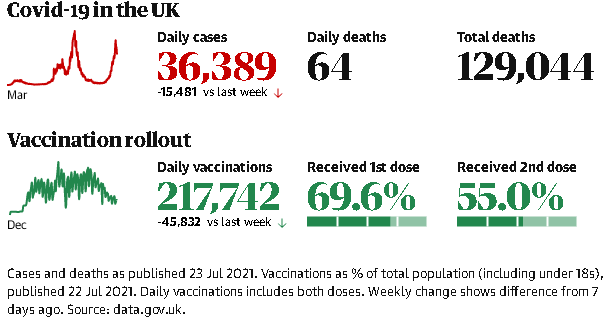
This was meant to be the day when Johnson could bask in the reflected glow of a largely reopened economy – “freedom day”. But with daily detected Covid infections at about 50,000 and ministers spooked at footage showing maskless crowds piling into nightclubs at the stroke of midnight, Johnson’s Downing Street press conference contained a surprise. From the end of September, all people entering nightclubs or similarly crowded venues would have to prove their double-vaccinated status. Not even a negative Covid test would do. The response from many Tory MPs was furious, and it remains uncertain whether Johnson could win a Commons vote on the issue.
Monday evening: national insurance rises for social care
After promising two years ago he had a plan for social care, Johnson had been under pressure to produce one before the recess. And so a starting point was carefully proposed – a rise in national insurance contributions to fund the system. But amid a pushback from Tory MPs mindful of Johnson’s election manifesto promise to not raise taxes, plus concern that NI rises predominantly affect younger people, and the knock-on confusion of the prime minister, health secretary and chancellor all being in self-isolation, the decision was rapidly kicked into the autumn.
Tuesday: no Covid checks on arrivals
After all the political fuss about France, it emerged that for arrivals from other amber list countries, and those on the green list, border force staff are no longer required even to make basic checks, for example to see if travellers have, as required, booked a Covid test or filled out a passenger locator form, a plan intended to reduce queues in busy periods.
Wednesday: rewrite the Northern Ireland protocol
As well as angering a reasonable number of his own MPs, Johnson’s political week also notably failed to endear him to the EU. In a much-anticipated statement, his Brexit minister, David Frost, announced a diplomatically audacious plan involving the rewriting of a central plank of the Brexit deal, the Northern Ireland protocol, saying the agreement he and Johnson had signed up to was unsustainable. The EU immediately rejected renegotiation, although some tweaks to border arrangements could be possible.
Wednesday afternoon: NHS pay deal (not) announced
Perhaps the most chaotic single moment of a politically confusing week came on Wednesday afternoon, when the junior health minister Helen Whately stood up in the Commons to make a statement widely presumed to announce a 3% pay deal for NHS staff in England, only to mysteriously not mention it. Amid bafflement and anger from Labour and NHS unions, the plan was then announced later that day, but not in the Commons. While it represented an increase on the initial 1% proposal, health unions said they would consider strike action.
Thursday: slight pingdemic U-turn
Having started the week insisting there would be no relaxing of self-isolation rules for double-vaccinated people before 16 August, but faced with 600,000-plus “pings” in the week, and pictures of empty supermarket shelves owing to staff shortages, late on Thursday a list was produced of “critical workers” who would immediately be allowed to avoid self-isolation. After frantic talks with industry leaders and open dissent from some Conservatives, workers from 16 key sectors, including health, transport and energy and food and drink supply – but not supermarket retail staff – were included.