

Enough Covid-19 vaccines to cover all Hongkongers as third deal struck
Key points:
• City has secured 7.5 million shots of vaccine from AstraZeneca, to be available middle of next year
• De facto cabinet passes emergency law to allow use of the new vaccines, while residents can choose among the options
• Government sets up an indemnity fund to offer financial assistance to residents who suffer from rare and unforeseen complications after receiving shot
• Arrivals from Britain must quarantine for 21 days at hotel after two travellers found to have new variant of coronavirus
Hong Kong will have more than enough Covid-19 vaccine for the entire population after a deal was struck with a third manufacturer that took the total supply to 22.5 million shots, the city’s leader has revealed as she dismissed speculation Beijing was dissatisfied with local authorities’ fight against the outbreak.
Appealing to all residents to get vaccinated, Chief Executive Carrie Lam Cheng Yuet-ngor also said an indemnity fund would be set up to provide financial help to those who suffered from “rare and unforeseen” complications. A new expert panel has also been established to vet the quality of the vaccines. Lam said residents would be allowed to choose which shots they wanted, suggesting a changed stance from her remarks last week.
But in a worrying development, two students who had recently returned to Hong Kong from Britain were confirmed as having been infected with the new variant of the coronavirus spreading rapidly across England. Beginning on Thursday, all arrivals from the country must spend 21 days in quarantine at a designated hotel, as opposed to the current arrangement allowing them to isolate for the third week at home.
Lam said that the new deal with manufacturer AstraZeneca, headquartered in Britain, would provide the city with another 7.5 million shots, building up a supply that will cover all 7.51 million residents.
“We have already procured 22.5 million doses, enough for the whole population of Hong Kong,” Lam said after a special meeting with members of her de facto cabinet, the Executive Council. “We are now looking for a fourth batch, so the total amount of doses will be equivalent to twice [what is needed for] the population.”
The government earlier secured 15 million shots of vaccine manufactured in mainland China and Europe, with the first batch expected to be available next month for high-risk groups under a free and voluntary scheme first targeting residents aged 60 or above, medical workers and people living and working in elderly care homes.
The first 7.5 million doses, from mainland supplier Sinovac Biotech, is expected to arrive next month. The second vaccine was co-developed by Germany’s BioNTech and US-based Pfizer, and secured via mainland firm Fosun Pharma. The AstraZeneca vaccine, jointly developed with the University of Oxford, is expected to arrive by the middle of next year.
Each person will need two shots of any of the vaccines to ensure they are effective, according to current clinical data.
Critics have expressed concerns over procuring vaccines linked to the mainland, but Lam warned against politicising the issue.
“Let’s don’t try to politicise what is a scientific issue for the good of Hong Kong,” she said. “It’s very difficult to set a target [on how many will get vaccinated]. If you ask me, we want everybody to get vaccinated, so it’s not just to protect yourself, but also your family members and also protecting Hong Kong society at large.”
Exco in the morning passed an emergency law to empower the government to circumvent the normal registration process for new medicines to get the shots to residents more quickly. The law, which is valid for one year, allows the secretary for food and health to approve the use of vaccines based on the assessment of the expert panel and approval of a drug regulatory body.
Professor Lau Chak-sing, former president of the Hong Kong Academy of Medicine, will be the convenor of the new panel consisting of 11 other members. A new task force has also been established to distribute the vaccines and is headed by health chief Professor Sophia Chan Siu-chee and civil service minister Patrick Nip Tak-kuen.
Lam said that while vaccine manufacturers would be exempted from certain liabilities, the protections would not be absolute.
“If vaccine manufacturers were involved in serious negligence, fraud or intended inappropriate behaviour, their liabilities could not be exempted and they need to take responsibility,” she said.
The indemnity fund will provide economic support to people who developed rare or unforeseen serious consequences after inoculation. The arrangement was still being planned and details would be released later, Lam said. Residents could sign up for their shots via a platform coming online soon, she added.
In a bid to clarify her earlier remarks over whether people could pick their manufacturer, Lam said different vaccines would arrive at separate times, and residents could wait for the next round of supply. She assured that all the vaccines were safe.
“These vaccines have undergone stringent clinical trials,” she said. “Our experts will also assess the data to ensure the safety, therefore the public does not need to be overly worried. The benefit of vaccination is far more than the risks.”
Chinese University Professor David Hui Shu-cheong, a member of the government’s task force on its pandemic response, said each resident must get two shots of the same vaccine. Only when 70 per cent of the population had antibodies would herd immunity be achieved and help contain the spread of the virus, Hui said. Overseas experience has shown that only one in a million people who were inoculated developed complications, he noted.
“While the vaccines cannot protect 100 per cent, it can lower the death rate and the chance of having other complications,” Hui said.
A new system will be set up to track the development of any complications and the government will also monitor how long the immunity offered by the vaccine will last.
Dr Thomas Tsang Ho-fai, formerly a senior health official and now a member of the vaccine distribution task force, said that even if 70 per cent of the population was vaccinated, social-distancing measures would need to remain in place to keep the pandemic under control.
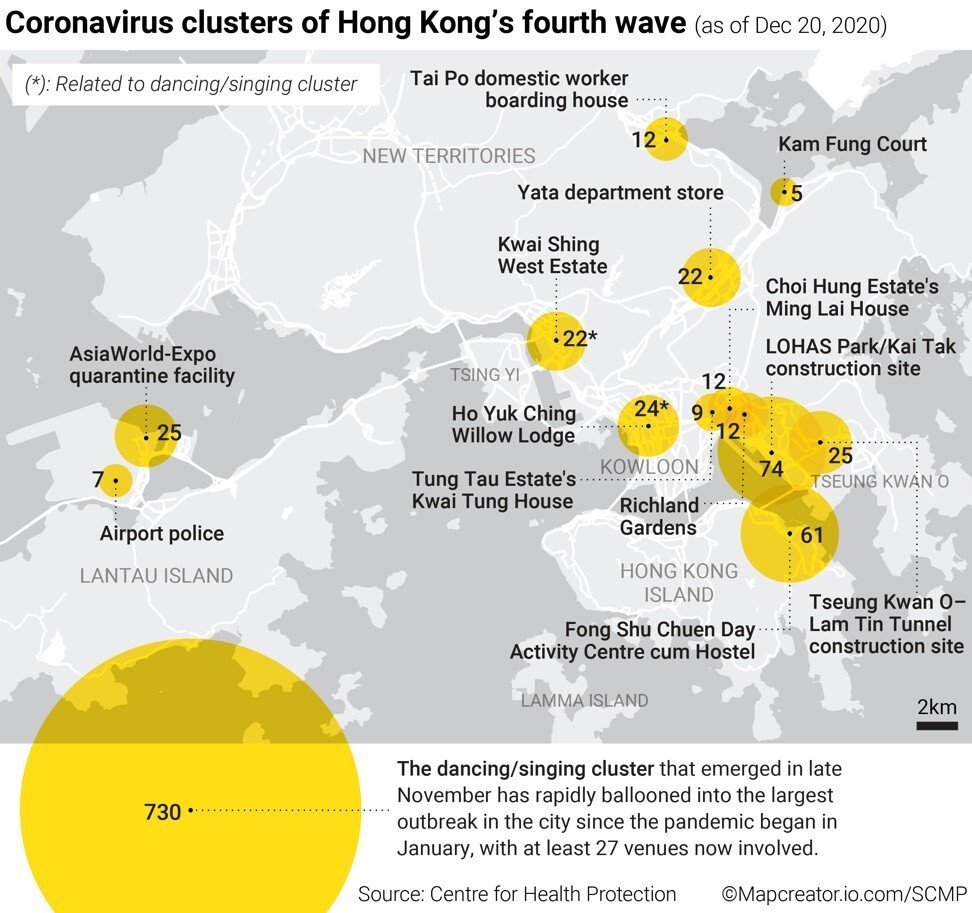
The city reported 53 new Covid-19 cases on Wednesday, taking the total to 8,353. The government has come under mounting pressure from Beijing and pro-establishment politicians to introduce compulsory testing to achieve zero infections, which Hong Kong ministers discussed with their counterparts in Shenzhen on Tuesday.
China’s National Health Commission said ministers and experts had exchanged with city officials ideas about virus testing, infection control and the prevention of imported cases.
“Leaders of the central government care deeply about Hong Kong people’s safety and health, and are also highly concerned about Hong Kong’s pandemic situation and infection-control measures,”commission vice-minister Lei Haichao said.
Asked whether Beijing was dissatisfied with Hong Kong’s fight against the outbreak, Lam said the meeting with mainland officials was a continuation of Beijing’s “strong degree of support” for the city.
“If you say the central government is concerned, of course they are concerned. I am concerned and all of us sitting here are concerned,” she said. “I can guarantee you it is not a meeting to give us instructions … I have already said in the policy address that we strive to achieve zero infections and we are doing it now.”
She urged residents to avoid gatherings during Christmas and stay at home.