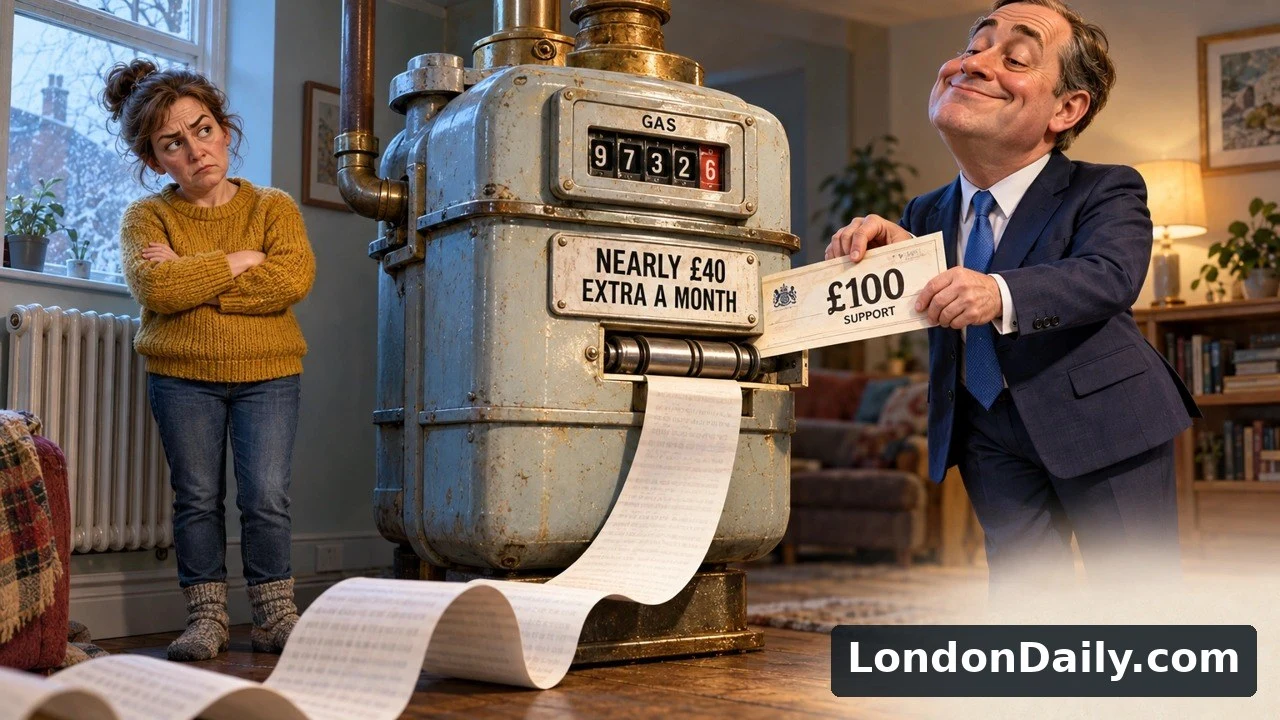
Energy bills in Britain are set to rise by an average of nearly £40 a month in January, an increase that would absorb the government’s £100 household payment within a few months. Further rises are expected in April.
The pressure predates the latest increase. A survey last month suggested that 1.7 million households, or 6 per cent of the total, planned not to switch on their heating at all this winter to save money.
The payment, announced in the Budget by Chancellor John Healey, is due in January for households in England in council tax bands A to D, covering four-fifths of households. It offers immediate assistance without reducing the underlying price of energy. Council tax bands also provide an imperfect measure of need: low-income households can live in band E properties, while wealthy households can occupy homes in band D.
High gas prices, driven by wars in Ukraine and Iran, leave British politicians with limited influence over the immediate international pressures. The longer-term dispute concerns how quickly Britain should replace its reliance on fossil fuels with renewable and nuclear power, and who should meet the transition costs.
Conservative and Reform politicians argue that abandoning the drive to net zero could bring rapid reductions in bills. Kemi Badenoch’s opposition to the policy marks a departure from the Conservative commitment to the 2050 target, legislated for under Theresa May and strongly supported by Boris Johnson. Johnson had previously mocked wind turbines as unable to “pull the skin off a rice pudding”.
The strongest practical argument for adjusting the transition’s pace concerns the order of investment: wind farms need cables connecting them to the national grid before their electricity can be used. Transition costs are also harder for consumers to bear when gas prices are already high. Abandoning low-carbon alternatives, however, would leave consumers exposed to volatile fossil-fuel prices.
Labour’s case is that domestic clean power can reduce that exposure. Energy Secretary Miatta Fahnbulleh said bringing bills down permanently meant “more cheap, clean, homegrown power so we’re less reliant on expensive fossil fuels, and reforming our broken energy system so it’s fairer for British people”.
That describes a longer-term programme, not an immediate substitute for January’s support. Renewable and nuclear capacity takes time and substantial investment to build. The unresolved issue is how households are helped through that interval, when a one-off payment runs out but higher bills continue.








Join the conversation