London Daily

Focus on the big picture.
Saturday, Jul 18, 2026

Elon Musk, Jeff Bezos, Other Top Billionaires Lose $1.4 Trillion In Worst Half Ever

Elon Musk, Jeff Bezos, Other Top Billionaires Lose $1.4 Trillion In Worst Half Ever

With policy makers now raising interest rates to combat elevated inflation, some of the highest-flying shares -- and the billionaires who own them -- are losing altitude fast.

Elon Musk's fortune plunged almost $62 billion. Jeff Bezos saw his wealth tumble by about $63 billion. Mark Zuckerberg's net worth was slashed by more than half.

All told, the world's 500 richest people lost $1.4 trillion in the first half of 2022, a dizzying decline that marks the steepest six-month drop ever for the global billionaire class.

It's a sharp departure from the previous two years, when the fortunes of the ultra-rich swelled as governments and central banks unleashed unprecedented stimulus measures in the wake of the 1Covid1-19 pandemic, juicing the value of everything from tech companies to cryptocurrencies.
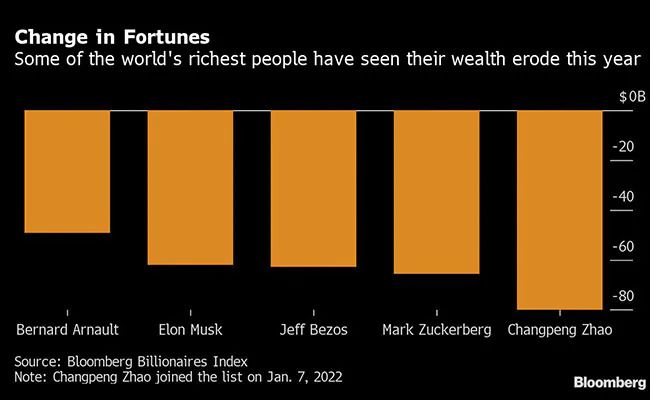

With policy makers now raising interest rates to combat elevated inflation, some of the highest-flying shares -- and the billionaires who own them -- are losing altitude fast. Tesla Inc. had its worst quarter ever in the three months through June, while Amazon.com Inc. plummeted by the most since the dot-com bubble burst.

Though the losses are piling up for the world's richest people, it only represents a modest move toward narrowing wealth inequality. Musk, Tesla's co-founder, still has the biggest fortune on the planet, at $208.5 billion, while Amazon's Bezos is second with a $129.6 billion net worth, according to the Bloomberg Billionaires Index.

Bernard Arnault, France's richest person, ranks third with a $128.7 billion fortune, followed by Bill Gates with $114.8 billion, according to the Bloomberg index. They're the only four that are worth more than $100 billion -- at the start of the year, 10 people worldwide exceeded that amount, including Zuckerberg, who is now 17th on the wealth list with $60 billion.

Changpeng Zhao, the crypto pioneer who debuted on the Bloomberg Billionaires Index in January with an estimated fortune of $96 billion, has seen his wealth tumble by almost $80 billion this year amid the turmoil in digital assets.

Contrarian Impulse
Still, the billionaire class has amassed so much wealth in recent years that not only can the vast majority withstand the worst first half since 1970 for the S&P 500 Index, but they're likely looking for bargains, said Thorne Perkin, president of Papamarkou Wellner Asset Management.

"Often their mindset is a bit more contrarian," Perkin said. "A lot of our clients look for opportunities when there's trouble in the streets."

That held true in the first half of the year in some of the most distressed corners of the global financial markets.

Vladimir Potanin, Russia's wealthiest man with a $35.2 billion fortune, acquired Societe Generale SA's entire position in Rosbank PJSC earlier this year amid the fallout from Vladimir Putin's invasion of Ukraine. He also bought out sanctioned Russian mogul Oleg Tinkov's stake in a digital bank for a fraction of what it was once worth.

Sam Bankman-Fried, chief executive officer of crypto exchange FTX, bought a 7.6% stake in Robinhood Markets Inc. in early May after the app-based brokerage's share price tumbled 77% from its hotly anticipated initial public offering last July. The 30-year-old billionaire has also been acting as a lender of last resort for some troubled crypto companies.

The most high-profile buyout of all belonged to Musk, who reached a $44 billion deal to buy Twitter Inc. He offered to pay $54.20 a share; the social-media company's stock traded at $37.44 at 10:25 a.m. in New York.

The world's richest man said in an interview with Bloomberg News Editor-in-Chief John Micklethwait last month that there are "a few unresolved matters" before the transaction can be completed.

"There's a limit to what I can say publicly," he said. "It is somewhat of a sensitive matter."

Newsletter

Related Articles

0:00
0:00
Close
Ukrainian Drone Barrage Kills Eight and Strikes Russian Logistics Network
Key Trends to Watch
Financial Conduct Authority Warns Cloud and Digital Risks Are Becoming a Financial Priority
Jeffrey Donaldson Appeals Sexual Abuse Conviction as Democratic Unionist Party Opens Review
Welsh Health Authorities Launch Emergency Meningitis Vaccination Programme for Students
Scottish Business Activity Falls for Third Month as Companies Face Rising Costs
Bank of England Regulators Demand Better Access to Digital Banking Services
United Kingdom Cuts Bilateral Aid to Several African Countries by Up to Ninety Per Cent
United Kingdom Introduces Tougher Deportation Rules After Rochdale Exploitation Scandal
NHS England Launches Wearable Technology Plan to Reduce Sepsis Deaths
Amazon Web Services Billing Error Sends Trillion-Dollar Invoices to British Companies
Bank of England Takes Direct Regulatory Role Over Major Global Cloud Providers
Extreme Summer Heat Drives Record Fire Risk and Rising Deaths Across Britain
United Kingdom Nationalisation of British Steel Sparks Diplomatic Dispute With China
United Kingdom Economy Shows Weak Growth Ahead of Major Autumn Budget
Andy Burnham Set to Become United Kingdom Prime Minister After Labour Leadership Victory
The Ten World Cup Finals That Defined Football History
Smartphones Are Getting More Expensive, Sales Are Collapsing, and Even Apple Admits: "Prices Will Rise"
The Monaco Bombing Has Become a Test of Ukraine’s Intelligence Accountability
Leadership Change and Strategic Rivalry Redraw the Political Map
Energy Risk, Uneven Growth and the New Geography of Global Capital
The AI Race Enters Its Infrastructure Era
Security and resilience remain long-term national priorities
Britain balances growth ambitions with public finance pressures
Regional devolution becomes a defining theme of the next Labour era
Industrial strategy returns to the centre of British economic policy
Political Instability Remains a Challenge for UK Investment Confidence
Brexit Economic Debate Continues as Public Concerns Over Long-Term Impact Remain
UK Climate Risks Rise as Met Office Warns Extreme Weather Is Becoming More Common
Housing Shortages and Regional Inequality Become Key Priorities Under Incoming Labour Leadership
National Health Service Reform Remains One of Britain’s Biggest Political Challenges
Bank of England Remains at Centre of UK Economic Debate Over Inflation and Growth
UK Economy Shows Recovery Signs but Households and Businesses Remain Under Pressure
Britain Deepens European Defence Cooperation as NATO Allies Seek Stronger Security Capabilities
United Kingdom Expands Sanctions Against Russian Cyber Networks Over Security Threats
UK Industrial Strategy Faces Test After Government Takes Control of British Steel
British Businesses Seek Policy Clarity as Andy Burnham Prepares to Lead Labour Government
Andy Burnham’s Labour Leadership Signals Major Shift Toward Regional Power and Devolution
British Steel Nationalisation Creates New UK-China Tensions Over Control of Strategic Industry
For 36 Years, He Scammed About 300 Luxury Hotels — Until He Was Caught
England's World Cup Exit Expected to Cost Hospitality and Retail £334 Million
Former ICC Prosecutor Aide Speaks Publicly About Allegations Against Karim Khan
Opposition Raises Questions Over June Heatwave Power Grid Pressures
Mastercard Explores Sale of Majority Stake in UK Payments Operator Vocalink
Boeing Forecasts Global Commercial Aircraft Fleet Will Double by 2045
London GP Surgeries Receive £18 Million to Expand Primary Care Capacity
Health Advisers Recommend Nationwide Meningitis B Vaccination for Teenagers
OECD Warns UK Economy Faces Slower Growth and Weak Productivity
Treasury Places Major Global Cloud Providers Under Direct Financial Oversight
Financial Markets Rally as Shabana Mahmood Emerges as Leading Treasury Candidate
×
