AI Isn’t Stealing Your Job. It’s Dismantling It Piece by Piece.
It is a compelling story.
It is also, at least for now, the wrong story.
What is actually happening inside corporations is quieter, colder, and arguably more dangerous.
AI is not replacing most workers outright.
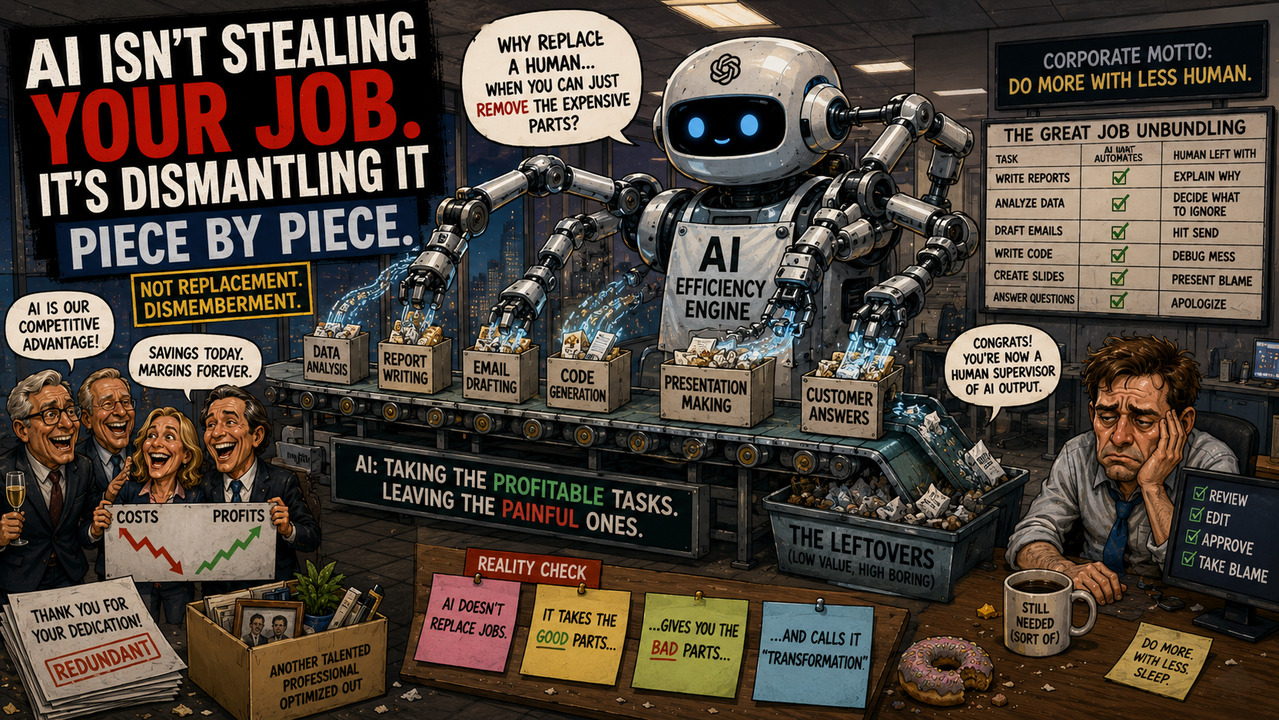
It is dissecting their jobs into components, automating the profitable fragments, and leaving humans to manage the leftovers.
And in many industries, that process has already begun.
The Great Corporate Unbundling of Human Work
The fantasy of full automation was always exaggerated. Most modern jobs are not singular tasks. They are bundles of responsibilities, improvisations, judgment calls, social negotiations, institutional memory, emotional intelligence, and bureaucratic survival.
A lawyer does not simply “write contracts.”
A software engineer does not merely “write code.”
A marketing executive does not only “make presentations.”
Jobs are ecosystems of micro-decisions.
Current AI systems are surprisingly powerful at handling narrow slices of those ecosystems — drafting emails, summarizing documents, generating code snippets, producing reports, analyzing spreadsheets, creating slide decks, reviewing data patterns, answering repetitive customer questions.
But they remain deeply unreliable at context, accountability, long-term strategic thinking, political nuance, and complex human coordination.
So corporations discovered something important:
They do not need AI to replace entire employees to dramatically reduce labor costs.
They only need it to eliminate enough tasks.
The Death of the “Complete Job”
This is the real revolution underway in offices across the world.
Companies are no longer asking:
“Can AI replace this employee?”
They are asking:
“Which parts of this employee are expensive?”
That subtle shift changes everything.
Consulting giant McKinsey & Company estimates that current AI systems are technically capable of automating large portions of many knowledge-worker activities. But automation is scattered unevenly across roles, which means companies are redesigning jobs rather than deleting them outright.
The result is corporate fragmentation.
One worker who previously handled five categories of work may now only handle two. Another employee absorbs the remaining tasks. Smaller teams suddenly produce the same output.
Not because AI became a magical employee.
Because AI became a productivity multiplier.
And productivity multipliers historically do not eliminate work immediately.
They eliminate headcount gradually.
That is exactly what is now happening across technology, finance, consulting, media, customer service, and software development.
AI Is Becoming the Ultimate Corporate Excuse
There is another uncomfortable truth hiding beneath the headlines:
Many companies are using AI not only as a tool — but as a narrative.
“AI efficiency” has become the perfect justification for layoffs investors already wanted.
When executives announce workforce reductions, AI now functions as a futuristic shield against criticism. It sounds visionary. Strategic. Inevitable.
But beneath the polished language often lies a more traditional motive:
Cut costs. Increase margins. Please shareholders.
Thousands of layoffs across the tech sector are now being publicly linked to AI-driven productivity gains. Companies claim smaller teams can achieve the same output thanks to automation tools.
Sometimes that is true.
Sometimes AI genuinely accelerates work dramatically.
But in many cases, AI is also becoming the corporate equivalent of a buzzword-powered restructuring strategy — a sleek new wrapper around an old business instinct: doing more with fewer people.
And investors love it.
The Software Engineer Myth Is Collapsing
No profession symbolizes the AI era more than software engineering.
For years, coding was treated almost like a protected elite skill — the sacred language of the digital economy. Children were told to “learn to code” as if programming itself guaranteed economic survival.
Now AI writes astonishing amounts of code in seconds.
That has triggered panic.
But even here, the reality is more complicated.
Modern software engineering is not simply typing syntax into a terminal. It involves architecture decisions, debugging, infrastructure design, cybersecurity considerations, product strategy, team coordination, code review, compliance, scalability, and understanding business goals.
AI can generate code.
It still struggles to truly understand systems.
Yet the profession is changing anyway.
Increasingly, engineers are becoming supervisors of AI-generated output rather than pure creators of code. The value is shifting away from manual production and toward judgment.
The engineer of the future may spend less time writing functions and more time evaluating machine-generated solutions, orchestrating workflows, identifying hidden failures, and translating human goals into machine-executable logic.
In other words:
The keyboard is losing value.
Decision-making is gaining value.
Some industry leaders even believe the term “software engineer” itself may eventually disappear, replaced by broader roles centered around “building” products with AI-assisted systems.
That sounds empowering.
But it also means the barrier to entry may fall — and when barriers fall, competition explodes.
The White-Collar Shock Has Finally Arrived
For decades, automation mainly threatened factory workers and routine labor.
AI changes the target.
This time, the disruption is aimed directly at white-collar professionals: analysts, designers, marketers, junior lawyers, recruiters, consultants, accountants, coders, coordinators, assistants, and researchers.
The educated classes long believed themselves insulated from technological displacement.
Now they are discovering that knowledge itself can be partially automated.
Not expertise in its entirety — at least not yet.
But enough expertise to destabilize entire career ladders.
That is the truly destabilizing part.
AI may not eliminate the senior executive immediately.
But it can absolutely weaken the need for junior staff beneath them.
And without junior roles, industries eventually lose the pipeline that creates future experts.
This creates a dangerous long-term possibility:
A hollowed-out professional economy where fewer humans gain the experience necessary to become masters of their fields.
AI’s Real Impact Is Psychological
Perhaps the greatest disruption is not technological at all.
It is emotional.
Workers increasingly feel trapped in an invisible competition against machines that improve every few months. Skills that once took years to master can suddenly feel commoditized overnight.
The anxiety is pervasive:
- If AI can draft reports, what happens to analysts?
- If AI can generate designs, what happens to designers?
- If AI can write code, what happens to developers?
- If AI can summarize law, what happens to junior attorneys?
- If AI can answer customer questions, what happens to support teams?
Even when jobs survive, workers feel diminished.
The role changes from creator to supervisor.
From expert to verifier.
From craftsman to editor.
That psychological downgrade may reshape workplace identity for an entire generation.
The Next Economic Divide Won’t Be Human vs AI
It will be:
Humans who effectively direct AI
vs.
Humans who compete against it directly.
That distinction may define the next decade of economic winners and losers.
Workers who understand systems, strategy, communication, leadership, negotiation, creativity, and cross-disciplinary thinking will likely remain valuable far longer than those whose work consists mainly of repetitive digital execution.
Because AI excels at repetition.
It struggles with ambiguity, trust, politics, ethics, persuasion, accountability, and genuine human connection.
For now.
But even that “for now” carries tension. The models improve relentlessly. Every few months, capabilities that once looked impossible become routine.
The ground keeps moving beneath the workforce.
The Brutal Reality Nobody Wants to Say Out Loud
AI is not arriving like a Hollywood apocalypse.
There will not be one dramatic day when humanity is replaced.
Instead, there will be:
- slightly smaller teams,
- fewer entry-level hires,
- increasing productivity expectations,
- silent automation of repetitive work,
- endless restructuring,
- rising pressure on remaining employees,
- and a slow erosion of what used to require entire departments.
No explosion.
No robot uprising.
Just a gradual corporate recalculation of how few humans are necessary.
And that may ultimately be more disruptive than sudden replacement ever was.
Because societies can react to disasters.
What they struggle to react to is slow transformation disguised as optimization.