London Daily

Focus on the big picture.
Saturday, Jul 18, 2026

Doctors warn Paris ICUs could be overwhelmed by Covid-19 surge

Doctors warn Paris ICUs could be overwhelmed by Covid-19 surge

Dozens of doctors from the Paris public hospital group (AP-HP) warned on Sunday they were preparing to have to triage patients in the next two weeks, amid fears of surging Covid-19 cases in the French capital.

In an op-ed, published in the Journal du Dimanche newspaper, 41 ICU and emergency doctors pointed to a "glaring mismatch between needs and available resources" and warned that "we already know that our capacities will be exceeded" in two weeks time.

"We will be forced to select which patients get access to the ICUs and which do not in order to save as many lives as possible. This triage will involve all patients, Covid and non-Covid, especially regarding access to critical care for adult patients," the op-ed read.

As of Saturday night, there were 1,429 patients in ICU in the Ile-de-France region alone, where Paris is located, according to data published by the French health authority, Santé Publique France. The head of the regional health agency (ARS) for Ile-de-France, Aurélien Rousseau, tweeted last week that it aimed to increase ICU beds in the region to 2,250, to cope with rising infections.

The Parisian doctors wrote in their op-ed they had "never experienced such a situation, even during the worst terrorist attacks in recent years," referring to the November 2015 terror attacks in Paris that killed 130 people and wounded 494.

"All indicators show that the current measures are and will be insufficient to rapidly reverse the alarming curve of contamination," they added, pointing to the government's strategy to curb a third wave of infections.
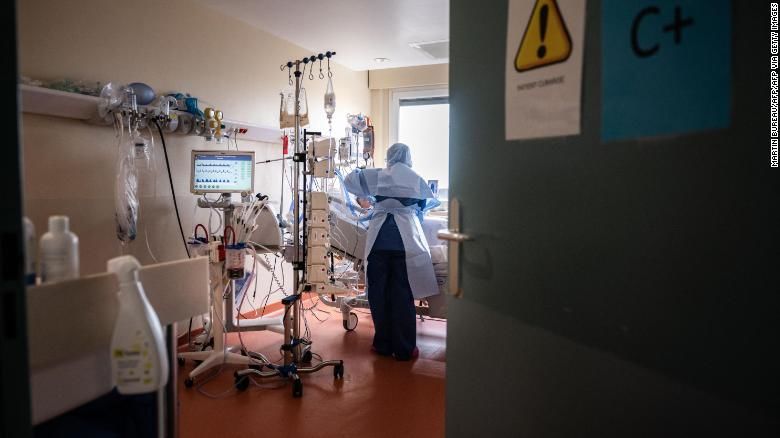
A nurse takes care of a patient suffering from Covid-19 at the intensive care unit of the Centre hospitalier privé de l'Europe in Port-Marly, on March 25, 2021.


France has confirmed more than 4.5 million Covid-19 cases since the start of the pandemic -- the fourth most cases in the world after the US, Brazil, and India. A total of 94,492 people have died in the country so far.

How to contain the virus


France is entering a decisive week. On Saturday evening, there were 4,791 people in ICUs nationally, nearing the peak of the country's second Covid-19 wave, which saw 4,903 people in ICU care on November 16.

French President Emmanuel Macron, who is up for re-election next year, has so far resisted imposing a third nationwide lockdown -- against the advice of his Scientific Council -- citing the potential impact it would have on mental health and on the French economy.

Instead, the government has favored a 7pm curfew, as well as regional "reinforced health restrictions" which allow schools in many areas to remain open, but require non-essential stores to close and limit people's movement to a 10-kilometer radius unless they have compelling business or health reasons to travel further.

Many medical workers have urged the French government in recent weeks to impose stronger national restrictions, in light of the contagious B.1.1.7 coronavirus variant, which was first identified in the United Kingdom and is now dominant in France.

At the end of a tense EU summit on Thursday night, the French president defended his decision not to implement a lockdown at the end of January.

"We didn't have the explosion of cases that every model predicted," Macron said in a press conference. "There won't be a mea culpa from me. I don't have remorse and won't acknowledge failure," he added.

But according to the Parisian doctors' op-ed, current measures aren't enough to contain the virus, and the national vaccination campaign has not advanced enough to "have any significant impact on the evolution of the outbreak in this period."

Macron has said accelerating vaccination is a "national priority," though he has also acknowledged shortfalls in Europe's "ambition" around vaccines in the bloc.

French veterinarians and dentists are now allowed to administer Covid-19 vaccines in the country in order to "speed up the campaign." A total of 7,550,454 people in France (11.2% of its population) have received a first dose of a Covid-19 vaccine as of Sunday, according to government data.


Newsletter

Related Articles

0:00
0:00
Close
Ukrainian Drone Barrage Kills Eight and Strikes Russian Logistics Network
Key Trends to Watch
Financial Conduct Authority Warns Cloud and Digital Risks Are Becoming a Financial Priority
Jeffrey Donaldson Appeals Sexual Abuse Conviction as Democratic Unionist Party Opens Review
Welsh Health Authorities Launch Emergency Meningitis Vaccination Programme for Students
Scottish Business Activity Falls for Third Month as Companies Face Rising Costs
Bank of England Regulators Demand Better Access to Digital Banking Services
United Kingdom Cuts Bilateral Aid to Several African Countries by Up to Ninety Per Cent
United Kingdom Introduces Tougher Deportation Rules After Rochdale Exploitation Scandal
NHS England Launches Wearable Technology Plan to Reduce Sepsis Deaths
Amazon Web Services Billing Error Sends Trillion-Dollar Invoices to British Companies
Bank of England Takes Direct Regulatory Role Over Major Global Cloud Providers
Extreme Summer Heat Drives Record Fire Risk and Rising Deaths Across Britain
United Kingdom Nationalisation of British Steel Sparks Diplomatic Dispute With China
United Kingdom Economy Shows Weak Growth Ahead of Major Autumn Budget
Andy Burnham Set to Become United Kingdom Prime Minister After Labour Leadership Victory
The Ten World Cup Finals That Defined Football History
Smartphones Are Getting More Expensive, Sales Are Collapsing, and Even Apple Admits: "Prices Will Rise"
The Monaco Bombing Has Become a Test of Ukraine’s Intelligence Accountability
Leadership Change and Strategic Rivalry Redraw the Political Map
Energy Risk, Uneven Growth and the New Geography of Global Capital
The AI Race Enters Its Infrastructure Era
Security and resilience remain long-term national priorities
Britain balances growth ambitions with public finance pressures
Regional devolution becomes a defining theme of the next Labour era
Industrial strategy returns to the centre of British economic policy
Political Instability Remains a Challenge for UK Investment Confidence
Brexit Economic Debate Continues as Public Concerns Over Long-Term Impact Remain
UK Climate Risks Rise as Met Office Warns Extreme Weather Is Becoming More Common
Housing Shortages and Regional Inequality Become Key Priorities Under Incoming Labour Leadership
National Health Service Reform Remains One of Britain’s Biggest Political Challenges
Bank of England Remains at Centre of UK Economic Debate Over Inflation and Growth
UK Economy Shows Recovery Signs but Households and Businesses Remain Under Pressure
Britain Deepens European Defence Cooperation as NATO Allies Seek Stronger Security Capabilities
United Kingdom Expands Sanctions Against Russian Cyber Networks Over Security Threats
UK Industrial Strategy Faces Test After Government Takes Control of British Steel
British Businesses Seek Policy Clarity as Andy Burnham Prepares to Lead Labour Government
Andy Burnham’s Labour Leadership Signals Major Shift Toward Regional Power and Devolution
British Steel Nationalisation Creates New UK-China Tensions Over Control of Strategic Industry
For 36 Years, He Scammed About 300 Luxury Hotels — Until He Was Caught
England's World Cup Exit Expected to Cost Hospitality and Retail £334 Million
Former ICC Prosecutor Aide Speaks Publicly About Allegations Against Karim Khan
Opposition Raises Questions Over June Heatwave Power Grid Pressures
Mastercard Explores Sale of Majority Stake in UK Payments Operator Vocalink
Boeing Forecasts Global Commercial Aircraft Fleet Will Double by 2045
London GP Surgeries Receive £18 Million to Expand Primary Care Capacity
Health Advisers Recommend Nationwide Meningitis B Vaccination for Teenagers
OECD Warns UK Economy Faces Slower Growth and Weak Productivity
Treasury Places Major Global Cloud Providers Under Direct Financial Oversight
Financial Markets Rally as Shabana Mahmood Emerges as Leading Treasury Candidate
×