

Crisis after crisis: what is going wrong at the Met police?
Beaming broadly as she faced the Prince of Wales in a gilded chamber at St James’s Palace, Cressida Dick was about to achieve another career high. A police officer of 38 years, she appeared exhilarated last Wednesday when receiving a damehood in recognition of her public service.
But storm clouds routinely follow the chief of Scotland Yard, and for Dick, more than most.
Several hours later, at 4.09pm, her force was pressured into releasing a statement defending its policing at Wembley after waves of ticketless supporters attempted to watch the Euro 2020 final on Sunday night.
At 9.15pm came another Met update, this time naming a 16-year-old boy fatally stabbed in south London, the latest teenage homicide in a spike that is climbing towards a 13-year high.
For seasoned observers of the Met, such daily highs and lows are part and parcel of life as Britain’s most senior police officer. But increasingly, they are noticing something quite new: the extraordinary tenacity of the position’s current incumbent.
As calls for her resignation intensify following a rolling series of scandals including a bungled VIP paedophile ring inquiry, failings surrounding the murder of Sarah Everard and findings that the force is “institutionally corrupt,” the commissioner’s reaction has been to ask for another four-year term.
Few, if any of her predecessors, would survive half of what Dick has endured. Increasingly, one question has become irresistible: how did its embattled chief become so bulletproof?
The answer can be partly found within the vast officers’ mess of the Met’s newish headquarters by the River Thames.
“She’s a good cop, simple as that,” says Ken Marsh of the woman who successfully led Operation Trident, one of the force’s grittiest jobs.
Marsh, chairman of the Metropolitan Police Federation, which represents more than 30,000 officers, believes her leadership style quickly seduced much of the rank and file.
“She’s not a shouter like some of her predecessors. She’s calm and that helps a lot. And she’s got our backs,” says Marsh, a veteran of 32 years service.
Her approach, he said, became evident weeks after becoming commissioner, during the chaos that followed the death of Keith Palmer, an unarmed PC who was stabbed when a terrorist attacked the Palace of Westminster in March 2017.
“We were running around like headless chickens but the first thing she did to me was come over and ask: ‘Ken are you looking after yourself?’ She’s one of the only senior officers who asks me how I am. That approach resonates among all of us,” said Marsh.
Others testify that her survivability might be rooted in her instinct to resist meddling in the affairs of the building 100 metres across the road from her office – the House of Commons.
“She appreciates politics can get very toxic very quickly. She is also not blind to the fact that some of her predecessors were badly burnt by failing to recognise that,” said a Whitehall source.
Another reason for Dick’s ability to fight fire is her relationship with the home secretary Priti Patel, herself under pressure following bullying allegations and divisive interventions on asylum and the right to protest.
At face value, Dick and Patel appear ideological bedfellows; both were horrified by the 2019 eco-protests that shut down the capital and are staunch advocates of stop and search.
Both, too, have spoken out over their opposition to taking the knee, the symbol of solidarity with the Black Lives Matter movement.
Shabnam Chaudhri, who rose to become one of the Met’s most senior female Asian officers and who knows Dick well, believes these illiberal instincts may eventually prove her undoing.
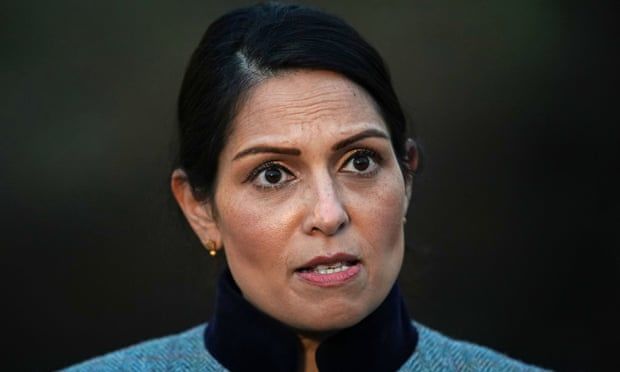 Priti Patel and Cressida Dick are advocates of stop and search.
“It’s fine to say [not taking the knee] but have you asked your officers? There was a lot of internal backlash from black officers and I know that because I speak to many of them. You have to show leadership but you also need to demonstrate that you’re human, that you’re the same,” said Chaudhri.
For former chief prosecutor Nazir Afzal, such dissent is made easier to surmount by the fact that the home secretary finds herself under so much scrutiny. He believes Patel has made a simple political calculation that means Dick’s position is secure. “The commissioner is effectively a human shield for Patel,” said Afzal. “Boris Johnson did the same with [former health secretary] Matt Hancock: it’s somebody else who can absorb the flak. For Patel it’s 100% what she’s doing with the commissioner. All of our ire can be directed at the commissioner rather than the person responsible for where the [policing] priorities are set.”
A similar assessment may have been made by the mayor of London, Sadiq Khan.
Although who gets the final say on whether to fire the commissioner can appear ambiguous, Khan’s predecessor, Boris Johnson, effectively ended Ian Blair’s stint as the head of the Met in 2008.
But Khan, to the exasperation of many on the left, is unwilling to do the same. On Friday, Khan’s office reiterated its unwavering support for Dick, saying it looked “forward to working a second term” with the 60-year-old.
Patel’s affinity with Dick matters more. It might even explain why the commissioner has so steadfastly backed some of the home secretary’s more controversial proposals such as restrictions on protest.
Marsh defines it as a “working relationship”, with Dick’s intelligence helping sustain a professional dynamic. However, the two are far from soulmates. “I wouldn’t say they get on well. They’re not cosy.” It’s also prudent to remember, he added, that Dick is not Patel’s chosen one and was selected by former home secretary Theresa May.
But Afzal is confident that as long as Dick, along with the capital’s mayor, receives the flak for issues such as rising knife crime then Patel will readily indulge the status quo.
“Yet the truth is that Sadiq can only spend what the home secretary and Home Office give. The home secretary is the most powerful individual here – politically she decides what happens,” he added.
Afzal, however, contests Marsh’s assertion that the commissioner has universal grassroots support.
“There are a catalogue of failings under her leadership that demonstrably have not only impacted on the public’s confidence but the officers themselves. Some of them have spoken to me and the morale is really low. Even before the Sarah Everard issue, throughout the pandemic they’ve felt that they haven’t had the leadership they needed.”
 Fan problems during the Euro 2020 final led to criticism of the Met.
Everard remains the final straw for many. Ten days ago Met officer Wayne Couzens pleaded guilty to killing the 33-year-old in south London amid allegations that police had failed to investigate previous incidents of indecent exposure by the killer. A vigil for Everard on Clapham Common had descended into chaos with women arrested amid allegations of heavy-handed policing. “Concerns spiralled with the Everard killing and how the vigil was policed in an inconsistent way compared to other protests,” said Afzal, a former chief crown prosecutor for north-west England.
Critics of the commissioner are also eager to dredge up the events of 16 years ago when Dick was gold commander in an operation that saw Jean Charles de Menezes shot dead at Stockwell tube station. Dick was exonerated, but the operation’s control room was condemned as “chaotic”.
Since then the charge sheet against Dick has considerably lengthened. Further failings on her watch include allegations that officers posed for selfies with the bodies of the victims of the Wembley park murders last June. The high-profile stop and search of British athlete Bianca Williams in west London last year outraged London’s black community.
Disquiet persists over Operation Midland, the Westminster sex abuse investigation that destroyed the lives of public figures on the testimony of a fantasist. Dick, who was briefly involved in the original operation, faces ongoing pressure to resign over this alone.
The most recent criticisms focus on last Sunday’s security failures at Wembley, with the force accused of failing to deploy sufficient officers or protect the venue from fans without tickets.
Weeks earlier, the Met’s handling of the Daniel Morgan murder investigation led an official inquiry to brand the force “institutionally corrupt.” Dick was personally censured for obstruction.
The findings over Morgan, says Chaudhri, proved the “killer” factor for her on whether Dick should continue in her post. “First we had the Met accused of institutional racism, then it was institutional corruption. There has to be a point where a line is drawn and they say: ‘You know what? We’ve got things wrong. We accept that.’
“The biggest problem is the denial,” said Chaudhri, a former detective superintendent who left the force in 2018 after 30 years.
But it is also issues around race that for many, including Chaudhri, stain Dick’s reputation. “I got on very well with her, but I didn’t feel that she really had a grip of what diversity really meant to her and policing.”
She points to how the enthusiastic policing of Black Lives Matter protests contrasted with the light touch taken against Extinction Rebellion demonstrations which paralysed London in 2019 and focused on high-profile areas.
“It’s a very sensitive issue for black communities,” said the 55-year-old. “I get told that a lot of serving BAME officers are scared because of the BLM approach, the stop and search agenda. I get a lot of people saying they are tired of trying to explain themselves.”
Marsh disagrees. “Out of the 43 forces in England and Wales, no other beats us for diversity. They don’t even get close.”
For others the ongoing youth violence epidemic is the issue that most weakens the commissioner’s position. After all, they say, it was her priority when accepting the top job in 2017.
Afzal believes Dick should resign to avoid trust in the police being eroded and further denting its ability to tackle knife crime.
“Policing without public confidence just isn’t going to happen. My concern is people are not going to come forward as either victims or witnesses,” he warned.
However those on the frontline of knife crime reject such assertions. Elena Noel, chair of Southwark’s anti-knife-crime forum and a former Home Office and London mayor adviser, states that not only is Dick “culturally competent”, but she also comprehends the complexities driving youth violence.
“Plus she understands the black community. She’s been brilliant. Cressida Dick is not to blame for knife crime. It needs a multi-agency approach,” said Noel.
Even so, some of the commissioner’s most ardent enthusiasts remain sceptical of her ambition to stay in post for another term.
“Fresh blood is always good,” said Marsh. “There are people in the wings like [assistant commissioner] Neil Basu, eminent people who could take the force in another direction. I’m not discrediting Cress but it’s healthy to freshen things up. A term is a term.”
Dick appears confident a second term is attainable. Not since Paul Condon in the 1990s has a Met commissioner served two full terms. Despite the litany of scandals, Dame Cressida Dick will back herself to achieve it.