London Daily

Focus on the big picture.
Monday, Apr 06, 2026

Covid: 'No reason' not to give boosters to under-50s

Covid: 'No reason' not to give boosters to under-50s

Rolling out booster jabs to younger age groups could help cut Covid infection rates to low levels across the UK, a leading scientist has said.

Prof Neil Ferguson said data suggests a third jab gives significant protection, even against mild illness.

He said he saw "no reason" why younger age groups should not be offered boosters after priority groups.

He also said the UK was unlikely to get a "catastrophic winter wave" this Christmas.

The UK recorded 38,351 new Covid-19 cases on Saturday, up by nearly 8,000 on the previous week. A further 157 deaths within 28 days of a positive test were also reported.

Health Secretary Sajid Javid tweeted that 12 million booster jabs had been given across the UK, with more than two million being delivered in one week.

In September, the government's scientific advisers recommended everyone over 50 should be offered a third dose of a Covid vaccine, along with front-line medical staff and younger adults with some underlying health conditions. The rollout began later that month.

Prof Ferguson, head of the modelling group at Imperial College London, told BBC Radio 4's Today Programme he saw "no reason why we shouldn't be rolling them out to younger age groups, once we've got through the priority groups, the over-50s and the clinically very vulnerable".

Modelling data on the immunity booster jabs provided to the UK population will be published next week, he said.

Prof Ferguson said he expected the data to be "very like" that seen in places such as Israel, where it showed people were "very substantially protected" after receiving their booster dose - not just from severe disease, "but even from just getting infected again, mild disease".
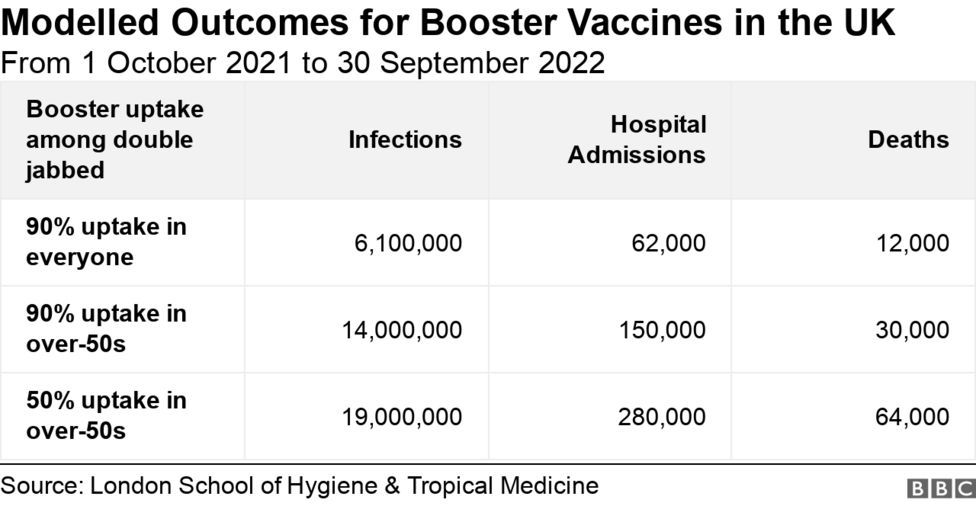

He added: "And that's what we've been missing in the last few months with the Delta variant, with people who have only had one or two doses."

He said, according to modelling carried out by his group and at the London School of Hygiene and Tropical Medicine, rolling out booster jabs to younger age groups "could make quite a big difference to driving down transmission to low levels".

However, Prof Ferguson, whose modelling led to the first nationwide restrictions in 2020, added this would be a decision for the Joint Committee on Vaccination and Immunisation (JCVI) committee to make.

Who is eligible to get the booster jab?


People are eligible for a booster jab in the UK if:

* They are aged 50 or over

* They are over-16 with a health condition that places them at high risk

* They are a front-line heath or social care worker

It must also have been six months (182 days) since their second dose.

Rules about who is eligible for a booster are the same throughout the UK.

In Scotland, people will be able to book boosters online from later this month. In Wales and Northern Ireland people will be invited to book an appointment and for most people this will happen at least six months after their second jabs.

Prof Ferguson said he thought the UK was unlikely to experience a "catastrophic winter wave at this point". He said "we are in a very different place from last year" and "the vaccination is having a huge effect" in the population's immunity levels.

Whereas restrictions have been reintroduced in some countries across Europe, such as the Netherlands, Prof Ferguson said the UK was in "quite a different situation" and he hoped it could "avoid" the return of social distancing measures this winter.

He said "we might see slow increases as we did in October" near Christmas, but the fast rollout of booster jabs has given the UK an advantage in the fight to control Covid.

In light of Boris Johnson's statement on Friday about "storm clouds" gathering over parts of Europe, Prof Ferguson said: "We can't be complacent, but at the moment I don't think we'll be in a situation the Netherlands is coming into where they really do need to get on top of rising case numbers using social distancing."

The UK has experienced a high number of cases since July, ranging from 30,000 to 50,000 new cases daily. Prof Ferguson said the high number of cases during the past four months "has obviously had a downside". But, "paradoxically it had an upside of boosting the immunity of the population compared to countries like Germany, the Netherlands and France", he added.

Germany recorded its highest number of new Covid infections on Wednesday, whilst Austria is set to impose a lockdown for unvaccinated people.

Across Europe, the highest number of hospitalisations and deaths from Covid have been among unvaccinated members of the population.

Recent data from the Office for National Statistics (ONS) has suggested infection levels are continuing to fall across the UK.

About one in 60 people in private households in England had Covid-19 in the week ending 6 November, down from one in 50 the previous week.

In Wales, about one in 45 people were estimated to have had the virus in the week ending 6 November, down from one in 40 the previous week.

In Northern Ireland, the figure was about one in 75 people, down from one in 65 the previous week, while in Scotland it was one in 85, down from one in 80.


Comments

Rebel with a cause 4 year ago
Where are all the statistics of those who have died or permanently injured because of the jab. Is there anybody out there with a brain? Even Bill Gates admitted the vax doesn't work. Yet, you insist on injecting people with an "upgrade" to support the software system already in their bodies. Either you've made the decision to become "trans-human" or not. It's your choice but don't you dare criticize those who did their research and didn't want that poison in their bodies.

Newsletter

Related Articles

0:00
0:00
Close
UK Considers Deploying Aircraft Carrier for US Independence Day Celebrations Amid Renewed Transatlantic Focus
United Kingdom Moves to Attract AI Firm Anthropic Amid Tensions with US Defense Officials
RAF Intercepts Iranian Drones in Middle East to Defend Allied Security Interests
Labour Signals Shift on Foie Gras and Fur Restrictions to Advance EU Trade Talks
Seven Arrested Near RAF Base as UK Authorities Respond to Protest Activity
Economic Pressures Mount as Analysts Warn UK Growth Is Being Constrained by Policy Burdens
UK Green Party’s Push for Church-State Separation Sparks Debate Over National Identity
Strategic Island Emerges as Growing Challenge for United States and United Kingdom Defense Planning
Pepsi Pulls Sponsorship from UK Festival Following Backlash Linked to Kanye West
Signs Emerge of Declining Enthusiasm for Social Media in the United Kingdom
Security Alert Raised Ahead of Meghan Markle’s Planned Visit to Australia
UK Food Halls Defy Hospitality Slowdown, Emerging as Bright Spot in Challenging Market
UK Sets Firm Conditions for Military Action, Insisting on Legal Mandate and Clear Strategy
UK Medicines Regulator Launches Probe into Peptide Clinics Over Health Claims
New North Sea Drilling Unlikely to Significantly Cut UK Gas Imports, Analysis Finds
Woman Linked to UK’s First All-Female Terror Plot Faces Deportation
Downed US Aircraft Over Iran Linked to Operations from UK Airfield
Two Men and Teen Detained in UK Following Attack on Jewish Charity Ambulance
UK Police Launch Inquiry After Firearms Left Unattended Outside Mayor’s Residence
Giuffre Family Calls on King Charles to Meet Epstein Survivors During US Visit
Amber Wind Warning Issued as Storm Dave Approaches Parts of the United Kingdom
Prince Harry and Meghan’s Australia Visit Set to Draw Heightened Global Attention
UK Considers Entry Fees for Overseas Visitors at Major Museums Ahead of 2026 Travel Season
UK Prime Minister and Kuwait Crown Prince Coordinate Security Response After Regional Escalation
Calls Grow to Expand Fully Paid Maternity Leave for UK Teachers Amid Workforce Pressures
UK Secures Tariff-Free Access to US Market in Landmark Pharmaceuticals Agreement
Trump Projects Strength in Critique of UK Leadership and Naval Readiness
UK FinTech Setback as VibePay and Smartlayer Cease Operations Amid Funding Pressures
UK Leads Global Coalition of Over Forty Nations to Address Strait of Hormuz Crisis
UK Firms Urged to Accelerate Preparation as New Sustainability Reporting Rules Take Shape
UK Moves Rapid Sentry Air Defence System to Kuwait After Drone Strike Escalation
Transatlantic Relations Tested as UK Seeks Balance While Trump Reshapes Strategic Approach
Trump’s Strategic Pressure on UK Seen as Push for Stronger Alignment and Fairer Terms
UK Focuses on Trade Finance to Secure Critical Materials for Defence and Energy Sectors
Majority of UK Businesses Hit by Middle East Conflict While Confidence Holds Firm
UK Royal Navy Faces Renewed Scrutiny as Debate Intensifies Over Capability and Readiness
Reform UK Faces Mounting Distractions as Policy Agenda Struggles to Gain Traction
Investigation Launched Into Northern Cyprus IVF Clinics After UK Families Receive Incorrect Sperm
International Meeting Issues Unified Call to Safeguard Navigation Through Strait of Hormuz
Potential Strait of Hormuz Closure Raises Concerns Over UK Food and Medicine Supply Chains
UK Leads Coalition of Over Forty Nations Urging Iran to Reopen Strait of Hormuz
UK Secures Tariff-Free Access for Medicines in Landmark US Pharma Trade Agreement
King Charles III Invited to Address Joint Session of U.S. Congress in Rare Diplomatic Honor
Debate Grows Over Whether Expanded North Sea Drilling Can Reduce UK Energy Bills
UK Faces Heightened Risk of Jet Fuel Shortages, Airline Chief Warns
UK Ends Police Investigations into Lawful Social Media Posts After Review Finds Overreach
Abramovich Moves to Establish Charity for Frozen Chelsea Sale Proceeds Amid UK Dispute
Starmer Reaffirms NATO Commitment While Responding to Trump’s Strategic Critique
UK Aid Reductions Raise Fears of Severe Human Impact Across Parts of Africa
UK Signals Renewed Push for EU Cooperation as Iran Conflict Reshapes Security Landscape
×