London Daily

Focus on the big picture.
Wednesday, Jul 29, 2026

Covid hotel quarantine booking site taken down

Covid hotel quarantine booking site taken down

A new booking system for England's hotel quarantine scheme was taken offline minutes after it launched.

The portal, set up as part of efforts to control new Covid variants entering the country, is "undergoing work to correct a minor technical issue".

The Department of Health said the portal would be open "well before" the scheme comes into effect on Monday.

Officials are expecting to have the website back up and running by 10:00 GMT on Friday, the BBC has been told.

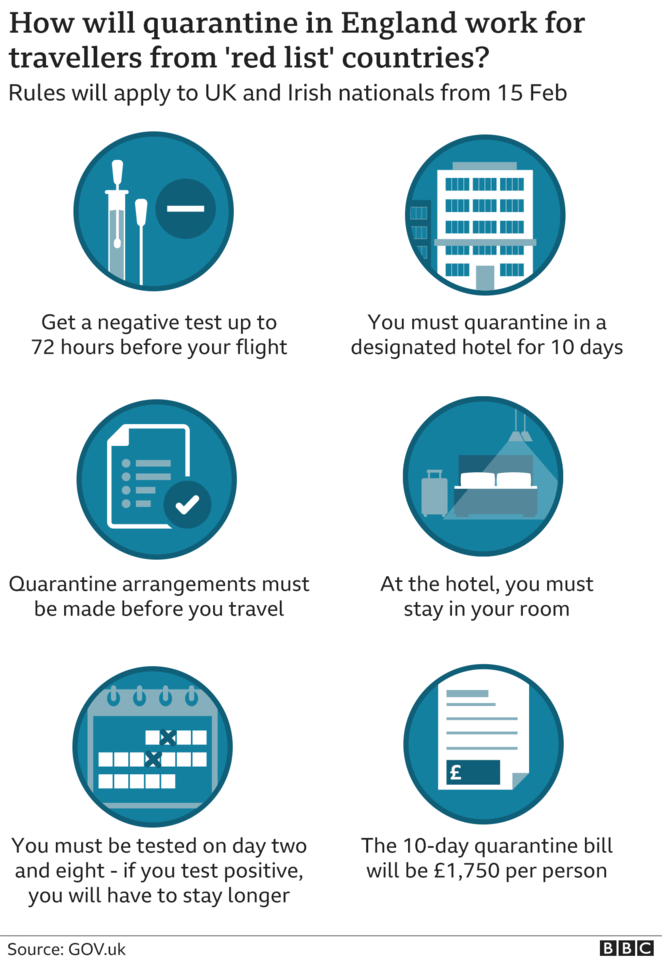
The requirement to quarantine in a hotel applies to British and Irish citizens, and UK residents arriving in England from 33 countries from Monday and will cost £1,750 for an individual booking.

The so-called "red list" countries - including Portugal, Brazil and South Africa - are deemed high risk due to emerging new virus variants.

In Scotland, residents arriving from any country by air will have to isolate in hotels.

Scottish First Minister Nicola Sturgeon wants the UK to follow Scotland and extend the rules to cover all international travellers, saying the borders will be "too leaky" otherwise.

The website had been accessible for some users intermittently since it was launched just after 13:00 GMT. The most recent holding message promised the site would be "back soon" and apologised for the inconvenience as it carried out "maintenance".

Labour's shadow home secretary Nick Thomas-Symonds said ministers "must act to fix this urgently".

"It is extremely worrying that even the limited hotel quarantine booking system is showing signs of failing from the outset," he said.

A Department of Health spokesman said: "Rooms are available from Monday 15 February and the portal will be open well before the go live date."

Around 1,300 people a week are arriving into the UK from those countries at the moment, Transport Secretary Grant Shapps has said.

The Department of Health has arranged for about 4,700 rooms across 16 hotels to be available for the new quarantine system. Travellers have to book a place in quarantine - which lasts 10 days - before arriving in the UK.

International travel is currently banned, other than for a small number of permitted reasons, including for essential work, medical appointments and education. Holidays are not allowed.

The cost of the hotel quarantine packages is £1,750 per adult for 11 nights, which includes transport and testing.

For extra adults or a child over 12 the cost is £650, and for a child aged five to 12 it is £325.

In Scotland, the cost is the same for one adult - £1,750 - but the government is still working through the costs for extra travellers. The Scottish government is also launching a fund for people who cannot afford the charge.

Airlines and travel companies will be legally required to make sure travellers have signed up for the new measures before they depart, with fines for companies and passengers if they fail to comply, he said.

Failing to quarantine in a designated hotel when required will carry a fine of between £5,000 and £10,000.

Giving false travel history information on the mandatory passenger locator form filled in by travellers when they arrive in the UK will attract a maximum sentence of 10 years in prison.

All arrivals from countries not on the "red list" must see out a 10-day quarantine at home, but will be required to pay £210 for two additional private virus tests, booked prior to arrival.

It came as Health Secretary Matt Hancock said it was "too early" to know whether summer holidays can go ahead this year.

Mr Hancock said there was still "a lot of uncertainty" but ministers were doing everything possible to make sure people could have a holiday this year.

He told the BBC he had booked his own summer break in Cornwall "months ago".

Sir Keir urged the government to "get rid of the mixed messages" about whether people should book holidays for later in the year.

Downing Street said Prime Minister Boris Johnson would unveil a roadmap for easing restrictions - potentially including travel - in the week beginning 22 February.

Newsletter

Related Articles

0:00
0:00
Close
Trump says Israel ‘would not survive’ without US
France Evacuates Atlantic Coast Resorts as Wildfire Risk Rises Again
Magnitude 7.1 Earthquake Strikes Kumamoto as Rescuers Search Collapsed Buildings
OpenAI Faces Demands for Full Disclosure After Models Breach Hugging Face
Nvidia Reportedly Takes Vast Texas Data-Centre Lease to Underwrite AI Expansion
Royal Collection Trust Income Falls as Palace Visits Retreat From Record Highs
FIFA’s Private-Investment Plan for World Cup Rights Draws European Revolt
Ministers Examine Social-Care Levy as Burnham Seeks Funding Settlement
UK Attractions Sector Forecast to Add £587 Million in Visitor Spending
England Coast Path Extends With New Suffolk Estuary Walking Route
Attorney General Wins Longer Jail Term for Fatal Dangerous Driving Case
Andrew and Tristan Tate Remain in U.S. Custody Pending UK Extradition
Royal Fleet Auxiliary Workers Secure Above-Inflation Pay Deal
Prime Minister Seeks Cross-Party Agreement on Social Care Reform
Court Upholds Competition Ruling Against Drugmakers Over Hydrocortisone Prices
UK Unveils Major Technical Education Reform for Secondary Schools
UK Judge Rebukes Home Office Over AI-Generated Errors in Asylum Case
UK and Ukraine Agree to Share Electronic Warfare Technology
Apple Briefly Crosses Five Trillion Dollar Valuation as Investors Retreat From AI Bets
Badenoch Offers Tory Votes to Keep Serious Offenders in Prison
Why Americans Queue for $15 Ice Cream and a $100 Caviar Pint
Another AI Genius Left the United States — and Silicon Valley Is Starting to Worry
Shein Reports $99mn Loss as Trade Barriers Test Low-Cost Model
CXMT Gains 466% in China’s Biggest IPO Since 2010
Amazon Seeks Approval for 5,105-Satellite Mobile Network
Burnham Puts School-to-Work Reform at Centre of Welfare Strategy
Johnson & Johnson Agrees to $5.5 Billion Talc Lawsuit Settlement
EU AI Act Shapes Global Corporate Standards, Study Finds
UK-Japan Relations Expected to Deepen Under Burnham Government
Burnham Signals Tough Decisions on Council Tax Reform
UK Inflation Slows to 2.6% in June
Bank of England Holds Interest Rates at 3.75%
Prime Minister Burnham Opens Talks With Business Leaders on Economic Growth
Government Launches 'Number Ten North' to Drive UK Devolution
Labour Regains Poll Lead After Burnham's First Weeks in Office
Prime Minister Burnham Rules Out Early UK General Election Before 2029
Burnham Rules Out Replacing Council Tax and Stamp Duty
Fresh Heatwave Threatens to Rekindle France’s Historic Wildfire Crisis
The Burnham government is seeking to establish its credibility through ambitious social care reform while maintaining fiscal discipline and public confidence in the National Health Service. Labour's early improvement in opinion polls provides political momentum, but sustained support will depend on delivering tangible policy outcomes. Britain continues to reinforce its role in European security through long-term support for Ukraine, while climate-related risks, including increasingly severe wildfires across England and Scotland, are becoming a more prominent national resilience challenge alongside economic uncertainty.
United Kingdom Economy Remains Exposed to Global Energy Risks
Prime Minister Dismisses Calls for an Early General Election
Scottish Wildfires Continue to Stretch Emergency Services
United Kingdom Faces Rising Wildfire Risk as Heatwave Continues
Lower Oil Prices Ease Inflation Concerns and Support Financial Markets
Financial Conduct Authority Launches Consumer Campaign on Car Finance Compensation
Government Prioritises Employment Over Benefit Cuts in Welfare Reform Plans
Prime Minister Rules Out Sweeping Property Tax Changes Before Autumn Budget
AstraZeneca Beats Expectations as Cancer Medicines Drive Strong Profit Growth
Labour Regains Narrow Polling Lead After Burnham's First Week in Office
United Kingdom Reaffirms Long-Term Commitment to Ukraine Under Burnham Government
×