London Daily

Focus on the big picture.
Saturday, Jun 13, 2026

Covid-19: Has the UK economy been hardest hit?

Covid-19: Has the UK economy been hardest hit?

The UK's GDP, which is the value of everything produced in the economy, was 9.9% down in 2020 compared with 2019.

There is no question that it has been a bad year for the UK economy, with severe restrictions imposed for a lot of the year as a result of coronavirus. It is also an economy reliant on consumer spending on things like hotels, restaurants and leisure activities, which have been badly hit by lockdowns.

But has the UK economy had a worse year than those in other advanced countries?

In an interview on Friday, Chancellor Rishi Sunak told BBC News: "We calculate GDP in a different way to pretty much everybody else."

He added that if you corrected for that difference: "What you find is that our performance is very much in line and comparable to other countries and, in fact, it may be on a margin better than places like Canada, Germany, Italy and Spain."

Shadow chancellor Anneliese Dodds told BBC News: "The UK has had the worst economic crisis of any major economy."
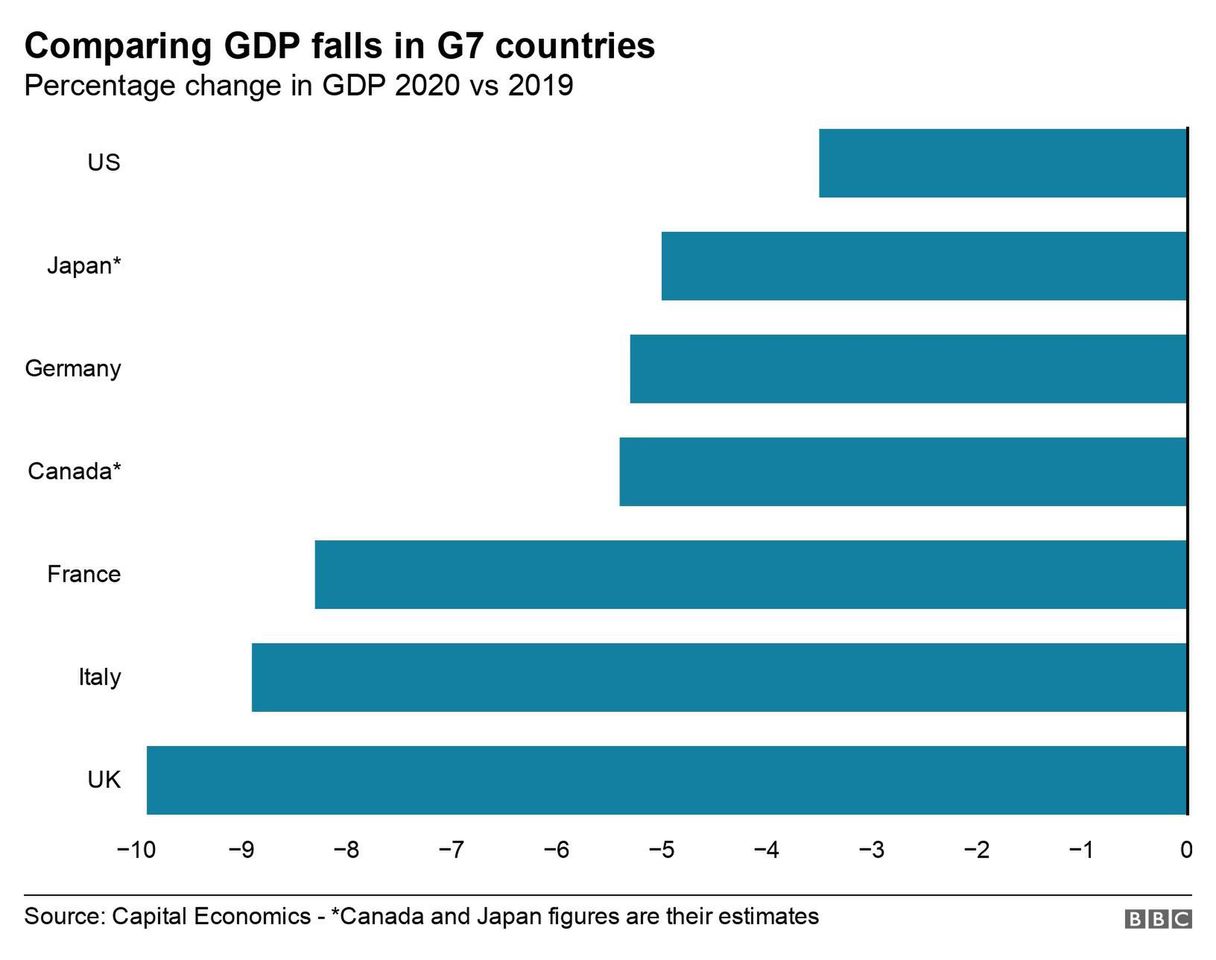

Spain, which is not in the G7 group of major advanced economies, registered a fall of 11%, so the UK economy certainly performed better than that.

The Office for National Statistics (ONS), which works out UK GDP, published a blog explaining the differences in methodology.

The tricky part is how you work out the output of public services such as healthcare or education.

If you want to know the output of a normal business, you just look at how much it has made from selling its goods or services.

That doesn't work as well with the public sector, so the ONS bases its figure on measures such as how many people have seen a GP, how many operations have taken place and the number of pupils receiving education.

Things like the closure of schools and the cancellation of non-urgent operations meant that the output of public services took a big hit in the pandemic.

Other countries tend to base their figures either on how much money has been spent on public services or how many hours have been worked by staff delivering them. As the amount of money spent has not fallen, that method would show less of a drop in their output.

That is also how the ONS works out GDP in nominal or cash terms. "Where the public services element is based on the money spent, the fall in UK GDP is broadly comparable to other G7 countries, and smaller than falls seen in Canada, Italy and Germany," it said.

"However, the 'real' estimates better reflect changes in the services being delivered."

The real estimate is the one that takes into account changes in prices, which the nominal one doesn't.

The ONS also looked at a measure of GDP excluding public services, which it said made little difference to the UK (which was factoring in a decline in public services already), but made Germany's figure worse by two percentage points. However, it added that: "In this approach the fall in UK GDP is still one of the largest in the G7."

Others have argued that while the distinction the chancellor mentioned may reduce the perceived fall in public sector output, it doesn't measure the drop in consumer spending or investment, both of which suffered from steep declines. "It is clear that the decline in GDP was significantly bigger in the UK than in Germany last year," said Andrew Kennington, from Capital Economics.

The UK economy fared badly last year. Adjusting for differences in methodology improves that performance, but it still leaves the UK towards the bottom of the league for economic performance.

Prof Diane Coyle, from University of Cambridge, told Reality Check: "This does show the limitations of GDP as a measure of economic wellbeing in any meaningful sense.

"It isn't a great framework for measuring any output outside the market, be that public services or environmental impacts."


Chancellor Rishi Sunak says the GDP slump is "comparable to other countries"


Newsletter

Related Articles

0:00
0:00
Close
UK Competition Watchdog Investigates Ryanair Family Seating Charges
Imperial College Study Links London Emissions Charges to Lower Hospital Admissions
Scottish First Minister Launches US Trade Initiative Ahead of World Cup Match in Boston
Fifteen Million Workers Gain Expanded Sick Pay Rights Under UK Reforms
British Retail Investors Secure Record Participation in SpaceX Share Offering
Keir Starmer and Micheál Martin Coordinate Response to Northern Ireland Violence
NHS Prepares for Major Disruption as Resident Doctors Announce Four-Day Strike
Bank of England Expected to Hold Rates as Energy Costs Complicate Inflation Outlook
Britain Moves to Ban Under-16s From High-Risk Social Media Platforms and AI Chatbots
UK Economy Contracts as Middle East Conflict Weighs on Growth
Defence Secretary John Healey Resigns Over Military Spending Dispute With Treasury
Prime Minister Keir Starmer Faces Leadership Crisis After Senior Cabinet Resignations
NHS Trust Secures Funding for AI Tool to Detect Heart Failure Earlier
Government Unveils £4.5 Billion Investment Plan for Walking and Cycling Infrastructure
Nationwide Reports UK House Prices Falling as Borrowing Costs Remain Elevated
Centre for Social Justice Says Two Million Britons Are Using Illegal Loan Sharks
UK Carmakers Warn EU Local Content Rules Could Damage British Manufacturing
UK Government Imposes Emergency Ban on Seven Potent Synthetic Opioids
Royal Navy Completes Major North Atlantic Anti-Submarine Exercise Off Norway
NHS Figures Show Nearly 3,000 Patients a Day Receiving Care in Hospital Corridors
CBI Cuts UK Growth Forecast as Middle East Tensions Drive Inflation Risks Higher
Dan Jarvis Appointed UK Defence Secretary Following Major Government Reshuffle
University College London Study Links Physical Punishment to Higher Risk of Bullying
East Midlands Railway Unveils First Refurbished Train in £60 Million Modernization Programme
RNLI Issues National Water Safety Appeal Ahead of Expected Heatwave
Climate Change Raises Subsidence Risks for Millions of Homes Across Southeast England
Manchester Advances Plans for Underground Piccadilly Station With £1 Million Funding Commitment
Anti-Immigration Violence Continues in Belfast Amid Heightened Security Concerns
UK Law Locks Great British Railways Into Public Ownership
Office for National Statistics Adopts Supermarket Checkout Data for Inflation Measurement
Applied Atomics Launches With $500 Million Space Infrastructure Order Book
BYD Plans Nationwide Rollout of Ultra-Fast EV Charging Network
UK House Prices Unexpectedly Fall in May
CBI Warns UK Growth Is Becoming Increasingly Dependent on Public Spending
Makerfield By-Election Fuels Speculation Over Labour’s Future Leadership
Britain Declines to Join EU SAFE Defence Fund
UK Unveils 2040 Emissions Target Despite Strong Political Opposition
Government Orders Full Review of Palantir’s NHS Data Contract
UK Borrowing Costs Climb as Markets Price in Further Bank of England Rate Rises
Resident Doctors Confirm Five-Day NHS Strike Across England
Violent Anti-Immigrant Riots in Belfast Spark Political and Diplomatic Tensions
United Kingdom Sees Recovery in Horizon Europe Research Funding Share to 9.3 Percent
UK Inflation Holds at 2.8 Percent as Office for Budget Responsibility Flags Persistent Price Pressures
United Kingdom Launches National Anti-Fraud Framework to Combat Rising Pension Scam Losses
United Kingdom Expands Sanctions on Israeli Groups While Funding Palestinian Authority Salaries and Gaza Mine Clearance
United Kingdom Issues Three-Month Ultimatum to Major Technology Firms Over Child Online Safety Controls
United Kingdom Government Moves Toward Blanket Social Media Ban for Children Under Sixteen
Widespread Anti-Immigration Rioting Erupts Across Belfast After Knife Attack Linked to Asylum Seeker
Farmers Warn of Crop Losses Following Months of Unseasonal Rainfall
Civil Aviation Authority Launches Review of Regional Airport Operations
×