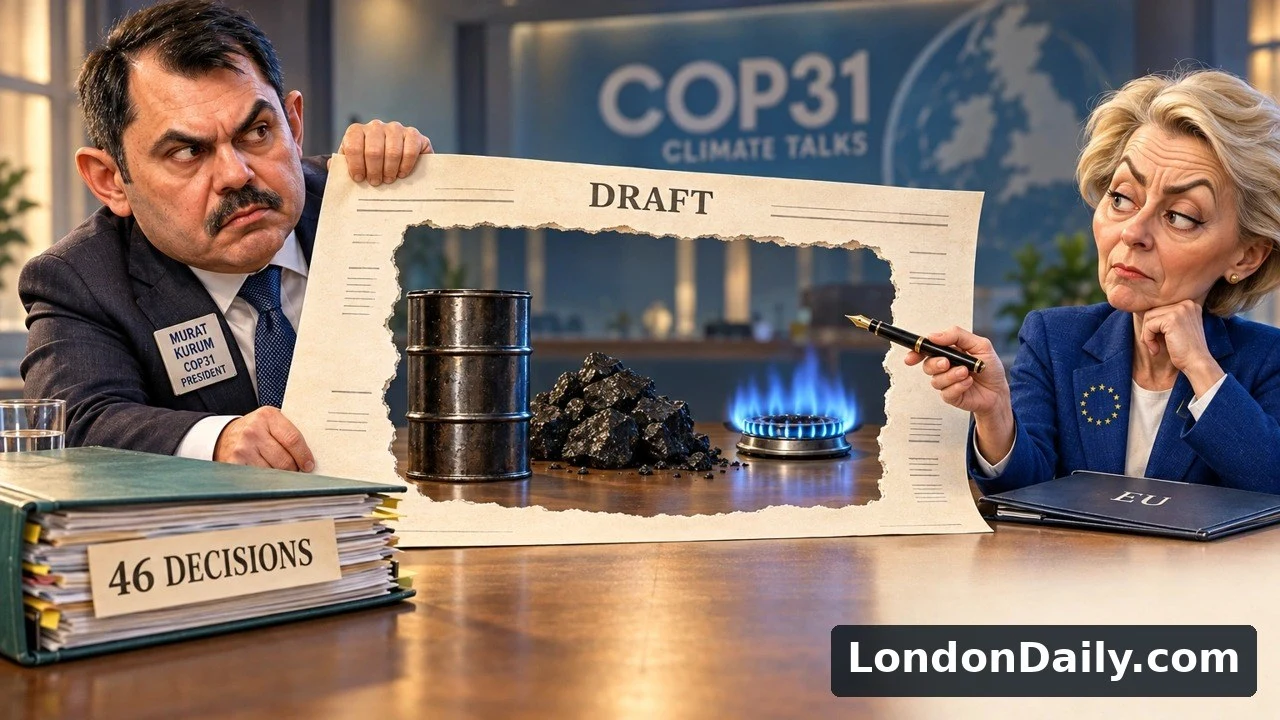
COP31 president Murat Kurum has accused the European Union of trying to dictate terms after it rejected a draft climate agreement that made no reference to fossil fuels, leaving the Antalya summit without an overall deal.
Kurum, also Turkey’s environment minister, defended the outcome on Friday during scrutiny of his ministry’s 2027 budget. He said Turkey had sought to protect the interests of all 196 countries, rather than follow Brussels.
“Turkey was not anyone's spokesperson at this summit, nor was it, nor can it be, anyone's pawn,” he said.
The talks ended on Sunday after more than two weeks of negotiations and over 45 hours of overtime, making them the longest-running UN climate talks. Disputes encompassed fossil-fuel language, the absence of new financial commitments and carbon capture and storage technologies. It was the first time since Copenhagen in 2009 that the talks had failed to produce a deal adopted by all.
The EU, Panama and others rejected the final draft presented by the Turkish and Australian presidencies as too weak to advance action against global warming. Ireland’s environment minister, Darragh O’Brien, said it was “unconscionable” to have “a climate act that makes no reference to fossil fuel”.
The omission went beyond terminology: the draft named neither coal, oil nor gas. It also dropped an earlier $120bn, about £90bn, target to help developing countries adapt to climate change. Yet the summit was the first to acknowledge that warming was set to exceed 1.5°C above pre-industrial levels, the Paris Agreement’s limit.
Kurum’s argument was that insisting on fossil-fuel wording sacrificed practical gains. Speaking on Monday after a cabinet meeting, he said negotiations had secured agreement on electrification, tripling adaptation finance, carbon capture technologies and methane reductions before those gains were “lost over a single reference to fossil fuels”.
The absence of an overarching agreement did not erase every decision. Countries unanimously adopted 46 measures, which Kurum called the “Antalya Decisions”, covering the Adaptation Fund, Just Transition and loss and damage financing. He described these as important steps towards implementing climate commitments.
He also argued that only three previous summits had produced cover decisions, naming Glasgow, Sharm El-Sheikh and Belem, and dismissed those texts as insufficiently focused on implementation. He blamed longstanding structural gridlock and accused countries of retreating when financial responsibility arose.
The distinction matters: Antalya delivered specific decisions, but no agreed overarching text resolving the disputes over fossil fuels and financial commitments.








Join the conversation