

Britain's third Covid wave may have PEAKED, top scientist claims
Professor Tim Spector, who runs Britain's largest Covid symptom tracking study, said new cases peaked at around 33,000 per day on July 6.
Symptomatic cases among unvaccinated Brits fell by 2.4 per cent, from 20,973 on July 5 to 20,487 on July 6.
But the number of vaccinated adults —who make up 87.2 per cent of the population — falling ill with the virus is still rising.
Another 12,905 vaccinated Brits were estimated to have caught Covid on July 6, meaning nearly half of all cases are now among the jabbed.
The data led Professor Spector, who is an epidemiologist at King's College London, to conclude that total new cases among both groups have plateaued at 33,000.
However, separate data measures show infections are still rising across the country. MailOnline analysis revealed today that as many as one in 60 people tested positive for the virus in some parts of England.
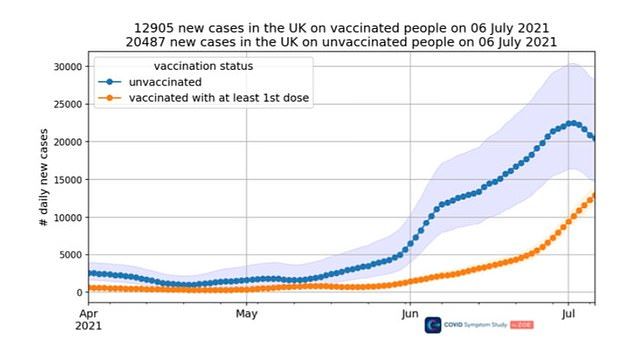 Data from the ZOE app showed that, while
unvaccinated people in the UK make up the majority of new Covid cases,
this number is beginning to fall. Meanwhile, cases among vaccinated
Brits are continuing to rise, although they make up the minority of
total cases
Data from the ZOE app showed that, while
unvaccinated people in the UK make up the majority of new Covid cases,
this number is beginning to fall. Meanwhile, cases among vaccinated
Brits are continuing to rise, although they make up the minority of
total cases
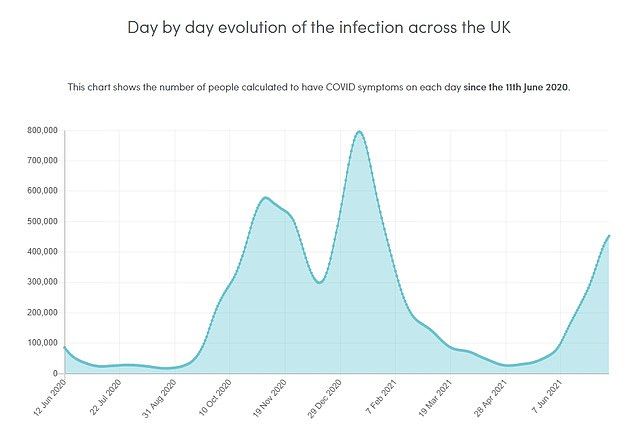 Data released by Professor Spector on Sunday
showed that cases in the UK increased overall, rising from 33,254 on
July 6 to 33,392 on July 7
Data released by Professor Spector on Sunday
showed that cases in the UK increased overall, rising from 33,254 on
July 6 to 33,392 on July 7
The ZOE Covid Symptom Study app tracks how the virus spreads, and what symptoms it causes, through data provided by hundreds of thousands of Brits.
Data released by the study on Sunday showed that cases in the UK increased overall, rising from 33,254 on July 6 to 33,392 the following day.
But the number of unvaccinated people catching Covid began to fall, while those with the jab continued to catch the virus.
This is likely because vaccinated Brits make up the vast majority of the population, with record numbers getting jabbed last month when the vaccine rollout expanded to all over-18s.
Full details of the weekly surveillance study will be published on Thursday.
Professor Spector said last week, when the most recent data was published, that the virus is 'not done with us' but there are already signs the third wave is slowing down.
ZOE figures showed for a second week in a row that cases have risen by a similar amount, prompting him to believe the third wave may already be slowing down.
It comes as MailOnline analysis revealed that one in 60 people tested positive for coronavirus last week in England's current hotspot.
Department of Health figures show Harton East — a neighbourhood in South Tyneside — had an infection rate of 1,621 cases for every 100,000 residents in the week ending July 7.
Two other districts within the town — Cleadon Park and Hebburn West — also saw more than 1.5 per cent of the population test positive in the same time-frame.
All but one of the England's 25 worst-hit areas are currently in the North East, MailOnline analysis shows. Some districts are now recording more cases than at any point in the pandemic.
Scientists are baffled as to what is behind the rapid spread, with some experts speculating a new variant may be behind the uptick in cases. Others claim partying students could be to blame, with the highly-transmissible Delta variant already dominant across the region.
Tom Hall, director of public health at South Tyneside Council, told MailOnline that the Delta strain is driving the uptick in cases, which are mainly among unvaccinated people. He said the council will continue to advise people in the region to get vaccinated and keep following Covid restrictions beyond July 19.
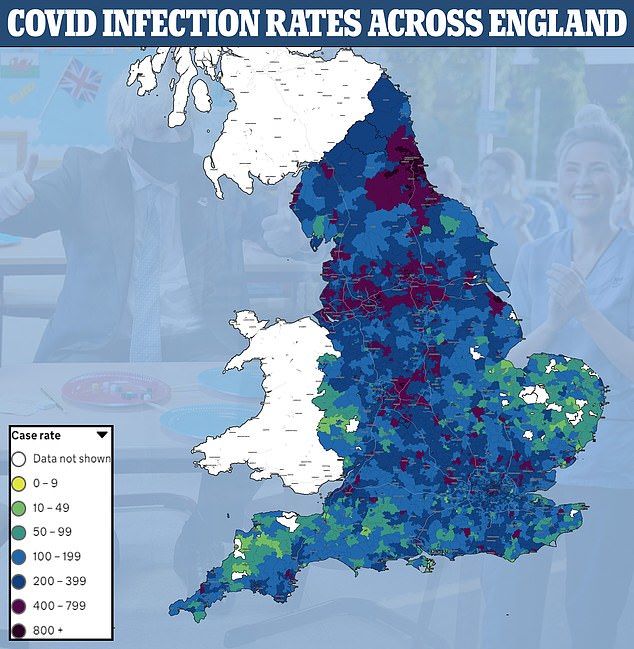 The North East continues to record the highest
number of Covid cases, after overtaking the North West as the country's
virus hotspot last week (shown in top right purple section of map). The
worst hit parts of England are in South Tyneside, where as many as one
in 60 people are testing positive for the virus in Harton East and
Cleadon Park. In contrast, just one in 416 people in London tested
positive for the virus
The North East continues to record the highest
number of Covid cases, after overtaking the North West as the country's
virus hotspot last week (shown in top right purple section of map). The
worst hit parts of England are in South Tyneside, where as many as one
in 60 people are testing positive for the virus in Harton East and
Cleadon Park. In contrast, just one in 416 people in London tested
positive for the virus
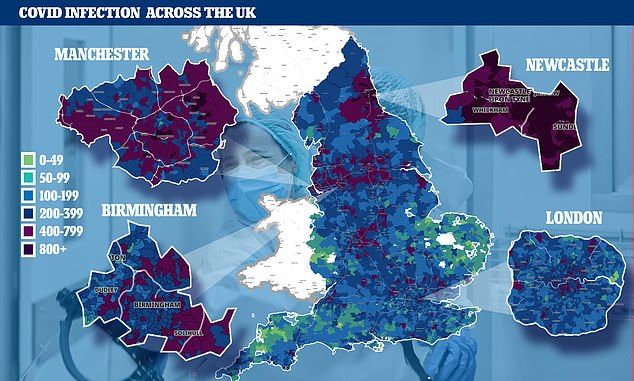
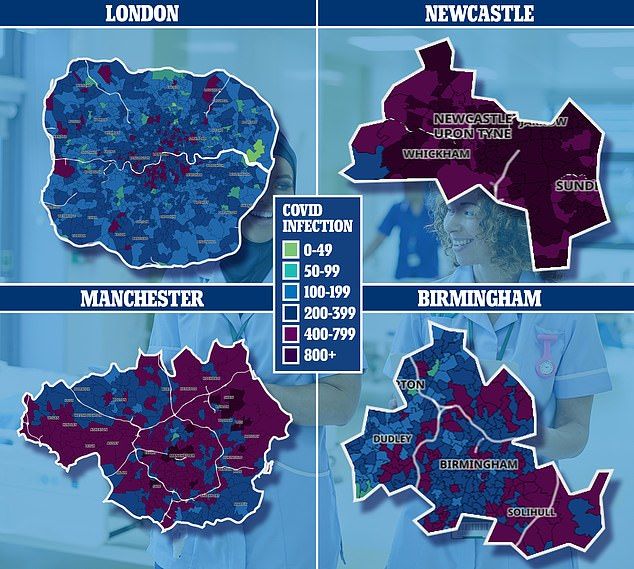 London has comparatively low case rates compared
to other major cities, with just 240 people per 100,000 testing
positive for the virus in the week leading up to July 6. This is much
lower than the rates in Newcastle (813), Manchester (518) and Birmingham
(353)
London has comparatively low case rates compared
to other major cities, with just 240 people per 100,000 testing
positive for the virus in the week leading up to July 6. This is much
lower than the rates in Newcastle (813), Manchester (518) and Birmingham
(353)
A group of 120 doctors last week penned a letter in top medical journal the Lancet saying easing restrictions was a reckless gamble.
Figures show the number of daily cases is rising by 30 per cent every seven days, amid the rapid spread of the highly-infectious Indian variant.
But there are signs the speed of growth is slowing down, with experts saying the end of Euro 2020 could lead to a drop in cases.
SAGE advisers have even claimed cases will fade naturally from next month because of growing immunity among the population.
After initially staying flat, hospital admissions and deaths are now rising quickly. One Public Health England expert warned hospitalisations could hit 3,000 a day soon.
But the vaccines have severely damaged a once-impenetrable link, with the proportion of patients who become seriously ill being just a fraction of what it was at the peak of the pandemic.
Freedom Day was originally postponed by four weeks from the original date on June 21 to give the NHS an month to vaccine millions more people amid the rapid spread of the Indian variant.
The mutant strain is now dominant in every region of England and is behind the rapid spike in cases across the North East.
Cases began rising exponentially in the region earlier this month and now appear to be doubling every 10 days, with an extra 3,669 people testing positive on July 6.
Around 706.5 cases per 100,000 residents tested positive on any given day in the North East last week — double the UK average.
Infection rates are even higher in the South Tyneside, with another 328 people testing positive yesterday, meaning cases are higher there now than at any other point in the pandemic so far.
Around 1,203 people per 100,000 tested positive for the virus in the borough, four times higher than the average across England.
In England, 11 of the 20 areas with the highest infection rates are in South Tyneside.
But promisingly, infection rates are highest among those aged 15 to 24, who are less likely to become seriously unwell from the virus.
This suggests that the high rate of infections may not lead to a similarly high spike in hospitalisations and deaths — unless the virus seeds in to older age groups.
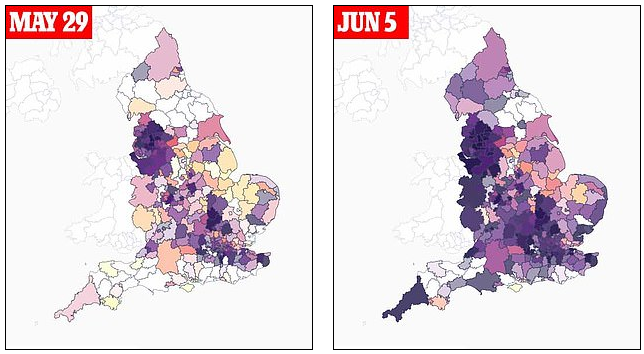 By the end of May, the Indian mutation caused
77.7 per cent of cases across England, while the once-dominant Kent
strain was responsible for just 21.8 per cent
By the end of May, the Indian mutation caused
77.7 per cent of cases across England, while the once-dominant Kent
strain was responsible for just 21.8 per cent
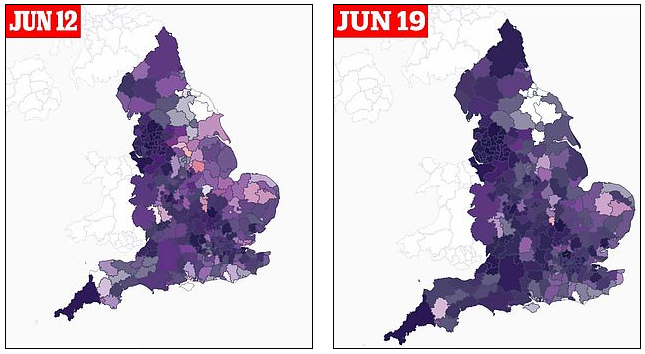 The Indian 'Delta' variant is now dominant in
more than 300 areas of England, MailOnline's analysis of testing data
revealed today. Figures show the ultra-transmissible strain had
overtaken the formerly dominant Kent variant in 303 local authorities by
June 12 — just two months after it was seeded in the country
The Indian 'Delta' variant is now dominant in
more than 300 areas of England, MailOnline's analysis of testing data
revealed today. Figures show the ultra-transmissible strain had
overtaken the formerly dominant Kent variant in 303 local authorities by
June 12 — just two months after it was seeded in the country
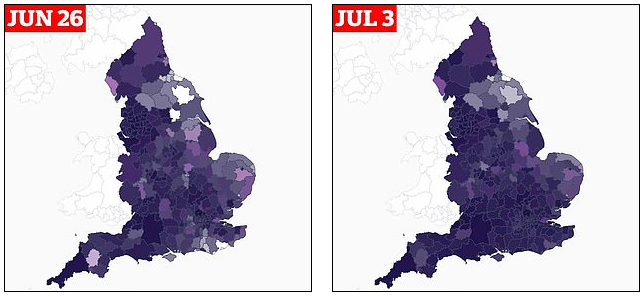 The Indian variant is now responsible for almost
all Covid cases in the country, with the most recent estimates from the
Sanger Institute stating that 99.3 per cent of all cases in the two
weeks up to July 3 were caused by the more infectious mutation
The Indian variant is now responsible for almost
all Covid cases in the country, with the most recent estimates from the
Sanger Institute stating that 99.3 per cent of all cases in the two
weeks up to July 3 were caused by the more infectious mutation