

Boris Johnson and the Lebedevs: how I exposed the prime minister’s defining scandal
In many ways, summer in London in July 2019 was not unlike summer in London in July 2022. The weather was warm, the sun shone and a Tory party leadership battle was under way.
It was the beginning of an era, not the end – on 24 July 2019, Boris Johnson walked into 10 Downing Street after being elected prime minister of the United Kingdom. But the seeds of a scandal that is beginning to seem as if it could – and should – become the defining legacy of his premiership had already been sown. Because the latest Johnson scandal to catch fire is of another order to Wallpapergate or Partygate or the one that finally forced him from office, his lies about disgraced MP, Chris Pincher.
It concerns his relationship with an ex-KGB lieutenant-colonel, Alexander Lebedev, and specifically a meeting with him, without his security detail or Foreign Office officials, at the height of the Skripal poisoning crisis.
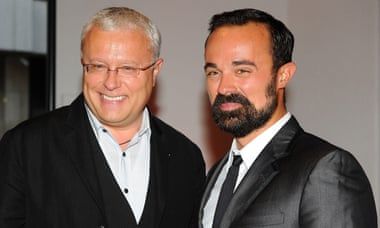 Ex-KGB lieutenant general Alexander Lebedev, left, and his son Evgeny.
This scandal isn’t about breaking his own laws or impropriety with Conservative party funds or Lulu Lytle wallpaper. It’s not even a scandal in the traditional sense. This is about what appears to be a fundamental breach of our national security. A breach that potentially endangered not just our country but the entire Nato alliance. And we still know almost nothing about it.
But it’s hard to overstate the seriousness of what we do know. In 2018, the Kremlin ordered two military intelligence officers to use a prohibited chemical weapon on a British street.
Their discarded bottle of novichok killed a British citizen – Dawn Sturgess. But it was only chance, pure luck, that it wasn’t more. As President Donald Trump’s former national security adviser, Fiona Hill, said this year: “There was enough nerve agent in that bottle to kill several thousand people.”
In Britain, we treated it as a botched assassination attempt, but Nato understood something far more sinister had taken place. It was a chemical warfare attack on the civilian population of a Nato country. Under Nato’s rules, an attack on one member nation is an attack on all. It acted quickly and decisively.
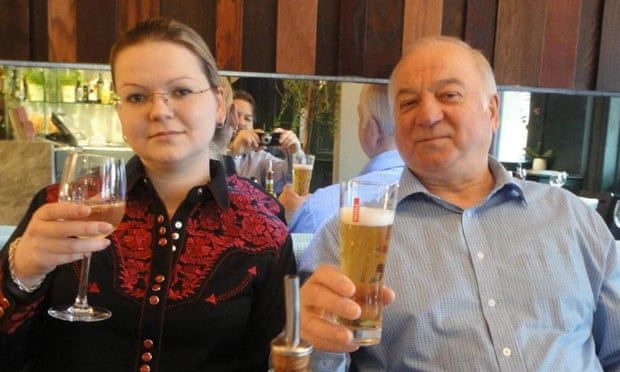 Sergei, right, and Yulia Skripal, who were
targeted by Russian military inteligence officers with novichok in
Salisbury in March 2018.
Sergei, right, and Yulia Skripal, who were
targeted by Russian military inteligence officers with novichok in
Salisbury in March 2018.
Johnson, as foreign secretary, oversaw Britain’s response, liaising with Nato as it orchestrated almost unprecedented international cooperation, imposing sanctions against Russia and expelling 342 Russian diplomats from countries around the world. Then, on 27 April, Nato’s secretary general, Jens Stoltenberg, convened a meeting in Brussels with foreign ministers of Nato’s member nations to discuss the crucial next steps.
Britain’s foreign secretary attended that meeting. He left it, apparently still holding documents. He somehow managed to lose the 24/7 security detail all foreign secretaries have. He flew to Italy alone. And there he met the a former lieutenant colonel in the KGB, Alexander Lebedev, a spy who was stationed inside the Russian embassy in London in the late 1980s and served alongside fellow officers who included Vladimir Putin. It was a meeting, Johnson acknowledged to MPs last week, that took place in breach of all protocols, without any foreign office officials present.
We still don’t know what was said at that meeting. We don’t know if there are any official records of it. We don’t know who else was there. We don’t know what documents Johnson had in his possession. We don’t know if he betrayed secrets – either deliberately or inadvertently – about Nato’s strategy.
“Profumo lost his job for a lot less,” former Conservative MP Rory Stewart has noted, referring to Britain’s most famous political scandal. In America, Trump’s national security adviser, Gen Mike Flynn, was sacked over unrecorded meetings with the Russian ambassador and Priti Patel for unofficial talks with the Israeli government. But what’s truly mindblowing about this story is that it has been in plain sight for almost the entirety of Johnson’s time in office.
In Britain, there is no need to bury abuses of power or even potential acts of treason. You don’t need to even bother to cover them up. Here we let our scandals fester for literally years.
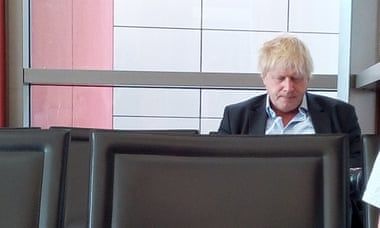 Boris Johnson looking unkempt at Perugia airport after attending a party at Evgeny Lebedev’s villa.
Because if you’re an attentive reader of the Observer, none of this was new. We first revealed that meeting with Alexander Lebedev in November 2019. We drew attention to it again when the Russia report that Johnson suppressed was finally published in July 2020. And yet again when Russia invaded Ukraine, pointing to its extraordinary implications for not just Britain’s security but Nato’s in March this year.
The news did not “emerge” last week. It was not even, as the BBC claimed, the first time it had been “confirmed”. We got confirmation from Lebedev’s press secretary three years ago and we – the Observer, the Guardian, and niche independent outlets Byline Times, Open Democracy and Tortoise Media – have been talking about this relationship to anyone who will listen for years.
What happened last week was just the first time that anyone with access to Johnson had ever asked him a question about it.
It was a bullet that Johnson very nearly dodged. The day before he stood on the steps of Downing Street and finally accepted the inevitable by resigning, he faced his final appearance before the liaison committee, the parliamentary body tasked with overseeing the office of the prime minister.
Sandwiched between inquiries about Ukraine and the cost of living crisis, was a buried landmine. Meg Hillier, the Labour MP for Hackney South and Shoreditch, stumbled with her pronunciation as she asked: “Could you just confirm, and I’d appreciate a yes or a no, that you met with the former KGB officer, Alexander Lebenov – Lebedev – when you were foreign secretary without officials on 28 April 2018?”
Even in the frenzy of a Westminster news cycle that had made headlines across the world, Johnson’s stumbling responses caught attention. “Boris Johnson admits to private meeting with ex-KGB agent,” the Guardian reported.
And a day later, shadow defence secretary Yvette Cooper asked an urgent question in the house followed by the deputy leader of the Labour party, Angela Rayner, calling for a full investigation. Something else momentous happened last week too: the BBC finally covered it.
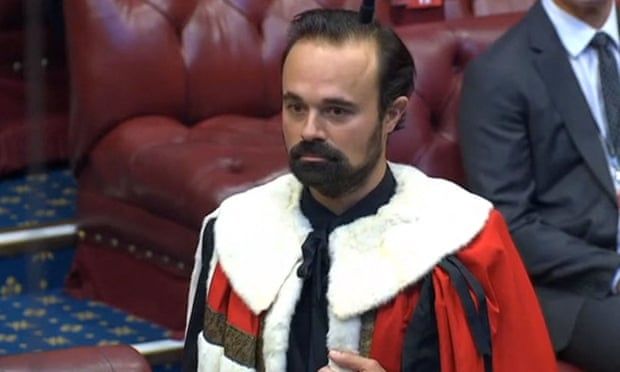 Evgeny Lebedev during his introduction in the House of Lords after being nominated for a life peerage.
I remember what the weather was like the week that Johnson took office because I spent it cycling around London trying to track down people who I thought might have information.
I’d had a tip about Johnson and his relationship with an unidentified Russian oligarch from an unimpeachable source and a process of elimination over months had led me finally to Alexander Lebedev, the one-time proprietor of the Evening Standard and the Independent and his party-loving son, Evgeny. He’s the man who still owns these newspapers and who, in 2020, Boris Johnson elevated to the peerage.
Days before Johnson became PM, Nick Hopkins, then investigations editor of the Guardian, had got a sniff of an astonishing story. He’d learned that Johnson had travelled to Evgeny Lebedev’s Italian villa for the weekend after that Nato summit without his security detail.
That first article prompted a Guardian reader to write in with further details. They had seen Johnson at Perugia’s San Francesco d’Assisi airport alone, without any luggage, in a dishevelled, hungover state “looking like he had slept in his clothes” and “struggling to walk in a straight line”.
But I had more information and I needed to find other sources and over the next days, I tried to find anyone who might know more. It included Sarah Sands, then editor of Radio 4’s Today programme.
She was a friend and colleague of Johnson’s, had been appointed editor of the Evening Standard by Evgeny and attended his weekend parties in Italy.
She agreed to see me at Broadcasting House and told me that she had been to Lebedev’s parties. “But I was always in the early shift. There was an early shift at his parties and a night shift. I was one of the boring married couples who went to bed early.”
That same day, I met Chris Steele, the former head of MI6’s Russia desk and the man behind the “Steele dossier”, a set of early – though contested – revelations about Trump’s relationship with Putin. “There’s no such thing as an ex-KGB officer,” he claimed.
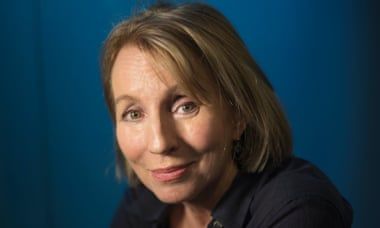 Sarah Sands, former editor of the Evening Standard.
I spoke to an ex-senior executive at the Independent and to former guests at Evgeny’s famously high-spirited parties, which he hosted at his London residence, Stud House, and Terranova, his Italian villa (his father owns a nearby castle that one former guest complained “has a medieval dungeon complete with chains but no pool” and where there were always “willowy blondes draped over the furniture”).
There was so much that was already an open secret. The Putin-friendly comment pieces that both Evgeny Lebedev and Alexander Lebedev had written in the Independent. Alexander’s support for Russia’s illegal occupation of Crimea. Evgeny’s friendship with Johnson that dated back to his days as London’s mayor when the support of the Lebedev-owned Evening Standard was a key asset in his re-election campaign. The fact that Evgeny owned a pet wolf he’d christened Boris and that he kept on a leash for photos. (Another dog was named Vladimir.)
None of this was secret information. The most extraordinary thing is not an ex-KGB lieutenant-colonel taking ownership of two important British newspapers and befriending the then mayor of London, it’s that even after Russia downed a passenger jet and attacked the US election and bombed Aleppo and let off a nerve agent in Salisbury, nobody thought this was newsworthy.
But my big break, and the only reason we know about this meeting with Alexander Lebedev, came two weeks later when, by extraordinary coincidence, I boarded an easyJet flight from a tiny regional airport in the Mediterranean. I had a seat reserved – 3C – and as I made my way towards it, I saw a familiar face. There in 3B was Rachel Johnson, the new prime minister’s sister.
It’s hard to say which of us looked the more shocked. “You’re sitting here?” she said. I hoisted my bag into the overhead locker and sat down. “Yep,” I said.
Rachel Johnson was not the source of the information about Alexander Lebedev’s previously unknown presence that weekend. But she was the next best thing. Were you at Evgeny’s party in Italy in April last year, I asked her almost as soon as I’d sat down.
“No,” she said. But then she turned to ask her companion. “But you were, weren’t you?” Yes, the person said, and casually mentioned a few of the other guests. “Oh yes. And his father. He flew in for lunch.”
It was an extraordinary bombshell. “Alexander Lebedev? Did he fly in from Moscow?” I asked. “Maybe,” the person said. “Yes. I’m not sure.” And they turned back to their inflight reading.
What happens at these parties, I asked Rachel. “You tell me,” she said. What do you mean? “You’ll have to ask one of the men,” she said. “The women are sent home at midnight.” She had been to one hosted by Evgeny at his London home, Stud House. “I was packed off in a cab while all the men were still there.”
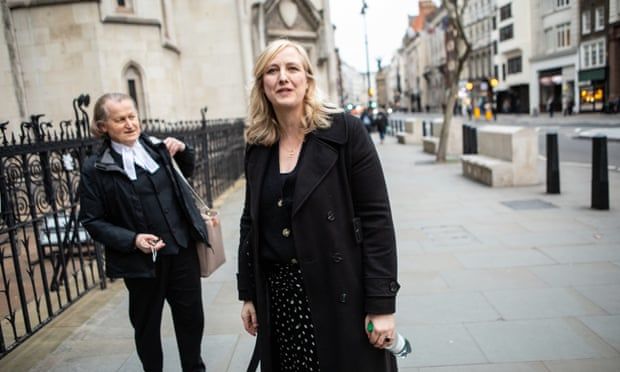 Observer journalist Carole Cadwalladr going to court during the libel suit brought against her by Arron Banks earlier this year.
Reporting on stories about Russia’s interference and British politics is extraordinarily difficult. It’s a month since I received the judgment in the libel suit Arron Banks brought against me as a result of my reporting on his relationship with Kremlin officials, a suit that began a month before Johnson took office and that has disfigured not just my journalism for the past three years, but my life.
Russian oligarchs and state-owned companies have brought suits against journalists Catherine Belton and Tom Burgis. And even when the chair of parliament’s intelligence and security committee revealed in parliament, weeks before the November 2019 general election, that Johnson had personally intervened to suppress the Russia report, there was almost no scrutiny of Johnson’s personal affiliations to Kremlin-linked individuals.
But it was that news that prompted me – with my colleague Mark Townsend – to get the Alexander Lebedev story out and on the record. And after a tortuous set of exchanges with Lebedev’s press spokesman in 2019, he confirmed the meeting, saying: “It was nothing out of the ordinary.”
He also said that Alexander Lebedev was an “outspoken critic of Putin”, that there was no suggestion he had “any relationship at all with the Kremlin”, and that “when the Lebedevs bought the papers, of course they would have been thoroughly vetted at that time”.
I also followed Sands’s advice. Back in July, she’d told me that she didn’t know what happened at the parties “on the late shift”. But she knew someone who would. “Ask Amol,” she said.
She meant Amol Rajan, the media editor of the BBC and now a presenter on the agenda-setting Today programme. Rachel Johnson cited him too as a guest at the Stud House party. Rajan, like Sands, had come to the BBC from the Lebedevs’ newspaper group.
Sands had been editor of the Evening Standard when Evgeny Lebedev appointed Rajan editor of the Independent in 2013, when Rajan was just 29. The Guardian’s report of the move at the time noted that “he has been a member of Lebedev’s inner circle for a number of years, acting as his private media adviser”.
On 14 November 2019, I messaged Rajan over Twitter to ask him “a couple of qs about Lebedev” and he promptly messaged back and picked up the phone. “There’s no ‘relationship’ now,” he told me. “I don’t know much about his current world. I worked closely with him for a long time but I left a long time ago.” I told him what Sarah Sands had told me about a “night shift” at his parties and how she had said he was a key member of that.
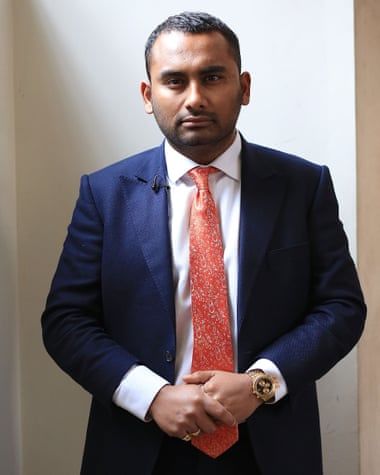 Amol Rajan, the BBC’s media editor and former editor of Lebedev’s Independent newspaper.
“I don’t know about that. I went many, many times many, many moons ago. I was a guest at a private house. I don’t talk about it but it’s not because I owe him anything. I’ve no idea what’s going on now. I was never there with Boris.
“I thought that story was out of order.” He was referring to a story by Open Democracy about an October party, at which the former glamour model Katie Price was reported to be a guest.
“Isn’t it in the public interest?” I asked him.
“I can see that. I just don’t think it’s on. It’s a private party at a private house.”
Townsend and I published our story on 17 November 2019. It landed to a deafening silence. The intelligence and security committee failed to get its Russia Report published. And less than a month later, in the early hours of 13 December, the Conservative party won a landslide victory and Boris Johnson was returned as prime minister.
Later that same day, he attended a party. A vodka and caviar party hosted at Evgeny Lebedev’s London home to celebrate his father, Alexander’s 60th birthday. A year later, his son took up his seat in the Lords. Johnson had appointed him to a life peerage and he is now Baron Lebedev of Hampton in the London Borough of Richmond upon Thames and of Siberia in the Russian Federation.
And last week, the BBC finally reported what the Observer first revealed in November 2019. It failed to mention that article. Or to ask its own media editor for his thoughts on the matter.
The British media and political establishment has never looked so ineffectual and incestuous. The Lebedev scandal isn’t even Profumo – it’s more serious than that. John Profumo slept with an escort, he didn’t hotfoot it out of the country with a possible stash of Nato documents to the mountain lair of an ex-KGB officer whose son he later ennobled.
It’s preposterous to even write the words, let alone to write them six months into the brutal war Russia has launched against Ukraine. It’s not just that we need answers. Our Nato allies need answers. Canada – one of the Five Eyes nations that shares intelligence with us – has sanctioned Alexander Lebedev. Why? And more to the point: why haven’t we?