London Daily

Focus on the big picture.
Thursday, Oct 22, 2026

Austria to go into full lockdown as Covid surges

Austria to go into full lockdown as Covid surges

Days after Austria imposed a lockdown on the unvaccinated, it has announced a full national Covid-19 lockdown starting on Monday.

Chancellor Alexander Schallenberg said it would last a maximum of 20 days and there would be a legal requirement to get vaccinated from 1 February 2022.

He was responding to record case numbers and one of the lowest vaccination levels in Western Europe.

Many other European countries are imposing restrictions as cases rise.

"We don't want a fifth wave," said Mr Schallenberg after meeting the governors of Austria's nine provinces at a resort in the west of the country.

For a long time, there had been a consensus over avoiding mandatory vaccinations, the chancellor said.

However, too many people had been incited not to get the jab, because of "too many political forces, flimsy vaccination opponents and fake news", he added. The measures are yet to be finalised.

Latest figures show the incidence rate has risen to 1,049.9 cases per 100,000 people in the past week, and Health Minister Wolfgang Mückstein said imposing a lockdown was a "last resort". A record 15,809 cases were reported in the past 24 hours, in a population of under nine million.

Under the measures, Austrians will be asked to work from home, non-essential shops will close, and schools will remain open for children who require face-to-face learning. They will continue until 12 December, but will be reassessed after 10 days.

Neighbouring Germany has seen several days of record infections this week, and Health Minister Jens Spahn has spoken of "a national emergency that requires a combined national effort".

German leaders have already agreed to introduce restrictions for unvaccinated people in areas with high hospital admissions. And parliament has backed requirements for people to show Covid passes on buses and trains, and in workplaces.

But now in Bavaria, which borders Austria, state premier Markus Söder has gone further, declaring a "de facto lockdown for the unvaccinated". Bars and clubs will close for three weeks and all Christmas markets have been cancelled. Where weekly incidence rates top 1,000 per 100,000 people - restaurants, hotels, sport and culture will also close.

Slovak Prime Minister Eduard Heger has already announced that a "lockdown for the unvaccinated" will start on Monday, and the Czech government is also limiting access to a variety of services. The Netherlands introduced a partial lockdown last weekend.

In the UK - where there is currently no lockdown, although masks have to be worn in some parts of the country - the incidence rate per 100,000 is 395.4 cases, officials figures show.
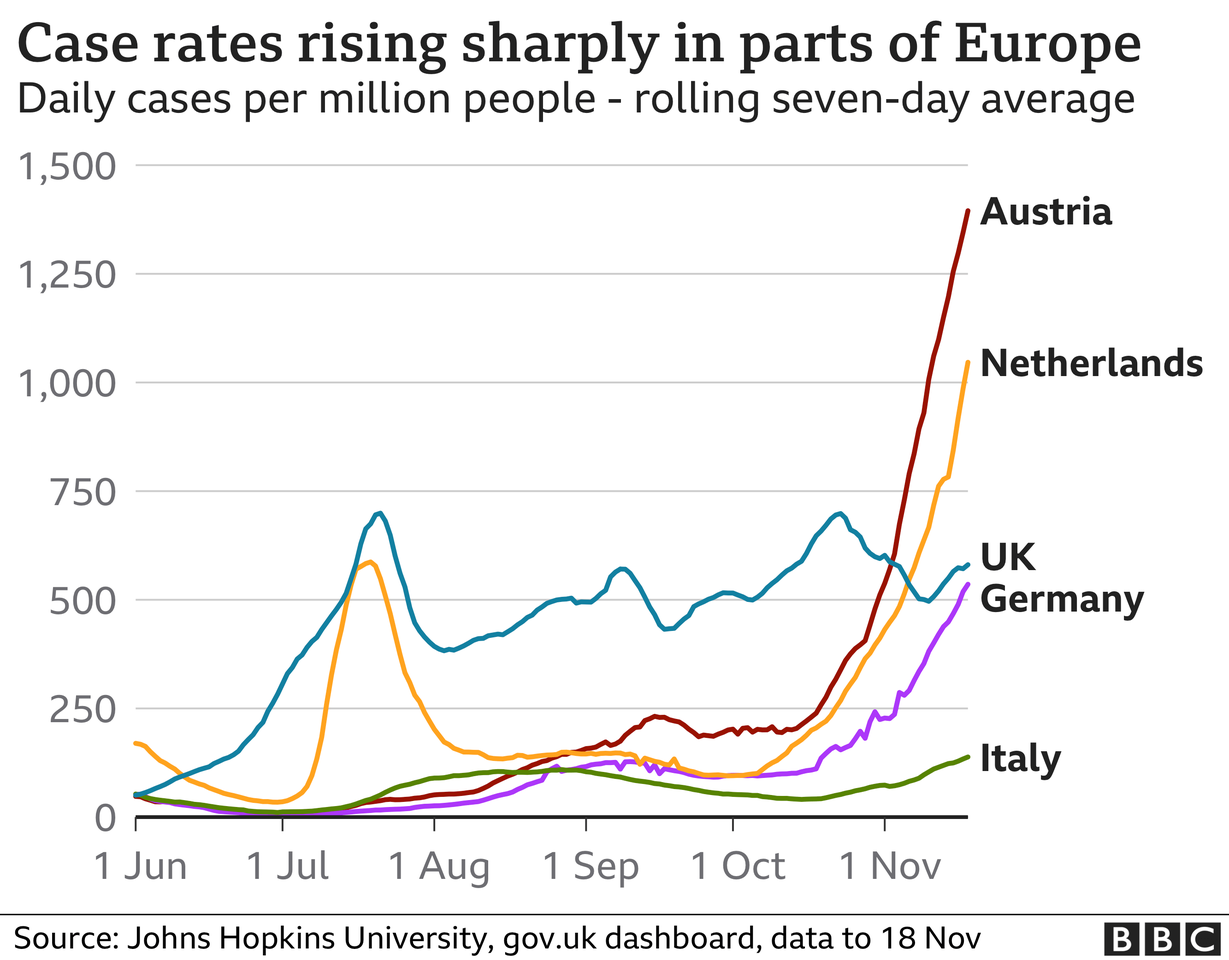

Austria's is the first full lockdown imposed by an EU country this winter.

The Europe regional director of the World Health Organization, Hans Kluge, has warned of a hard winter ahead. He blamed insufficient vaccination coverage along with "the easing of preventive measures and the spread of the more transmissible Delta variant".

Russia on Friday declared a record number of 1,254 Covid deaths in the past 24 hours, for the third day in a row.

Hungary reported its highest level of infections - with 11,289 new cases in a population of 10 million. A third booster jab will be made mandatory for health workers from Saturday, along with masks in most enclosed spaces.

Tighter restrictions also come into force in Belgium on Saturday, requiring working from home for four days a week.

Is Europe heading for lockdown?

There are only two ways for countries to slow the spread of Covid - build up enough immunity or limit contact between other people.

That wall of immunity - from a year of vaccination - is facing its first real test as winter rolls in across Europe.

It is already clear some countries - Austria being the most notable - have not vaccinated enough and feel the "need" to go back to restrictions that nobody "wants".

But it does not mean that every country is doomed to a winter lockdown.

Those that have vaccinated more, given boosters to more and protected more of the vulnerable and elderly (who are the most likely to need hospital care) have the best shot at a manageable winter.

The impact of the UK having high levels of Covid through autumn, which will have topped up immunity levels, will be closely watched too.

However, it is still only November. There are many dark months to get through before the weather improves and makes it harder for Covid to spread.

Newsletter

Related Articles

0:00
0:00
Close
Parliamentary Inquiry Highlights Urgent Need to Address Housing Shortage as Scottish Completions Hit Eleven-Year Low
United Kingdom and Singapore Sign Comprehensive Financial Agreement to Deepen Digital and Sustainable Market Ties
Greggs Announces Plan to Close Four Manufacturing Facilities and Cut Seven Hundred and Forty Jobs
International Monetary Fund Raises United Kingdom Economic Growth Forecast While Warning of Inflationary Pressures
Energy Security and Net Zero Committee Urges Government to Shift Policy Costs Onto Gas to Lower Household Bills
Housebuilding Across Scotland Plummets to Eleven-Year Low Despite Government Pledges to Tackle National Housing Emergency
Greggs Announces Factory Closures Across Northern England and Scotland Affecting Seven Hundred Forty Jobs
United Kingdom and Singapore Conclude Eleventh Financial Dialogue in Singapore to Deepen Cooperation on Digital Finance and Capital Markets
Energy Security and Net Zero Committee Urges Government to Shift Policy Costs to Gas Bills and Tap Windfall Profits to Lower Consumer Prices
British Broadcasting Corporation Announces Major Cost-Cutting Overhaul to Close Linear Broadcast Services for Television Channels BBC Three and BBC Scotland Alongside Digital Radio Station BBC Radio Four Extra
London Capital Markets Face Renewed Scrutiny After High-Profile Offerings Underperform Post-Listing
Green Party Wins Historic First Westminster Parliamentary By-Election in Gorton and Denton
Environment Secretary Emma Reynolds Unveils Sweeping Regulatory Overhaul for English Water Industry
United Kingdom Health Security Agency Confirms Thirty-Four Cases in Kent Meningitis Outbreak
Ministry of Defence Prepares Heat Pump Subsidy Cuts to Fund Urgent Military Modernization
British and European Union Officials Schedule Long-Awaited Bilateral Leaders Summit for November Twentieth
Bank of England Governor Andrew Bailey Urges Strict Fiscal Credibility to Protect British Bond Markets
United Kingdom Inflation Rises to Three Point One Percent Driven by Escalating Fuel Costs
Profit Warnings Among London-Listed Companies Reach Two-Year High Amid Global Energy Shocks
Chancellor John Healey Signals Targeted Tax Changes on Banks and London Corporate Offices Ahead of Budget
British Government Reallocates Twenty-Five Per Cent of International Climate Finance to Global Biodiversity Projects
Initial British Carbon Border Taxes Set to Undercut Parallel European Union Tariffs on Industrial Imports
Whitehall Prepares National Zero-Interest Loan Initiative to Accelerate Domestic Heat Pump and Solar Adoption
European Union Offers British Automakers Access to Hybrid Vehicle Trade Protections Subject to Strict Regulatory Alignment
British Probation Officers Threaten Widespread Industrial Action After Rejecting Five Per Cent Government Pay Offer
Microsoft Abandons Major British Artificial Intelligence Data Centre Citing Severe National Grid Power Constraints
United Kingdom Inflation Accelerates to Three Point Four Per Cent Ahead of Chancellor John Healey's Inaugural Autumn Budget
Surging Cloned Number Plates Severely Complicate Traffic Enforcement and Police Investigations
Mounting Opposition Challenges Planned Rollout of Autonomous Taxis Across London
Influential Think Tank Urges Rejoining European Union to Navigate Geopolitical Crises
Government Review Recommends Slashing Benefits to Fund Youth Employment Initiatives
Senior Minister Shabana Mahmood Seeks New Law Enforcement Pact With European Union
Airbus Executive Warns Britain Risks Losing Crucial Role in European Space Industry
Exorbitant Electricity Costs Push British Steelmakers to Worst Competitive Position in Three Years
British Food and Beverage Exports to European Union Collapse by Over a Third Since Brexit
Up to Twenty English Maternity Units Face Impending Closure Due to Safety and Staffing Crises
Government Declares Severe Drought Across Southern England Following Record Dry Spell
Corporate Profit Warnings Reach Two-Year High Amid Middle East Conflict and Rising Costs
International Monetary Fund Warns Chancellor John Healey Against Proposed Bank Tax Raid
Northern Ireland Secures Favorable Agricultural Export Agreement with European Union
Scottish Government Approves Major Offshore Floating Wind Farm Near Aberdeenshire
High Speed Two Rail Project Faces Three Billion Pound Cost Escalation on Initial Phase
National Health Service Warns of Winter Capacity Crisis Across English Hospitals
Tata Steel Confirms Two Thousand Job Cuts at Port Talbot to Fund Green Transition
Global Microchip Developer Announces Three Billion Pound Semiconductor Plant in Cambridge
United Kingdom Artificial Intelligence Safety Institute Proposes Mandatory Licensing for Generative Models
United Kingdom Commits Additional Long-Range Weapons and Air Defenses to Ukraine
British Chancellor Overhauls Infrastructure Financing to Bypass Borrowing Constraints
Bank of England Holds Benchmark Interest Rate at Four Point Five Percent
First Minister Rhun ap Iorwerth Confirms Constitutional Discussions Over Welsh Independence During Initial Bilateral Call with Prime Minister
×