

Aukus: China denounces US-UK-Australia pact as irresponsible
The deal will see the US and UK give Australia the technology to build nuclear-powered submarines for the first time.
It is being widely viewed as an effort to counter China's influence in the contested South China Sea.
The region has been a flashpoint for years and tensions there remain high.
Chinese foreign ministry spokesman Zhao Lijian said the alliance risked "severely damaging regional peace... and intensifying the arms race".
He criticised what he called "the obsolete Cold War... mentality" and warned the three countries were "hurting their own interests".
Chinese state media carried similar editorials denouncing the pact, and one in the Global Times newspaper said Australia had now "turned itself into an adversary of China".
The US is sharing its submarine technology for the first time in 50 years, having previously only shared it with the UK.
It means Australia will now be able to build nuclear-powered submarines that are faster and harder to detect than conventionally powered fleets. They can stay submerged for months and shoot missiles longer distances - although Australia says it has no intention of putting nuclear weapons on them.
The new partnership, under the name Aukus, was announced in a joint virtual press conference between US President Joe Biden, UK Prime Minister Boris Johnson and his Australian counterpart Scott Morrison on Wednesday evening and Thursday morning.
And while China was not mentioned directly, the three leaders referred repeatedly to regional security concerns which they said had "grown significantly".
"This is an historic opportunity for the three nations, with like-minded allies and partners, to protect shared values and promote security and prosperity in the Indo-Pacific region," a joint statement read.
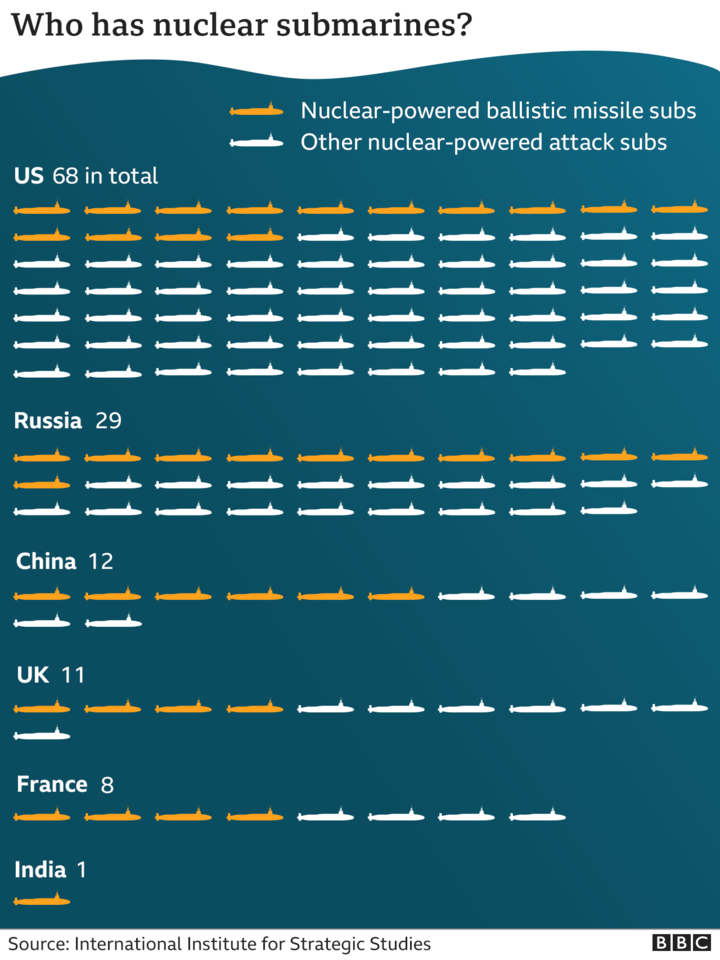
The Aukus alliance is probably the most significant security arrangement between the three nations since World War Two, analysts say.
It means Australia will become just the seventh nation in the world to operate nuclear-powered submarines.
While they are the big-ticket item in the deal, cyber capabilities and other undersea technologies will also be shared.
"This really shows that all three nations are drawing a line in the sand to start and counter [China's] aggressive moves," said Guy Boekenstein from the Asia Society Australia.
Boris Johnson later said the pact would "preserve security and stability around the world" and generate "hundreds of high-skilled jobs".
UK Defence Secretary Ben Wallace told the BBC that China was "embarking on one of the biggest military spends in history... Our partners in those regions want to be able to stand their own ground."
In recent years, Beijing has been accused of raising tensions in disputed territories such as the South China Sea.
It has been increasingly assertive over what it says are centuries-old rights to the contested region, and has been rapidly building up its military presence to back up those claims.
The US has bolstered its military presence too, and has been investing heavily in other partnerships in the region such as with Japan and South Korea.
Having the submarines stationed in Australia is critical to US influence in the region, analysts say.
Tensions between China and Australia
China is Australia's biggest trading partner, and in the past, the two have maintained good relations.
But in recent years, political tensions have created a deep rift, stoked by Australia criticising China's treatment of ethnic Uighurs, banning some technology from telecom giant Huawei and supporting an investigation into the origins of the coronavirus pandemic.
Western nations have also been wary of China's booming infrastructure investment on Pacific islands, and have criticised its heavy trade sanctions against countries like Australia - last year it slapped Australian wine with taxes of up to 200%.
On Thursday, US Secretary of State Antony Blinken said the US stood solidly behind Australia in its defences against China.
"Beijing has seen over the past months that Australia will not back down and the threats of economic retaliation and pressure simply will not work," he said.
'A stab in the back'
But France has also reacted angrily to the new pact, because it means Australia will now abandon a $50bn (€31bn; £27bn) deal with it to build 12 submarines.
"It's really a stab in the back," France's Foreign Minister Jean-Yves Le Drian told France Info radio. "We had established a relationship of trust with Australia, this trust has been betrayed."
The European Union's foreign policy chief, Josep Borrell said he understood why France was disappointed by the deal, adding that the EU was not consulted about the new alliance.
"This forces us once again... to reflect on the need to make the issue of European strategic autonomy a priority. This shows that we must survive on our own," he said on Thursday.
Secretary Blinken said the US cooperated "incredibly closely" with France and would continue to do so, adding that "we place fundamental value on that relationship, on that partnership".