


YouTube Fake Biden’s popularity by systematically deleting thousands of Dislikes from videos
Zach Vorhies, former senior software engineer at Google and YouTube, now self-proclaimed whistleblower, has started his own investigation into disappearing dislikes for a Joe Biden video. The "dislikes" or thumbs-down icon shows the video with 1.9K "likes" and 11K "dislikes," while the same video shortly after shows 2.4K Likes vs. 4.8K Dislikes, dropping the original number of Dislikes by more than half.
The videos were uploaded or streamed from the official White House government YouTube page. In the example posted by Vorhies, no one has contested his assertion, and Twitter has not labeled the tweet as misinformation. The post has received 2.7K retweets, 425 comments, and 4.5K Likes.
It’s important to note that at one point Vorhies leaked documents to the right-wing group Project Veritas, then became a committed anti-vaxxer (vaccine) and promoter of QAnon. Last year he laid out a plan to promote “Plandemic,” a pair of 2020 conspiracy theory videos produced by Mikki Willis that Wikipedia claims promote misinformation about the COVID-19 pandemic.
Vorhies' post on Twitter set off a firestorm of followers on several platforms, including Gab.com, where TexasVet posted similar images of Press Secretary Jen Psaki on Wednesday at 3:11 and then again at 7:31. The earlier post, time-stamped at 3:11, shows 1.8K likes and 10K dislikes for the video. The 7:31 time-stamped still image of the video shows 2.5K likes and 3.1K dislikes, cutting the dislikes by more than two thirds.
YouTube notes the policies and systems in place to ensure that engagement on YouTube is authentic, and that fraudulent metrics are removed. Sometimes the Likes or Dislikes are a result of spam, according to YouTube documents, at which time they are removed.
This de-spamming process is ongoing, per YouTube. It starts as soon as a video is uploaded and continues to ensure that all metrics are valid.
It turns out this happens more often than some think, and it can become an issue. A 2019 article on The Verge calls attention to “Dislike mobs,” which are the YouTube equivalent to review bombing that negatively impacts a product or service.
Engagement metrics on videos are updated regularly to reflect organic engagement. This process initiates as soon as the stream starts and continues for several hours.
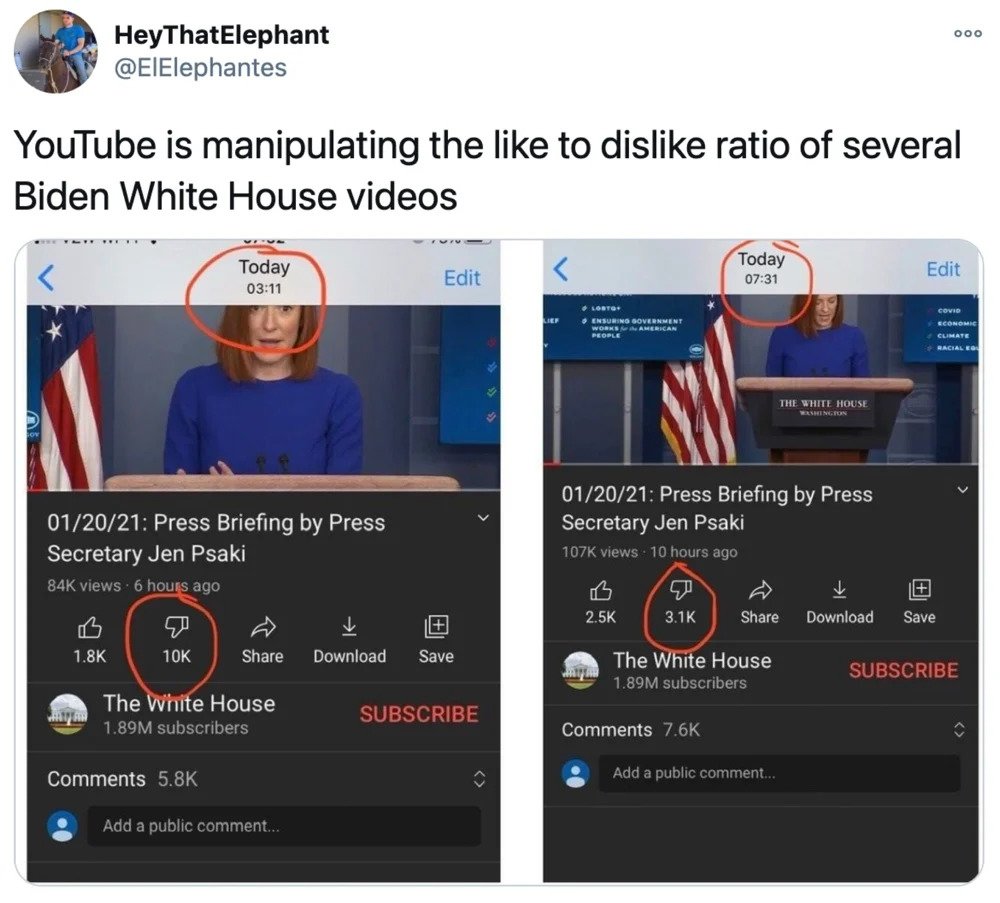
YouTube deleted what appears to be thousands of “dislikes” from videos on the official channel of President Joe Biden’s White House. The company said it’s a part of its regular efforts to remove engagement it considers inauthentic.
People on the platform noticed that dislikes have been disappearing by the thousands from several White House videos and started posting before-and-after screenshots on social media shortly after the incoming administration took over the channel and published its first videos.
The screenshots indicate a total of at least 16,000 dislikes were removed from at least three videos. Even after the adjustments, the five videos on the channel had about 14,000 likes combined versus nearly 60,000 dislikes as of 3:30 p.m. on Jan. 21.
In response to a screenshot of one of the videos, YouTube told The Epoch Times that it’s monitoring engagement on the site to detect and remove activity it considers spam so that only engagement it considers organic remains. The mechanism worked as intended in the case of the Biden video, the company stated.
“YouTube regularly removes any spam likes or dislikes from your videos,” the company stated in a 2019 tweet. “It may take up to 48 hours for the numbers to be updated.”
It isn’t clear how YouTube discerns between authentic and inauthentic engagement; the company didn’t immediately respond to a request for further details.
YouTube and its owner, Google, have long faced accusations of political bias. The companies have said their products are developed and run as politically neutral, but employee accounts and leaked internal materials indicate the companies are indeed infusing their politics into their products.
Google shifted millions of votes in the Nov. 3, 2020, presidential election by pushing its political agenda onto its users, according to research psychologist Robert Epstein, who assembled a team of more than 700 voters to monitor what results they were receiving from channels such as search results, reminders, search suggestions, and newsfeeds ahead of the election.
In the aftermath of the election, YouTube banned content that said the election was stolen through fraud, an allegation raised by former President Donald Trump and many others. The allegation hasn’t been proven in court, although it is supported by a significant body of evidence, including hundreds of sworn affidavits and analyses of statistical anomalies.
Google and YouTube are the world’s two most popular websites, according to Alexa ranking. Politicians on both sides of the aisle have raised concerns over the massive power held by Google and several other tech giants.