

Welcome to Trussworld
Just hours after reading at the queen’s funeral, Britain’s new prime minister headed for New York to set out her stall on the world stage. The biggest question awaiting her: Was anyone listening?
The trip had been the focus of careful planning by the transition team preparing for the arrival of a new occupant of No. 10 Downing Street over the summer. For Truss, who arrived in Downing Street with a more distinct foreign policy agenda — though less name recognition — than her predecessors, the U.N. General Assembly was a significant outing.
A No. 10 official said the monarch’s passing had forced Truss’ team to briefly consider the possibility that she would not make it. But while she insisted to journalists traveling aboard her plane that her focus had been on the period of national mourning, in reality, she was multitasking as work began behind the scenes to establish a “slimmed down” No.10 team for the trip, said one person involved, with more policy meetings and fewer receptions. Former Prime Minister Boris Johnson may have been a global star, but for the team coordinating such trips, some of whom stayed on in Downing Street, Truss is more reliable and less prone to unscripted brouhaha.
Her two previous jobs as international trade secretary and foreign secretary provided a launchpad from which to formulate her view of the world: namely one in which democracies must prevail in a battle of ideas against authoritarian regimes such as Russia and China.
“There is a real struggle going on between different forms of society — between democracies and autocracies,” she told delegates. “Unless democratic societies deliver on the economy and security our citizens expect, we will fall behind.”
She called on the G7 and like-minded partners to act as an “economic NATO,” collectively defending prosperity.
What’s less clear is if anybody took any notice: In a sparsely attended hall, Truss’ words fell somewhat flat after a 12-hour day of speeches in which U.S. President Joe Biden and Ukraine’s Volodymyr Zelenskyy, via video, had also spoken. Biden even hosted a leaders’ reception at a museum across town that started just ahead of Truss’ speech. The traveling British press pack had also gone home by the time she spoke in order to report on an impending economic announcement and not many others seemed to want to stick around.
There was little buzz around her debut, according to two U.S. and European attendees. One suggested this was inevitable — with all eyes on Biden and Zelenskyy, and in particular, after Russian President Vladimir Putin escalated the nuclear threat — but another faulted her decision not to do any foreign media on the trip.
Foreign policy PM
Truss places particular importance on expanding the traditional G7 gang to hug close countries including India, Australia, Indonesia and South Africa.
Truss told POLITICO en route to New York: “What our foreign policy is about is working closely with our allies to enhance our economic security and our hard security, and it’s about entering deeper partnerships, of course, with our long-standing allies like the United States and our European colleagues, but also with countries like India that we want closer defense and economic cooperation [with].”
She added: “Japan is a very important ally — Australia, New Zealand, moving forward with AUKUS so that we are able to make sure democracies are not undermined and we do not see an increasing encroachment of authoritarianism around the world,” referencing the trilateral security pact between Australia, the United Kingdom, and the United States.
One of her first audiences in New York was with Japan’s Fumio Kishida, a friendly meeting that took place over bento boxes in a Midtown restaurant where Truss proved a dab hand with the chopsticks.
A senior government official described her global outlook as “a big part of her identity” and said she had a tendency to be “hyperactive” on this front.
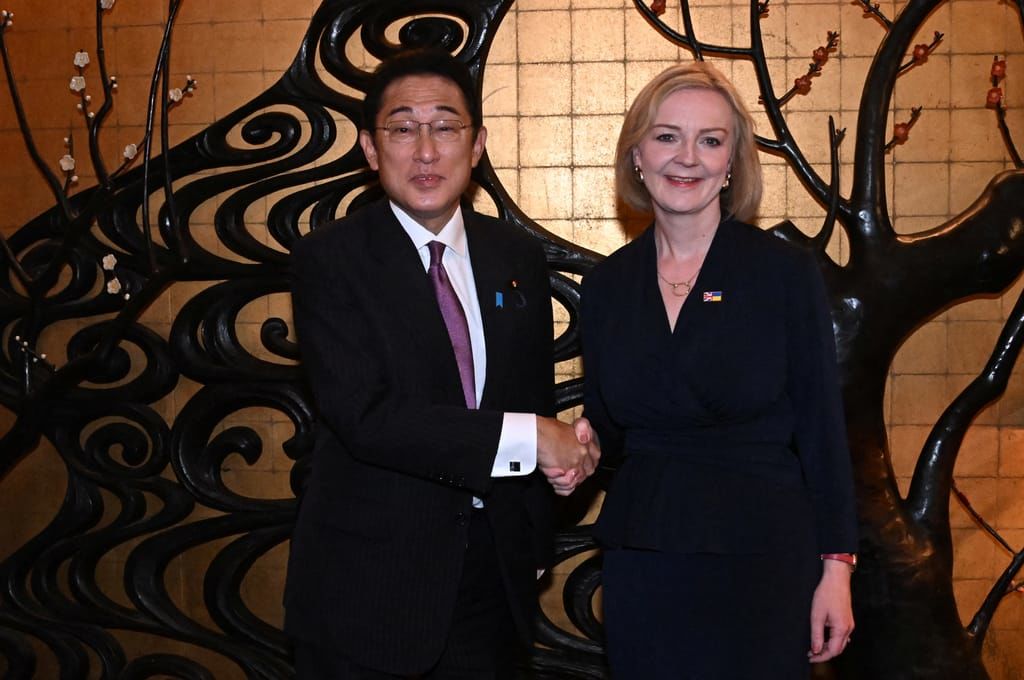 British Prime Minister Liz Truss with Japan’s Prime Minister Fumio
Kishida ahead of a lunch bilateral meeting at a Japanese restaurant
during their visit to the US
British Prime Minister Liz Truss with Japan’s Prime Minister Fumio
Kishida ahead of a lunch bilateral meeting at a Japanese restaurant
during their visit to the US
A former Conservative Party adviser predicted: “Foreign policy [under the Truss administration] is going to be run from No. 10. People say it was ever thus, but it’s not the same,” noting of her Foreign Secretary James Cleverly: “He’s a nice, fun guy who’ll go around being jovial.”
Another priority is to demonstrate toughness on Russia’s Ukraine war. Standing up to Moscow was centered in all her UNGA activities, and has also informed her newly minted top team.
She has appointed Vicky Ford as development minister and brought her into the Cabinet — a role expected to focus on reconstruction in Ukraine.
Best-laid plans
But for all the words of solidarity over Russia and China, the prime minister’s meetings with Western allies were overshadowed by the ongoing impasse over trade rules in Northern Ireland.
While Downing Street may have wanted to concentrate on Ukraine, Biden had other ideas. His national security adviser, Jake Sullivan, loudly advertised the president’s desire to discuss the protocol, and Biden declared he was “looking forward to hearing what’s on your mind” with reference to Northern Ireland.
However, after the meeting, which ran over, a Downing Street spokesman said only that they agreed “that the priority must be protecting the Belfast (Good Friday) Agreement and preserving the gains of peace in Northern Ireland,” in line with previous statements.
She avoided the topic altogether in her one-on-one with French President Emmanuel Macron, while it was mentioned briefly in neutral terms in the official readouts of her encounter with European Commission President Ursula von der Leyen.
A sense of lack of progress was accentuated by signals from the government that they regard next year’s 25-year anniversary of the Good Friday peace agreement as a key decision point.
The PM’s spokesman denied Truss was allowing the matter to drift. “The view is that this is an important issue that needs to be resolved,” he said, suggesting they saw the meeting with von der Leyen — which took place in private with no aides — as the most fruitful on this front.
British officials also kicked back against the idea the new prime minister had not made an impact.
U.K. Ambassador to the U.S. Karen Pierce told reporters: “She knows America really well. She’s been coming here for several years in other guises … She comes personally from time to time, and she’s established really good working relationships.”
Separately, a diplomatic aide reflected Truss would remain steadfast on Ukraine, noting that she was buoyed by continued public backing, a support much stronger than that in France or Germany.
They described Britain’s strong stance against Russia as both politically expedient and morally right: “It’s just as well, because after Brexit, without Ukraine, what is our foreign policy?”

