

UK inflation: Supermarkets say price rises will ease soon
Inflation was expected to fall below 10% last month but soaring food prices meant it fell by less than expected.
"You would expect to see [global food price falls] reflected in supermarkets but we're not there yet," the Office for National Statistics told the BBC.
The retail industry body said there was a three to nine-month lag to see price falls reflected in shops.
"As food production costs peaked in October 2022, we expect consumer food prices to start coming down over the next few months," the British Retail Consortium said.
Inflation, which measures the rate of price rises, fell to 10.1% in the year to March from 10.4% in February, driven by food prices rising at their fastest rate for 45 years.
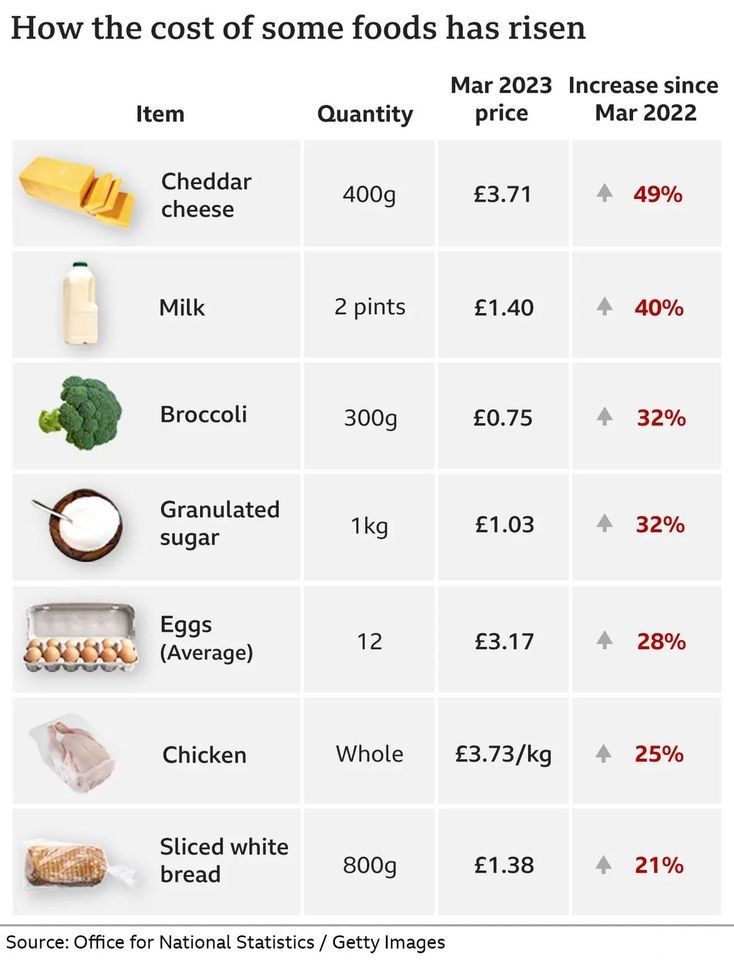
There were big jumps in prices for products including olive oil (up 49%), milk (up 38%) and ready meals (up 21%).
Campaigners point out that rising food prices hit poorer households the hardest, as they spend a greater proportion of their income on groceries.
The war in Ukraine has driven up food prices around the world, but the UK has faced other problems on top of this - from Brexit red tape to labour shortages.
This year in particular, bad weather abroad led to shortages of some vegetables - a situation made worse by UK farmers producing less due to surging energy costs.
UK farmers have also argued that supermarkets are not paying a fair price for their produce - something the supermarkets deny.
The government's former food tsar Henry Dimbleby has said supermarkets having "fixed-price contracts" with suppliers means that when food is scarce, some producers opt to sell less to the UK and more elsewhere in Europe.
Grant Fitzner, chief economist for the Office for National Statistics, which provides the figures, said the agency did not make forecasts. But he said it was "certainly within the realm of possibility" that double digit inflation is sustained at least for another month with food prices continuing as they are.
Jane from Blackpool has found the last five to six months tough on the purse, particularly with the weekly shop.
She told the BBC's Radio Five Live that she couldn't afford to eat breakfast or lunch. "For teatime we have a jacket potato with beans. A couple of times a week we'll add cheese to that because we're feeling a little bit more flush. And on a really good occasion we'll have tuna."
For many people like Jane, higher prices across the board have meant having to run on a tighter budget.
"We got a letter last month saying our mortgage rate is going to go up again. I listen to the news in the hope the mortgage rates are going to go down or something's going to give."
Inflation in the UK remains higher than in other Western countries, including the US, Germany, France and Italy. On Wednesday, new figures showed eurozone inflation eased to 6.9% last month, from 8.5%.
Analysts at Capital Economics said UK inflation had "risen further and stayed higher than elsewhere as the UK has experienced the worst of both worlds - a big energy shock, like the euro-zone, and labour shortages - even worse than the US."
UK energy prices are likely to come down quickly, it added, but the issues in the labour market would probably persist until late 2024.
Chancellor Jeremy Hunt said he was still confident that inflation would fall sharply by the end of the year.
He added: "We have a plan and if we're going to reduce that pressure on families, it's absolutely essential that we stick to that plan, and we see it through so that we halve inflation this year as the prime minister has promised."
But Rachel Reeves, Labour's shadow chancellor, said: "The reality is that under the Tories our economy is weaker, prices are out of control and never have people paid so much to get so little in return."
While food prices remained stubbornly high, petrol prices eased, bringing some relief for motorists.
Unleaded petrol prices peaked at about £1.90 in July and were down below £1.50 in March.
Falling inflation doesn't mean prices are falling, but just that the rate of price rises is slowing.

Simon Mellin, founder and chief executive of The Modern Milkman, a milk delivery service, said the food industry had faced soaring costs in recent months, with milk, eggs and packaging prices all going up.
He believes that food prices will start to stabilise, but will remain at a much higher level than they were this time last year.
"I'm really unsure if food prices will drop as much as everyone expects," he told the BBC.
"I expect some reductions but I wouldn't personally expect huge reductions in the next twelve months."
He said he was trying not to pass higher prices onto customers, but added that it was a balance the business had to tread.
The Bank of England has been raising interest rates to try and curb inflation. In March, the Bank increased rates for the eleventh time in a row, taking the main rate to 4.25%.
The idea is that when people have less money to spend, they buy fewer things, reducing the demand for goods and slowing price rises.
Following the latest inflation figures, Luke Bartholomew, senior economist at abrdn, said a further rate rise next month is now "likely", with inflation pressures proving "more persistent than the Bank of England expected".
Rate rises mean higher mortgage payments for some homeowners and those with loans. But they can also benefit savers if banks pass on the higher rate to customers.