London Daily

Focus on the big picture.
Thursday, May 28, 2026

UK gov’t facing High Court battle over arms sales to Saudi Arabia

UK gov’t facing High Court battle over arms sales to Saudi Arabia

The Campaign Against Arms Trade group says the weapons exports have contributed to the deaths of thousands of civilians.

A campaign group has launched a courtroom battle against the United Kingdom’s arms sales to Saudi Arabia, warning the weapons are worsening a major humanitarian disaster in war-torn Yemen.

The United Kingdom’s High Court on Tuesday began hearing the case brought forward by the Campaign Against Arms Trade (CAAT), which says arms exports have contributed to the deaths of thousands of civilians.

The UK-based group is challenging the lawfulness of a decision taken by the British government in 2020 to continue supplying weapons to the Saudi-led coalition involved in the nine-year-old conflict in Yemen.

It marks the latest development in a long-running battle over the legality of the exports, which CAAT says have made the UK more than 23 billion pounds ($28bn) since the war began.
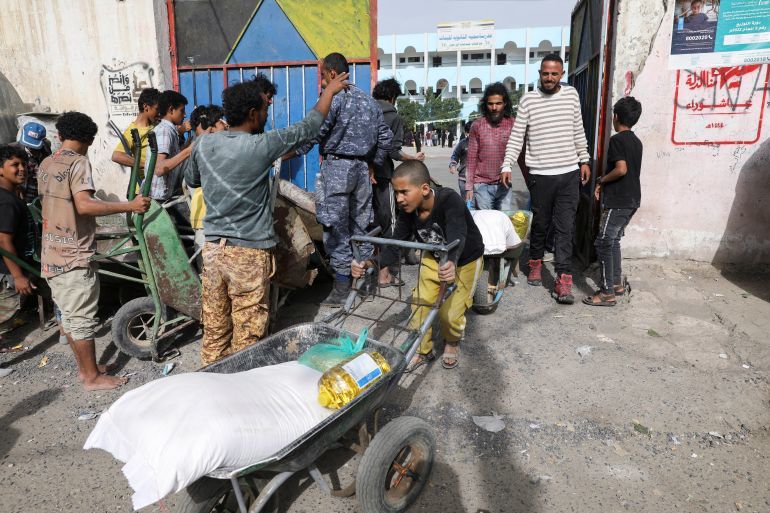
Yemen is facing one of the world’s most pressing humanitarian crises, with more than 23 million people estimated by the UN to be in need of humanitarian assistance

CAAT won a similar fight in 2019, when Court of Appeal judges said continuing to license military equipment that could be used in the war in Yemen for export was unlawful amid concerns it may have been used to commit war crimes.

The government temporarily halted sales following the ruling. UK law does not allow for the export of weapons if there is a “clear risk” they may be used to carry out war crimes.

However, exports resumed in mid-2020 under the order of then-trade minister Liz Truss after a governmental review.

The review concluded that possible violations of international humanitarian law by actors using UK-supplied weapons were only “isolated incidents”.


Governmental review under scrutiny


British arms sales to Saudi Arabia have continued in recent years, despite the UK’s leading ally, the United States adopting a partial ban on weapons exports to the kingdom because of the war in Yemen.

Meanwhile, campaigners and rights groups have disputed the validity of the governmental review’s findings.

“The ample evidence of laws of war violations by the Saudi-led coalition in Yemen throughout the war make clear that these violations are not simply ‘isolated incidents’ as claimed by the UK government,” Niku Jafarnia, Yemen and Bahrain researcher at Human Rights Watch, said.

“UK weapons have been used in some of these violations with total impunity,” Jafarnia said.

“At a time when the UK is promoting a rules-based international order, and rightly calling out Russia for serious violations of international law, it needs to apply those same rules to itself and end the sale of weapons to Saudi Arabia.”

The weapons supplied by the UK include Paveway guided bombs and Brimstone and Storm Shadow missiles.


‘UK bombs kill civilians’


Emily Apple, a spokesperson for CAAT, accused the government of “caring more about profit than war crimes”.

“The … case is being taken in solidarity with the people of Yemen who deserve justice,” Apple said.

“We cannot sit by while UK bombs kill civilians and cause devastation while UK arms dealers profit.”

The conflict in Yemen started in 2014 when Houthi rebels, backed by Iran, seized large swaths of the country, including the capital, Sanaa.

The war escalated in March 2015, when the Saudi Arabia-led coalition intervened in an attempt to restore the government of President Abd-Rabbu Mansour Hadi.

The coalition has been assisted by several Western powers, including the UK and the US.

Both sides in the conflict have since been accused of war crimes during fighting that has killed more than 8,900 people to date, according to the Yemen Data Project.

A United Nations-brokered truce deal agreed to in April of last year has largely held, despite expiring in early October.

The agreement has delivered the longest stretch of relative calm in Yemen since the war began, but both sides have stepped up moves to economically weaken the other in the interim.


Newsletter

Related Articles

0:00
0:00
Close
US and Iran Exchange Direct Military Strikes Amid Fragile Gulf Ceasefire
World Health Organization Warns of Catastrophic Ebola Outbreak in DR Congo
Russia Threatens New Wave of Strikes on Ukrainian Infrastructure and Embassies
Scientists Warn Atlantic Ocean Currents Could Collapse Faster Than Projected
Anthropic Reaches $900 Billion Valuation in Historic AI Funding Round
Washington Imposes Crippling Sanctions on Iranian Maritime Authority
Japan and the Philippines Initiate Strategic Intelligence-Sharing Pact
Microsoft Deploys Autonomous Computer-Using AI Agents to Global Markets
Anthropic Secures $45 Billion Compute Infrastructure Agreement With SpaceX
U.S. Director of National Intelligence Resigns Amid Administration Shakeup
Micron Technology Crosses Trillion-Dollar Valuation Amid Unprecedented Hardware Demand
Canada and Germany Finalize Historic Long-Term LNG Export Agreement
China Expands International Travel Restrictions on Domestic AI Researchers
Japan Approves Sweeping Overhaul of National Intelligence Apparatus
Global Airlines Scramble Logistics as Middle East Airspace Remains Fractured
Japan's Naphtha Imports Plunge 47 Percent Amid Strait of Hormuz Closure
Global Crude Prices Retreat Below $96 as Gulf Tensions Momentarily Ease
Generative AI Outperforms Human Baselines in Landmark Global Creativity Study
NASA Partners With Private Aerospace to Unveil Permanent Lunar Base Architecture
South Korean Equity Markets Surge on Next-Generation Memory Chip Frenzy
U.S. Treasury Yields Slip as Energy-Driven Inflation Anxiety Cools
Extreme Spring Heatwave Blankets Europe Raising Summer Climate Alarms
European Union Faces Widespread Local Backlash Over Mega Data Centers
Washington Prepares Cuba Contingency Plans Amid Escalating Havana Pressure
U.S. Maintains Strategic Trade Tariffs Despite Advancing International Pacts
Canada Defies U.S. Defense Contractors With Swedish Arctic Surveillance Fleet Purchase
Wall Street Hovers Near Record Highs as Retail Sector Defies Inflation Constraints
Caesars Entertainment Agrees to $17.6 Billion Acquisition by Fertitta
White House Accelerates Infrastructure Security Following Violent Incidents
Prediction Market Legal Battles Escalate as Kalshi Sues Minnesota
World Health Organization Issues High Alert on Mutating Avian Influenza
'They're people from all walks of life across the UK'
EU Digital ID Claims Misstate What Brussels Can Legally Force on Member States
The Great Western Exit: Why Best Citizens Are Fleeing the Rich World [PODCAST]
The New Robber Barons of Intelligence: Are AI Bosses More Powerful Than Rockefeller?
The End of the Old Order [Podcast]
Britain’s Democracy Is Now a Costume
The AI Gold Rush Is Coming for America’s Last Open Spaces [Podcast]
The Pentagon’s AI Squeeze: Eight Tech Giants Get In, Anthropic Gets Shut Out [Podcast]
The War Map: Professor Jiang’s Dark Theory of Iran, Trump, China, Russia, Israel, and the Coming Global Shock [Podcast]
Labour Is No Longer a National Party [Podcast]
AI Isn’t Stealing Your Job. It’s Dismantling It Piece by Piece.
Lawyers vs Engineers: Why China Builds While America Litigates [Podcast]
Churchill’s Glass: The Drunk, the Doctor, and the Myth Britain Refuses to Sober Up From
Apple issues an unusual warning: this is how your iPhone can be hacked without you doing anything
Kennedy’s Quiet War on Antidepressants Sparks Alarm Across America’s Medical Establishment
The Met Gala Meets the Age of Billionaire Backlash
Russian Oligarch’s Superyacht Crosses Hormuz via Iran-Controlled Route
Gunfire Disrupts White House Correspondents’ Dinner as Trump Is Evacuated
A Leak, a King, and a Fracturing Alliance
×