

UK farmers call for urgent action to prevent soaring food prices
Farmers are calling for urgent government action to prevent soaring food prices and potential shortages in the UK as the war in Ukraine threatens grain and oilseed harvests, energy costs and the production of fertiliser.
The National Farmers’ Union (NFU) has written to the government warning of “multiple compounding factors that have profound implications and risks for our food security” including further pressure on labour costs as Ukrainian workers have made up about 60% of workers taking up seasonal worker visas to pick and pack produce since the UK left the European Union.
It has called for a review of the immigration system to help bring in 10,000 more seasonal workers and for urgent action to prioritise gas for food production and make it easier to use organic fertilisers and manure as an alternative to those produced using fossil fuels.
Minette Batters, the president of the NFU, said the war had “focused attention on the importance and fragility of food security, both at home and abroad”.
“There are some clear short and long-term actions that government can take to maintain confidence and stability across the UK’s food producing businesses,” she said. “We have shared these with government and we want to stress that we stand ready to take these forward together, in order to navigate the extreme volatility we see today and expect to grow in the coming months.”
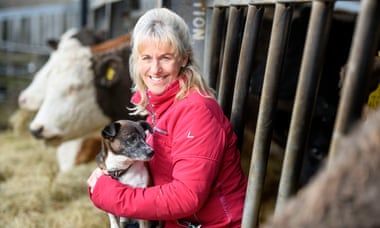 The NFU president Minette Batters on her farm near Salisbury, Wiltshire with her herd of Simmental Cross cattle.
While the UK does not import much wheat directly from Ukraine, the country plays a significant part in European food production and the war there has forced up prices across the board.
The country also accounts for about 45% of rapeseed which is imported to the UK and used to make cooking oil, more than a fifth of maize imports, which are used for animal feed and biofuels, while 80% of sunflower oil comes from the Black Sea region and has been interrupted by the war, according to analysts at the UK’s Agriculture and Horticulture Development Board.
The NFU’s call for action comes as Yara, one of the world’s largest fertiliser producers, said it was now running at only half its normal capacity after shutting two plants in Italy and France this week because of the rising price of gas, a key input to the production process. Gas prices have risen amid the risk of a cutoff in supply from Russia, which produces about 40% of that used in Europe.
Svein Tore Holsether, the chief executive of Yara, warned that further closures could be on the cards if gas prices continued to rise. As well as potentially affecting the production of fertiliser by the autumn, it could also hit supplies of CO2, a byproduct of the production process which is used in animal slaughter and food packaging.
“Things are changing day by day. We have a lot of uncertainty at the moment and it is hard to predict going forward but there is a real risk that CO2 will be impacted as a result of this.”
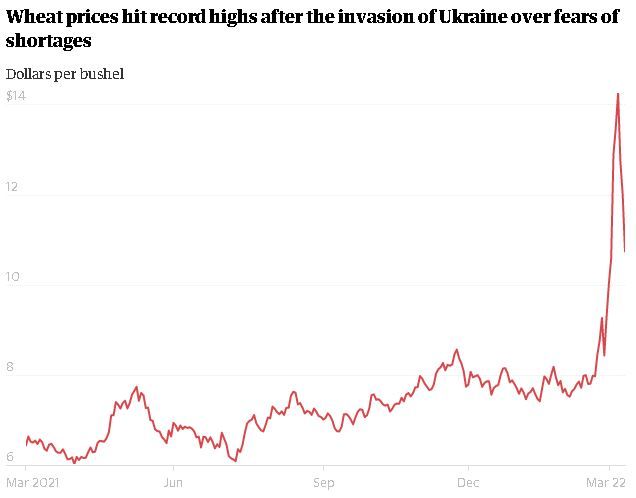
Meanwhile, pig farmers warned that the industry faced collapse as the soaring grain price only added to existing cost prices on feed and from labour shortages.
“The situation is now beyond desperate and there is no light at the end of the tunnel,” said Rob Mutimer, chair of the National Pig Association.
The group has written to retailers asking for an increase in payments to more than £2 per kilogram, more than 50% or about 70p more than is currently being paid.
Without the extra payment the NPA said more farmers would quit the industry, which has suffered months of difficulties.
“We are staring down the barrel of a total collapse of the British pig industry, which is not only a tragedy for the producers themselves, but will leave UK consumers short of one of their favourite and most versatile meats,” he said.
The wheat price now stands in the region of £300 a tonne, compared with about £215 a tonne just a few days ago.
Poultry and pork producers are likely to be the first to be affected by the rising grain price as bakeries and other producers using flour generally pay for their supplies well in advance.
The next few weeks are critical for sowing wheat and other crops in Ukraine, where about 15% of the land is currently occupied by Russia according to the boss of MHP, one of the country’s biggest grain producers.
Dr John Rich, the chair of MHP, told the BBC: “If this continues, of course our ability to sow rapidly diminishes, particularly if [the Russian army] moves into the west of the country where a large part of our operations are based.”
He said this could lead to the complete failure of Ukraine to produce any grain.
“The consequences are unimaginable as far as Ukraine is concerned,” he said.
“For the wider world, it’s simple. The price of wheat will continue to rise, the price of corn and other commodities will rise significantly, and you’ll have spiralling inflation at a time when we’ve already had problems with the global supply chain because of Covid,” he added.