

UK economy rebounds as Covid restrictions ease
Data from the Office for National Statistics showed that the expansion in gross domestic product (GDP) was fuelled by retail, restaurants and hotels.
Education also boosted the economy as schools reopened in the second quarter.
However, the figure was slightly below the 5% the Bank of England expected.
The UK economy is now 4.4% smaller than it was before the pandemic.
Growth in the second quarter contrasts with the first three months of the year, when the economy shrank by 1.6% while Covid restrictions were still in place.
Chancellor Rishi Sunak told the BBC: "Today's figures show that the economy is recovering very strongly, exceeding many people's expectations.
"But I'm not complacent. The economy and our public finances have experienced a significant shock. It is going to take us time to fully recover from that."
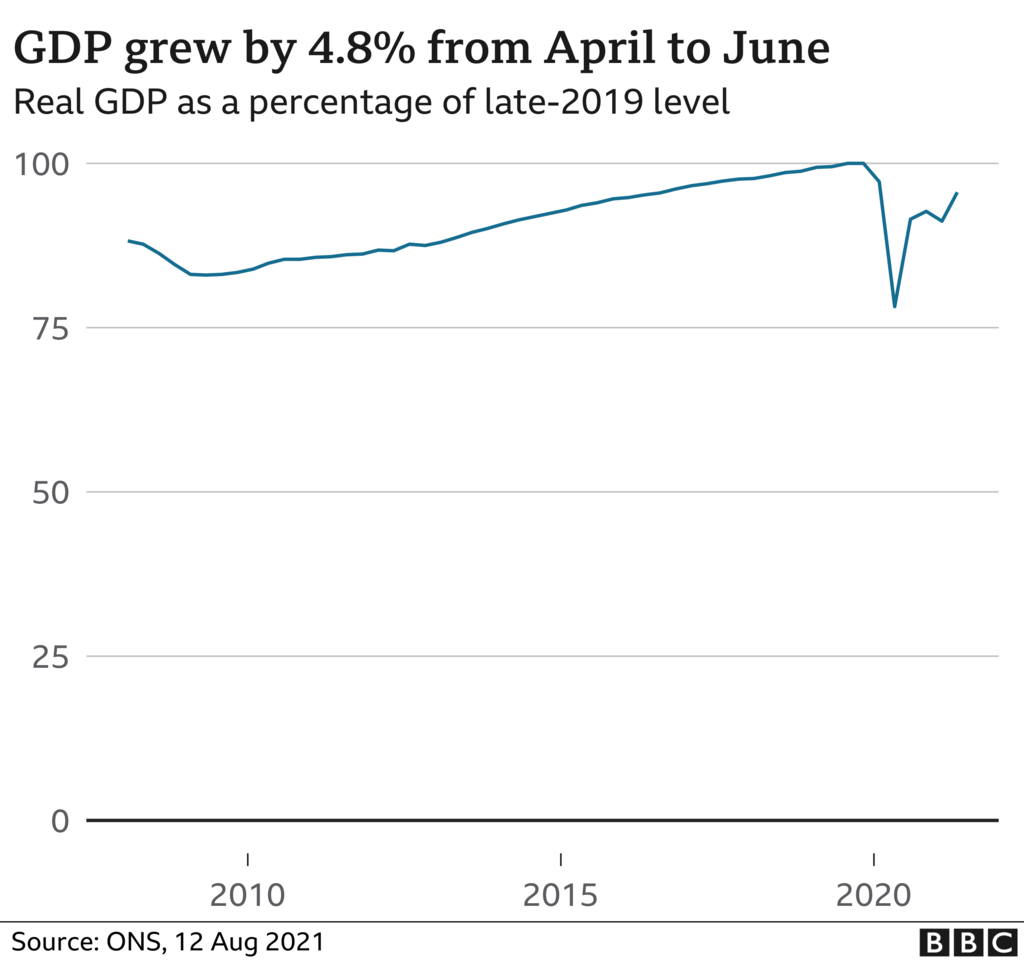
Capital Economics said it expected the economy to return to pre-Covid levels later this year.
"We are comfortable with our view that monthly GDP will return to its February 2020 pre-pandemic size by October and that the economy may yet surprise most forecasters by emerging from the pandemic without much scarring," said senior UK economist Ruth Gregory.
In April, non-essential retailers reopened, as well as gyms, hairdressers and outdoor dining. In May, pubs, restaurants and cafes were allowed to serve customers indoors, while theatres, galleries and cinemas were allowed to open their doors.
The main driver of growth was consumer spending, which rose by 7.3% over the quarter, ahead of expectations.

The UK is not just a nation of shopkeepers, but social animals. And it's that large proportion of "social spending" - on hotels, restaurants and leisure - that made our economy so vulnerable to lockdowns. The UK was the fastest shrinking of the G7 nations in 2020 and conversely, maybe one of the fastest of the big players to recover in 2021 as restrictions lift.
The consumer has led the way, driving output to within 5% of pre-pandemic levels, despite the Delta variant of Covid. It's growth that some feared just months ago would take far longer to materialise.
But what happens next is still uncertain. The safety net that has protected livelihoods - the furlough scheme - ends in October. Economists think there will be some job losses, albeit far fewer than assumed a year ago.
The biggest risk, however, will come from further variants and a resurgence in infections and restrictions. Policymakers are assuming we're done with the latter. A year ago, they were predicting there'd be no more national lockdowns: let's hope they're right this time.
If so, the impressive vaccination rate in the UK should stand the economy in good stead - others are not that fortunate. Be it health or wealth, it's access to vaccinations that may increasingly make the difference between the haves and have-nots as we try to escape the grip of this pandemic.
At the end of the quarter in June, the monthly growth is estimated at 1%, slightly more than most economists expected.
Pantheon Macroeconomics said that nearly half of the economic expansion in June came from activity in the health sector, "reportedly due primarily to a surge in people visiting their GP".
Hargreaves Lansdowne said: "Fears that the arrival of the Delta variant and the 'pingdemic' that followed might impact growth have so far not really materialised."
However, the ONS revised down its figure for May from 0.8% to 0.6% during a month of heavy rainfall.
The UK economy has been supported by the government's wage support scheme. But from July, employers have had to make contributions to staff wages and the scheme is set to close by the end of September.
'It's been very tough'
The economy is rebounding, but the pandemic is still having an impact on the restaurant trade, according to Asma Khan, founder and owner of Darjeeling Express, a family-owned Indian restaurant in London's Covent Garden.
"It's been very tough," she told the BBC. "The insecurity has been very hard to deal with, the way the lockdown happened in March of last year."
Mrs Khan said that she was "grateful" for the furlough scheme which allowed her to keep her entire staff on.
Even so, "I was still liable for all the rents and all the financial costs mounted up," she added.
There is, however, "a lot of optimism", Mrs Khan said. People are booking months in advance to dine at her restaurant, which recently welcomed comic actors Paul Rudd, of the US, and Canadian Dan Levy.
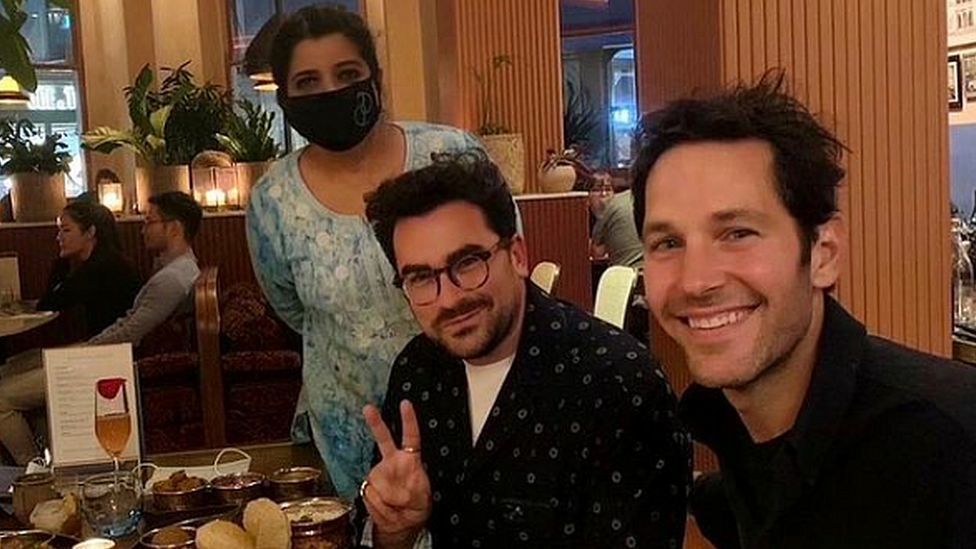
"We had, I think, 1,300 bookings in five hours when we started opening all up all the other dates," she said.
Mrs Khan said the changing nature of the UK's travel restrictions remained a concern. She said businesses like hers in central London were "completely dependent on tourists".
"People are worried because this whole insecurity of the red list, the amber list. This fluctuation is basically deterring a lot of people, except the very brave, to want to come in because they don't know whether the status of their country is going to change by the time they're ready to go back."
Following the release of second-quarter GDP figures, Mr Sunak said the UK had "the fastest quarterly growth rate among the G7 economies".
But Pantheon Macroeconomics said: "The UK economy almost certainly was the hardest hit by Covid-19 in the G7."
While UK GDP is still 4.4% smaller than its pre-pandemic level, the US has seen its economy recover, making it 0.8% larger than before Covid.
Pantheon also said France's economy was 3.3% below pre-pandemic levels, Germany was 3.6% below and Italy's GDP was 3.8% lower.
Japan and Canada have yet to report up-to-date figures, but Pantheon said: "Both economies had fared much better than the UK in previous quarters."