London Daily

Focus on the big picture.
Sunday, Jul 19, 2026

UK Covid death toll has passed 175,000, says ONS

UK Covid death toll has passed 175,000, says ONS

Figure of 176,035 differs significantly from government’s official count – which exceeded 150,000 at weekend

The UK’s main statistical body has reported more than 175,000 deaths involving Covid since the start of the pandemic.

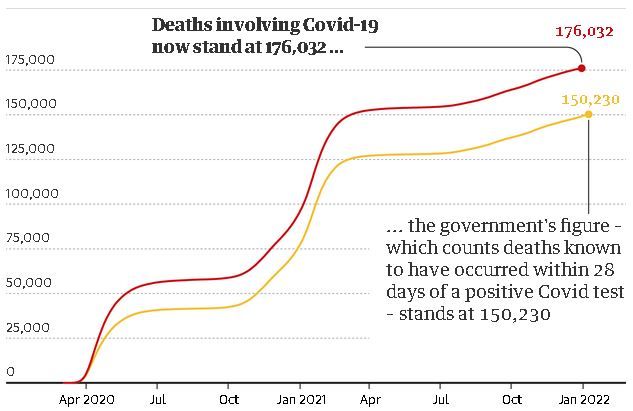
The ONS has reported 176,035 deaths where Covid was mentioned on the death certificate since March 2020. The figure differs significantly from the government’s official count – which exceeded 150,000 deaths over the weekend – which requires patients to have had a positive test within 28 days before their death.

The ONS figures are considered to be more accurate but because of delays in death registration they are not as up-to-date as the government figures. The 175,000 total was passed on 20 December 2021, but owing to these time lags, the ONS figures have only now been confirmed.

This latest release takes the 2021 death toll to 81,037, down from 94,998 in 2020. However, the figures for more recent dates may still be revised upwards, especially because the number of deaths registered in the last week of the year will have been affected by the Christmas and Boxing Day bank holidays, which means they will not yet have been recorded.

A total of 3,891 people have died of Covid since the first case of the Omicron variant was discovered in the UK on 27 November. The average lag between infection and death is 16-18 days and can be up to eight weeks, according to the ONS, so the Omicron death toll may increase further in coming weeks.

The number of deaths this winter has not yet come near the peak of previous waves despite a huge surge in Omicron cases. On 29 December, 246,000 new cases were confirmed, smashing previous records and taking the seven-day average figure to 192,000.

There were more than 7,000 deaths in November and December last year, compared with about 30,000 in November and December 2020.

Kit Yates, co-director of the Centre for Mathematical Biology at the University of Bath, said: “We can expect both of these [death] figures [from the ONS and the government’s official count] to continue to rise for some time, reflecting the huge rises in infections that we’ve seen and the fact that cases have moved up the age ranges impacting more vulnerable older people.
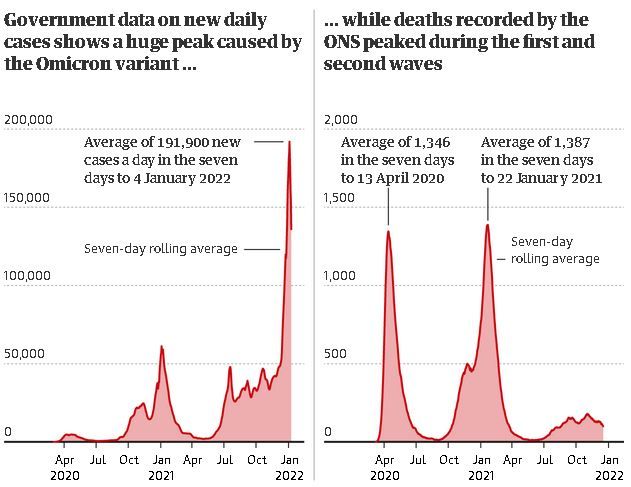

“Even so, we wouldn’t expect to see deaths get close to the disastrous figures we saw at this time last year and during the first wave, when we saw over 9,000 deaths a week. In large part this is due to the vaccination/booster programme, which has delivered good protection against severe disease and death.

Of the deaths registered in the last week of December in England and Wales, 582 mentioned Covid, or 6.9% of all deaths, a decrease on the previous week when there were 852 deaths, or 6.5% of deaths in the week to Christmas Eve.

Between the beginning of the pandemic and the end of 2021 there has been a crude Covid death rate of 262 deaths per 100,000 people in the UK, rising to 291 per 100,000 population in Wales, home to the highest proportion of people aged 65-plus of the UK’s constituency countries.

The figures come as the government is considering cutting the mandatory isolation period for people infected with Covid-19 from seven to five days after a number of sectors have been affected by staff shortages.

Boris Johnson said: “The thing to do is to look at the science. We are looking at that and we will act according to the science.”

Newsletter

Related Articles

0:00
0:00
Close
Iran Claims It Destroyed Bahrain’s Main Artificial Intelligence Center in Missile and Drone Strike
Brothers Andrew and Tristan Tate Who Turned "Toxic Masculinity" Into a Brand Arrested in Miami as Britain Seeks Their Extradition
Trump Administration Pressures Banks to Restrict Financial Access for Undocumented Immigrants
Passenger Bound for Germany Refused to Sit Beside a Woman on a Plane — Then Slapped a Flight Attendant
Ukraine’s Leadership Rift Spills Into the Streets as Protesters Target Army Chief
Ukrainian Drone Barrage Kills Eight and Strikes Russian Logistics Network
Key Trends to Watch
Financial Conduct Authority Warns Cloud and Digital Risks Are Becoming a Financial Priority
Jeffrey Donaldson Appeals Sexual Abuse Conviction as Democratic Unionist Party Opens Review
Welsh Health Authorities Launch Emergency Meningitis Vaccination Programme for Students
Scottish Business Activity Falls for Third Month as Companies Face Rising Costs
Bank of England Regulators Demand Better Access to Digital Banking Services
United Kingdom Cuts Bilateral Aid to Several African Countries by Up to Ninety Per Cent
United Kingdom Introduces Tougher Deportation Rules After Rochdale Exploitation Scandal
NHS England Launches Wearable Technology Plan to Reduce Sepsis Deaths
Amazon Web Services Billing Error Sends Trillion-Dollar Invoices to British Companies
Bank of England Takes Direct Regulatory Role Over Major Global Cloud Providers
Extreme Summer Heat Drives Record Fire Risk and Rising Deaths Across Britain
United Kingdom Nationalisation of British Steel Sparks Diplomatic Dispute With China
United Kingdom Economy Shows Weak Growth Ahead of Major Autumn Budget
Andy Burnham Set to Become United Kingdom Prime Minister After Labour Leadership Victory
The Ten World Cup Finals That Defined Football History
Smartphones Are Getting More Expensive, Sales Are Collapsing, and Even Apple Admits: "Prices Will Rise"
The Monaco Bombing Has Become a Test of Ukraine’s Intelligence Accountability
Leadership Change and Strategic Rivalry Redraw the Political Map
Energy Risk, Uneven Growth and the New Geography of Global Capital
The AI Race Enters Its Infrastructure Era
Security and resilience remain long-term national priorities
Britain balances growth ambitions with public finance pressures
Regional devolution becomes a defining theme of the next Labour era
Industrial strategy returns to the centre of British economic policy
Political Instability Remains a Challenge for UK Investment Confidence
Brexit Economic Debate Continues as Public Concerns Over Long-Term Impact Remain
UK Climate Risks Rise as Met Office Warns Extreme Weather Is Becoming More Common
Housing Shortages and Regional Inequality Become Key Priorities Under Incoming Labour Leadership
National Health Service Reform Remains One of Britain’s Biggest Political Challenges
Bank of England Remains at Centre of UK Economic Debate Over Inflation and Growth
UK Economy Shows Recovery Signs but Households and Businesses Remain Under Pressure
Britain Deepens European Defence Cooperation as NATO Allies Seek Stronger Security Capabilities
United Kingdom Expands Sanctions Against Russian Cyber Networks Over Security Threats
UK Industrial Strategy Faces Test After Government Takes Control of British Steel
British Businesses Seek Policy Clarity as Andy Burnham Prepares to Lead Labour Government
Andy Burnham’s Labour Leadership Signals Major Shift Toward Regional Power and Devolution
British Steel Nationalisation Creates New UK-China Tensions Over Control of Strategic Industry
For 36 Years, He Scammed About 300 Luxury Hotels — Until He Was Caught
England's World Cup Exit Expected to Cost Hospitality and Retail £334 Million
Former ICC Prosecutor Aide Speaks Publicly About Allegations Against Karim Khan
Opposition Raises Questions Over June Heatwave Power Grid Pressures
Mastercard Explores Sale of Majority Stake in UK Payments Operator Vocalink
Boeing Forecasts Global Commercial Aircraft Fleet Will Double by 2045
×