London Daily

Focus on the big picture.
Tuesday, Jul 28, 2026

UK coronavirus infections may be 'stabilising'

UK coronavirus infections may be 'stabilising'

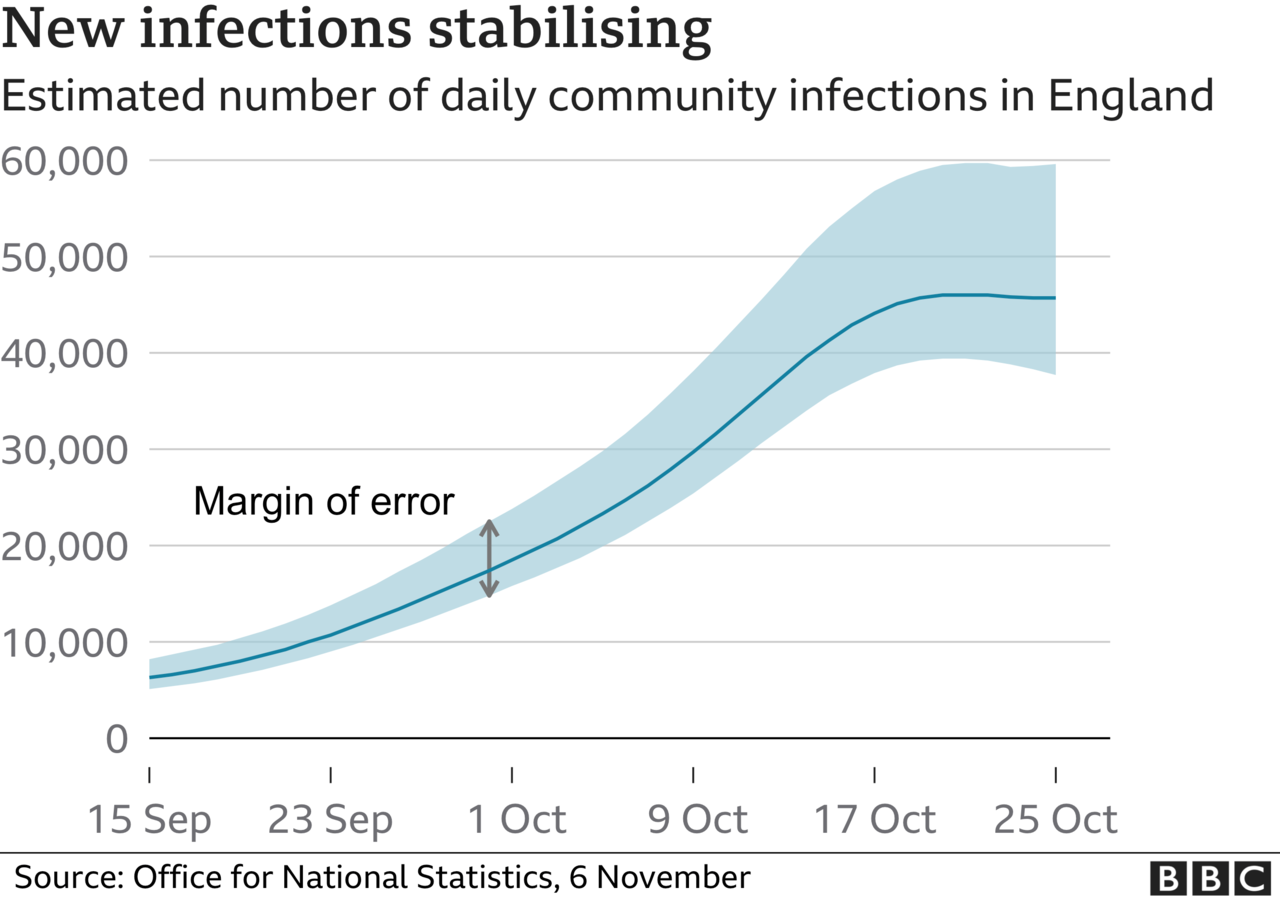
The increase in coronavirus infections appears to be slowing around the UK, latest data from the Office for National Statistics show.

Although the number of people with Covid continues to rise, the growth is levelling off.

In the week to 30 October, ONS says new daily infections in England stabilised at around 50,000.

That means around one person in every 90 in England has Covid. In Wales and Scotland the figure is slightly lower.

There, one in 110 people are testing positive for the virus.

In Northern Ireland it is one in 75 - and it is too soon to say if rates are levelling off there, say experts.

The ONS data looks at Covid-19 infections in the community, and does not include cases in hospitals, care homes or other institutional settings.

It shows:

*  There have been increases in infection rates in every region in England apart from the North East over the last two weeks

*  The North West and Yorkshire and the Humber continue to have the highest infection rates


With much of the UK in lockdown, experts hope the number of new infections can reduce in coming weeks.

In Liverpool, city-wide mass testing for Covid has begun.

Everyone living or working in the region will be offered repeat tests, whether or not they have symptoms, as part of a two-week pilot.

Meanwhile, data from the Covid Symptom Study app - based on a million people logging symptoms and 13,000 recent swab test results - suggests 42,049 people are developing Covid symptoms every day in the UK.

The R number remains the same as last week, at between 1.1 and 1.3, which means that on average every 10 people infected will infect between 11 and 13 other people and the outbreak is growing.

Ruth Studley from the ONS said: "At a national level we are seeing infections slow across England and Wales but they are still increasing.

"The level of infection in young adults and older teenagers appears to have levelled off recently. However, they continue to be the most likely to be infected despite increases in all other age groups."

Prof James Naismith from Oxford University said the findings were "encouraging" and suggested that the spread of the virus was slowing.

"This is evidence that the social restrictions prior to lockdown have had a real impact.

"Should next week's data show a similar stabilisation or reduction, then we can be confident that the second wave has for now stabilised. The national lockdown will not begin to show up in ONS figures for another two weeks, but we would expect it to bring a rapid decrease in the number of new infections.

"If we can contain the virus until the new year, mass testing, vaccines and new medicines will transform our outlook."

A Birmingham hospital has postponed all its non-emergency procedures because of an increase in the number of Covid-19 patients.

Queen Elizabeth Hospital is currently treating 389 patients who have tested positive, with 36 in its Intensive Care Unit (ICU). That compares with 60 in-patients a month ago, and just five in ICU.

Newsletter

Related Articles

0:00
0:00
Close
Badenoch Offers Tory Votes to Keep Serious Offenders in Prison
Why Americans Queue for $15 Ice Cream and a $100 Caviar Pint
Another AI Genius Left the United States — and Silicon Valley Is Starting to Worry
Shein Reports $99mn Loss as Trade Barriers Test Low-Cost Model
CXMT Gains 466% in China’s Biggest IPO Since 2010
Amazon Seeks Approval for 5,105-Satellite Mobile Network
Burnham Puts School-to-Work Reform at Centre of Welfare Strategy
Burnham Rules Out Replacing Council Tax and Stamp Duty
Fresh Heatwave Threatens to Rekindle France’s Historic Wildfire Crisis
The Burnham government is seeking to establish its credibility through ambitious social care reform while maintaining fiscal discipline and public confidence in the National Health Service. Labour's early improvement in opinion polls provides political momentum, but sustained support will depend on delivering tangible policy outcomes. Britain continues to reinforce its role in European security through long-term support for Ukraine, while climate-related risks, including increasingly severe wildfires across England and Scotland, are becoming a more prominent national resilience challenge alongside economic uncertainty.
United Kingdom Economy Remains Exposed to Global Energy Risks
Prime Minister Dismisses Calls for an Early General Election
Scottish Wildfires Continue to Stretch Emergency Services
United Kingdom Faces Rising Wildfire Risk as Heatwave Continues
Lower Oil Prices Ease Inflation Concerns and Support Financial Markets
Financial Conduct Authority Launches Consumer Campaign on Car Finance Compensation
Government Prioritises Employment Over Benefit Cuts in Welfare Reform Plans
Prime Minister Rules Out Sweeping Property Tax Changes Before Autumn Budget
AstraZeneca Beats Expectations as Cancer Medicines Drive Strong Profit Growth
Labour Regains Narrow Polling Lead After Burnham's First Week in Office
United Kingdom Reaffirms Long-Term Commitment to Ukraine Under Burnham Government
Prime Minister Andy Burnham Makes Social Care Reform the First Major Test of His Government
Following OpenAI's Cyberattack: 'Most Companies Still Do Not Understand What Is Coming'
Autopsy Finds No Violence in Death of Epstein-Linked Model Scout
Indian Education Minister Resigns After Cockroach Youth Protests
California Desert Data-Centre Plan Stalls as Water and Power Disputes Mount
Northern Ireland Border Security Tightened After Military-Grade Explosive Interception
British Hospitality Sector Targets Summer Visitors Through Regional Promotions
England River Access Debate Intensifies After New Data Shows Limited Public Access
Royal Navy Strengthens Maritime Vigilance Amid Rising Security Concerns
UK Education Department Expands Mental Health Support for Young People Entering Work
UK Tourism Industry Launches Summer Campaigns to Boost Domestic Travel
North England Transport Plans Advance to Support Industrial Growth
Financial Markets Watch New Government’s Economic Strategy as Investors Assess Fiscal Risks
Royal Navy Continues Monitoring Russian Naval Activity Near UK Waters
UK Care Workers May Receive Immigration Exemptions Under Proposed Visa Changes
Health Secretary Yvette Cooper Begins Emergency Talks to Address NHS Staffing Shortages
UK Banks Launch High-Interest Savings Offers to Attract Household Deposits
North Sea Oil Drilling Projects Face Delays After Offshore Equipment Accident
Cairngorms Wildfire Highlights Growing Pressure on UK Emergency Services
UK Government Borrowing Plans Put Pressure on Ten-Year Gilt Markets
Royal Navy Aircraft Carrier HMS Prince of Wales Returns After NATO Northern Flank Mission
Metropolitan Police Opens Criminal Investigation Into Reform UK Political Donations
Scottish Government Requests Military Support as Cairngorms Wildfire Forces Emergency Response
Andy Burnham Takes Office as UK Prime Minister and Unveils New Cabinet Team
War, Youth Revolt and the Global Struggle for Control
War, Power and the Rising Price of Political Decisions
High Street Sales Suffer Sharpest Summer Decline in Five Years
Wales Approves Higher Taxes on Second Homes and Long-Term Empty Properties
Environment Agency Imposes Record £150 Million Penalty on Water Companies
×