

UK and Saudi Arabia look to 'join hands' in clean energy innovation
The UK and Saudi Arabia must “join hands” to boost trade in clean energy innovation to capitalise on the close relationship between the two countries as global transition to net zero accelerates, panellists at the UK/Saudi Sustainable Investment Forum have said.
While the UK set out a 10-point plan towards the target, Saudi Arabia’s Vision 2030 has made sustainability a top priority, with the similarities in strategy offering opportunities to step up trade between the nations.
“We all know that the world is facing nothing less now than a green industrial revolution and I really believe that there are huge benefits to both our countries if we join hands to face this together,” Lord Gerry Grimstone, Minister for Investment at the UK’s Department of Trade, told delegates attending the forum, hosted by the Saudi British Joint Business Council.
Mr Grimstone said Prime Minister Boris Johnson made “strengthening the ties of friendship and opportunity” with the kingdom a top priority for Britain, with the government “committed to enhancing strategic investments”.
Majed Al Qasabi, Saudi Arabia’s minister of commerce, said the “likeability factor” between the kingdom and the UK as well as the unique historical relationship between the nations offers investment opportunities for UK investors.
"Today, the real success, the real opportunity is the [Saudi Arabian] government’s operating model," Mr Al Qasabi said. "The government is being proactive, the government is being pro-investment and investment-friendly and is revamping all of its bureaucracy."
With Saudi Arabia's government exploring numerous hybrid solutions between nature, technology and energy, “there is a unique mix of opportunities”, Mr Al Qasabi said, as the country unleashes new sectors such as tourism, culture, mining and logistics.
“We really look forward to working together on joint ventures to leverage [UK] experience and expertise to bring it to Saudi Arabia,” he said.
Saudi Arabia, the world's largest exporter of oil, plans to add gas and renewables' capacity equating to one million barrels of oil day a by 2030, the kingdom’s Crown Prince Mohammed bin Salman said earlier this year, as the country looks to commit to lowering emissions and the energy effects of fossil fuel as part of its diversification strategy for 2030.
The country’s 300 megawatt Sakaka power plant, for example, which was inaugurated in April, is the kingdom's first solar utility-scale project. Built at a cost of 1.2bn Saudi riyals, it is part of the kingdom's plan to add 27.3 gigawatts of clean energy to its grid by 2024.
Since the kingdom unveiled its Vision 2030 in 2016, non-oil revenue in the country has grown to SAR 350bn from SAR166bn, with the non-oil sector in the country growing 4.5 per cent last year.
Eman Al Mutairi, Saudi Arabia's Vice Minister of Commerce, said the country has already achieved many of the goals set out in the vision strategy, which saw the policy firmly focused on diversifying the economy and weaning off oil and gas.
Now as the country emerges from the pandemic, Ms Al Mutairi said the country is still working towards a sustainable economy as it looks to build back better, offering plenty of investment opportunities to overseas investors such as the UK.
“Our vision still stands and our targets for the vision still stand,” she said. “We are working on a more sustainable economy and on a more sustainable environment, and all our vision initiatives and programmes are still ongoing and we're still accelerating this transformation.”
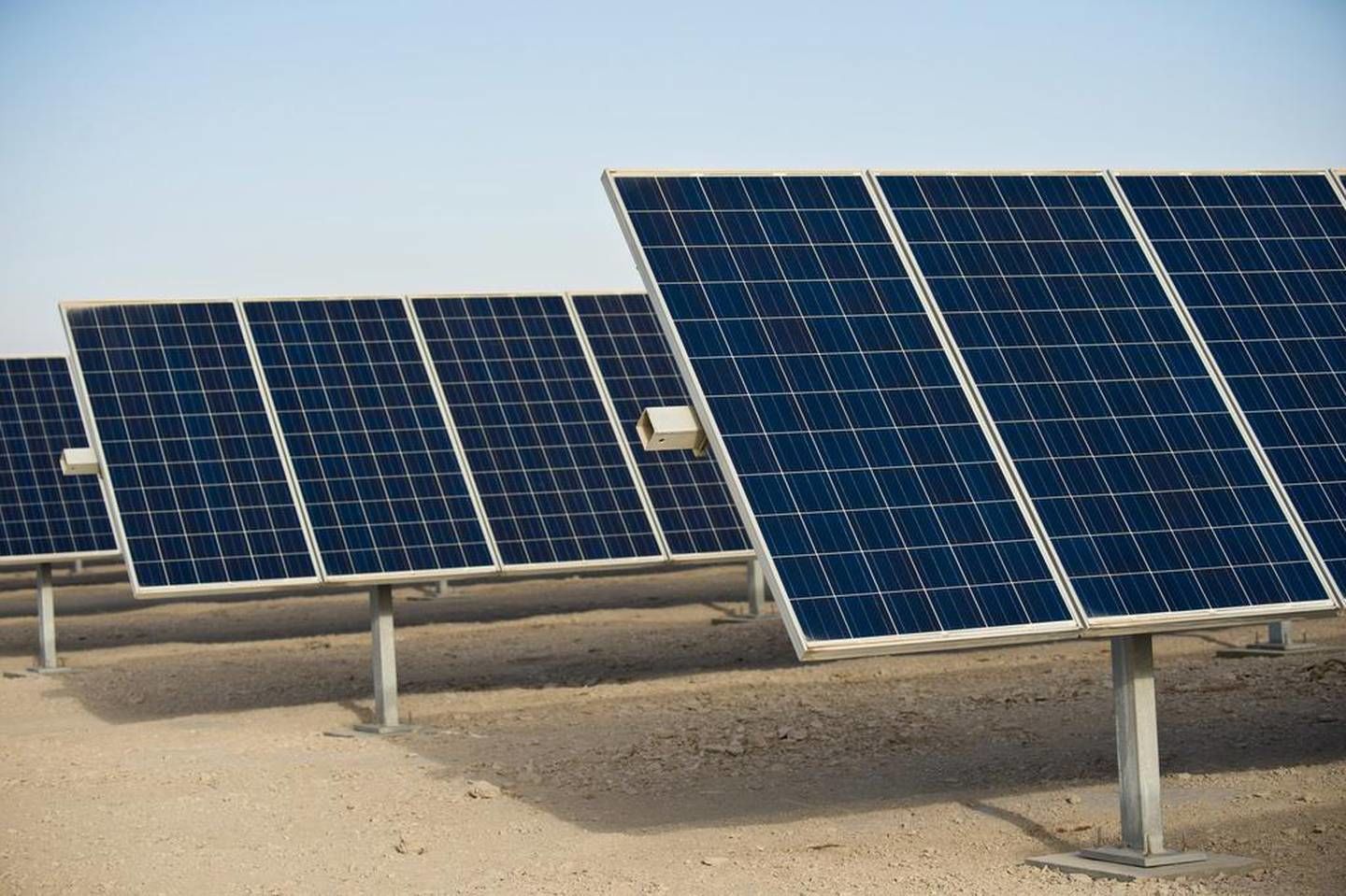 Saudi Arabia's first solar project, a 300-megawatt scheme at Sakaka, will reach full commercial operation by the end of year.
Louis Taylor, chief executive of UK Export Finance, said the UK’s 10-point plan and the Saudi Vision 2030 plan shared similarities.
“There’s a massive shared ambition in relation to net zero and clean growth between the United Kingdom and the kingdom,” Mr Taylor said.
“Clean and sustainable investment is very much at the heart of vision 2030 and new technology at the heart of vision 2030 and the UK and UKEF has lots to offer in relation to all of this.”
However, with many companies now making pledges on net zero, they can only achieve those by using technology that does not "yet exist, at least on a commercial scale", Mr Taylor said.
“I think of technologies like green hydrogen ... electrification of vehicular transport, particularly larger vehicles, floating offshore wind, small modular reactors – all of these technologies are the future ... but they're not here right now. And there is risk around that that makes it difficult to finance it all at this stage,” he said.
However, with the UK at the forefront of research into clean energy, the biggest user of offshore wind globally as well as a leader in green finance, it has much to offer Saudi Arabia, he said.
UKEF has about £7bn in market capacity for the kingdom, Mr Taylor said, with options to help UK companies work with the public and private sector
“We can work with goods, services, or intangibles like intellectual property, and we're very flexible around structures such as project finance, or Islamic Finance, and we can finance in local currency as well,” he said.
For Saudi Arabian investors looking for partnership opportunities in the UK, Beverley Gower-Jones, managing partner at the UK Clean Growth Fund, said it was fundamental to stimulate and funds SMEs looking to create innovations to help the economy reach net zero.
The fund, which has raised more than 60 per cent of its target of £100m, is focused on key market sectors such as power, transport, industry and waste.
“The technologies focused on, in terms of that collaboration between Saudi and the UK, are things like infrastructure charging for electric vehicles,” she said.
However, to ensure the UK and Saudi Arabia can make this transition to a greener, more sustainable future happen, they also need the support of the financial sector.
Fahad Al Saif, head of corporate finance at Saudi's Public Investment Fund, said the sovereign wealth fund was mandated by its board to invest $40bn annually into the kingdom with 13 sectors identified that are “going to create the new economy and sustainability”.
He pointed to Neom, a futuristic development in Saudi Arabia whose flagship project is a zero-carbon city, where energy production is focused on a green hydrogen, which is already attracting significant foreign direct investment.
“PIF is very much around ESG by creating the jobs for the Saudis, by creating the new economy for salaries, by also creating the diversity of revenue for the Saudis," he said.
“We are very much focused throughout the direction, but also ensuring that we are a proactive player into the global economy to create change and sustainability.”
However, to help PIF expand its green investment further, Mr Al Saif said the financial sector must ensure there is standardisation and normalisation for the ESG market and “also an equal share for emerging markets and developing markets to tap into ESG investors”.
“We're all aware that emerging markets will be raising multiple of these figures that we are seeing today,” he said.
Meanwhile, Faizal Bhana, director of Middle East, Africa and India at Jersey Finance, said there were "large reservoirs of similarity” between ESG investing and Islamic Finance.
“As early as 2019, we see this alignment between the principles of Sharia and ESG thinking in the next generation.
"If we think about Saudi Arabia, more than 60 per cent of the population in Saudi Arabia is under 30, so this demographic is key and these alignments that are recognised by this demographic are significantly pushing this forward," he said.
"If you're interested in ESG, then you're interested in Islamic finance. It's not by chance that we see the push for the green economy, diversification away from oil, the giga-projects we've heard about, the transformation of Riyadh into a greener city, the importance of sustainability across the vision 2030 strategy.
"Deeply rooted personal beliefs to do good, even in the pursuit of economic gain have played an important part in putting these strategies together," he said