

Trials, pardons, prison time: How Trump's legal woes could play out and what it means for 2024
The FBI waded into uncharted territory when it executed a search warrant in August at former President Donald Trump's Mar-a-Lago club and personal residence in Palm Beach, Florida.
According to the unsealed warrant and an accompanying FBI manifest of items seized, the feds recovered 20 boxes from Mar-a-Lago and at least 11 sets of classified documents, including some marked top secret. The warrant also indicated that the Justice Department was investigating whether Trump violated three federal laws, including the Espionage Act, related to the handling of national security information.
The raid — and its continued fallout — sparked a national firestorm as the public grappled with the reality that there was an active criminal investigation into the former president of the United States and a current 2024 Republican presidential candidate.
After Trump announced his third presidential bid in November, Attorney General Merrick Garland tapped Jack Smith, a veteran war crimes prosecutor, to be special counsel in charge of any DOJ investigations involving Trump, including the classified documents inquiry and the sprawling Capitol riot probe.
The unprecedented position the department is in has prompted a slew of questions. Chief among them: What happens next, and how might this end for Trump?
Here are some possibilities:
The investigations conclude with no charges filed
In the US's 250-year history, no ex-commander in chief has ever faced criminal charges. And while the FBI's raid indicated that its investigation had entered an aggressive phase, the inquiry may very well wrap up without an indictment against Trump.
For a somewhat similar example of this option playing out, look to Trump's former personal defense attorney Rudy Giuliani. The FBI raided Giuliani's home and office last year and seized more than a dozen of his electronic devices as part of a criminal investigation into whether Giuliani broke foreign-lobbying laws.
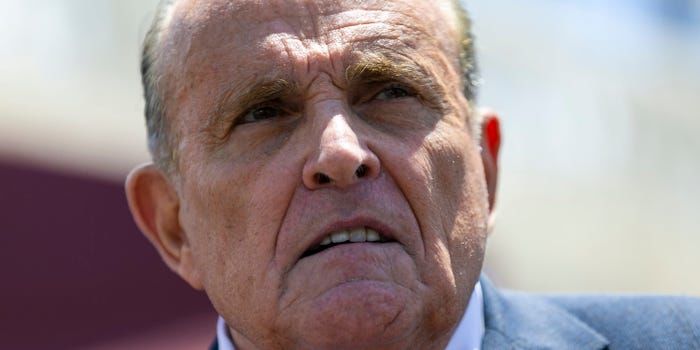 Former New York City Mayor Rudy Giuliani.
Over the summer, the feds returned Giuliani's devices to him, and The New York Times reported that he's unlikely to face criminal charges related to his work in Ukraine.
Barbara McQuade, a former US attorney for the Eastern District of Michigan, cautioned against assuming that the Mar-a-Lago raid would lead to an indictment and said it's possible the Justice Department wanted only to recover the records Trump had at his Florida property.
"In a case involving sensitive documents, a high priority for the government is to protect the content from disclosure, which can be difficult when trying a case in open court," McQuade told Insider. "The warrant may have been executed just to get the documents back. It was Trump who made the public announcement about it."
In the event that no charges are filed against him, Trump would have a clear path to landing in the White House again.
Trump agrees not to seek public office to avoid an indictment
On the other end of the spectrum, prosecutors could pursue criminal charges against the 45th president in connection to his handling of government records. If they did, it could go one of several ways.
One option with some historical precedent: a deal in which Trump agrees to suspend his campaign and not seek public office in exchange for avoiding charges.
In 2001, on his last day in office, then-President Bill Clinton cut a deal with the Whitewater special prosecutor Robert Ray: If Clinton gave up his license to practice law in his home state of Arkansas for five years, the Whitewater team wouldn't pursue criminal charges against him for lying under oath about his sexual relationship with the former White House intern Monica Lewinsky.
Whitewater investigators also imposed a $250,000 fine on Clinton, which he paid, and the Supreme Court suspended him from arguing cases before it. The court gave Clinton 40 days to explain why he shouldn't be disbarred after the Arkansas Bar Association suspended him, but rather than face disbarment, Clinton resigned his membership on the Supreme Court Bar.

In Trump's case, while the Justice Department's investigation into his handling of government records is now the most public-facing one, it isn't the only ongoing federal inquiry connected to him. The department is also conducting a wide-ranging investigation into the January 6, 2021, Capitol riot, and several former high-ranking White House officials have been subpoenaed as at least two grand juries investigate events leading up to the attack.
Prosecutors are said to be zeroing in on Trump's actions surrounding the riot, and CNN reported his lawyers had grown more concerned about Trump's legal exposure as the attorney general publicly emphasized that "no person is above the law."
Then there's Congress' separate investigation into January 6, which has highlighted several laws lawmakers think Trump may have broken in connection to the riot. The bipartisan select committee overseeing the investigation is expected to ask the DOJ to prosecute Trump on three charges: conspiracy to defraud the US, obstruction of an official proceeding, and inciting an insurrection.
Trump's defense lawyer Alina Habba previously appeared to allude to the possibility of him agreeing not to seek office again in exchange for avoiding criminal charges.
"I've sat across from him every time he gets frustrated, and I say to him, 'Mr. President, if you would like me to resolve all your litigation, you should announce that you are not running for office, and all of this will stop,'" Habba said on Real America's Voice.
Trump is indicted, convicted, and ends up behind bars — but can still run for president
If Trump is charged with a crime — or crimes — but forgoes a plea deal, the case will proceed to a criminal trial. According to the FBI's search warrant, prosecutors are looking into whether Trump violated three federal laws relate to his handling of national security information:
* 18 USC § 793, a key facet of the Espionage Act relating to the removal of information pertaining to the US's national defense. Conviction on this count carries a maximum penalty of 10 years in prison.
* 18 USC § 2071, which bars the concealment, removal, or mutilation generally of government records. Conviction on this count carries a maximum penalty of three years and disqualification from holding public office.
* 18 USC § 1519, which prohibits the destruction, alteration, or falsification of records "with the intent to impede, obstruct, or influence the investigation or proper administration of any matter" within the jurisdiction of federal agencies or departments. Conviction on this count carries a maximum penalty of 20 years in prison.
In all, the former president, if convicted, would be facing up to 33 years of incarceration, according to legal experts.
"These are serious crimes because they risk our national security," McQuade, the former US attorney, said. "The facts will matter. I would imagine that as with the investigation of Hillary Clinton, DOJ will want to assess intent."
She added that the inclusion of Section 1519 — the obstruction statute — "suggests that Trump may have tried to conceal from the government what he had."
"If so, that factor would tend to favor prosecution," she said.
That begs the question: If Trump is charged, convicted, and winds up in prison, can he still run for president in 2024?
The short answer is yes, and it's been done before.
As Insider previously reported, there's nothing in the Constitution that blocks someone from mounting a presidential run if they're behind bars. The socialist candidate Eugene Debs had been convicted of treason under the Espionage Act when he ran for president in 1920. And Lyndon LaRouche, who was convicted of mail fraud in 1988 and imprisoned, ran for president in 1992.
If he's convicted for violating two of the three laws mentioned above, Trump could still run for president, even if he's incarcerated. If he's convicted of violating Section 2071, however, he could be disqualified from holding office again.
That said, legal scholars told The New York Times that it's unlikely Trump would be blocked from running again even if he's convicted of a Section 2071 violation, citing Supreme Court rulings that indicate Congress cannot overrule the Constitution's eligibility criteria for the presidency.
Biden grants Trump executive clemency
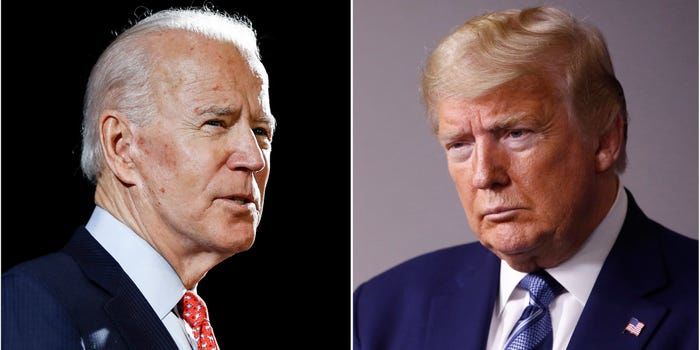
President Joe Biden could elect to grant Trump executive clemency — in the form of a pardon, commutation, amnesty, or reprieve — if Trump got indicted, convicted, or even faced the threat of indictment during Biden's administration. The most famous historical example of this was when President Gerald Ford pardoned his predecessor, Richard Nixon, after Nixon resigned from office amid the Watergate scandal.
Congress dropped its impeachment investigation into Nixon following his resignation, but he still faced the risk of criminal prosecution on both a state and a federal level. In September 1974, Ford granted Nixon a full and unconditional pardon for any crimes he may have committed while president.
While the move was seen as a step toward helping the country heal in the wake of Watergate, it's also widely believed to be one of the main reasons Ford lost his own bid to serve a full term in the 1976 election against Jimmy Carter.
Now, more than four decades later, legal experts suggest it's highly likely Biden will grant Trump a pardon or a commutation if he's convicted, indicted, or under threat of indictment to avoid further inflaming political divisions in the country.
"My 100% is really that there is no way that a former POTUS is going to spend time in jail, or that Biden (or any normal POTUS) would allow that," Asha Rangappa, a former FBI agent and a dean at Yale Law School, tweeted.
Aziz Huq, a law professor at the University of Chicago, made a similar point.
A narrow pardon for offenses related to the mishandling of classified information, as opposed to a blanket pardon like the one Ford granted Nixon, "might minimize damage to the rule of law, while shoring up our democratic norms," Huq wrote for Politico.
"While hardly perfect, it might well be the least bad option to protect our constitutional democracy," he added.
But it's worth noting that a presidential pardon wouldn't shield Trump from state charges.
The Fulton County district attorney's office is investigating whether Trump and his allies violated Georgia laws in their quest to nullify Biden's election victory in the state — and some legal experts say this investigation is a bigger risk to Trump than the Justice Department's.
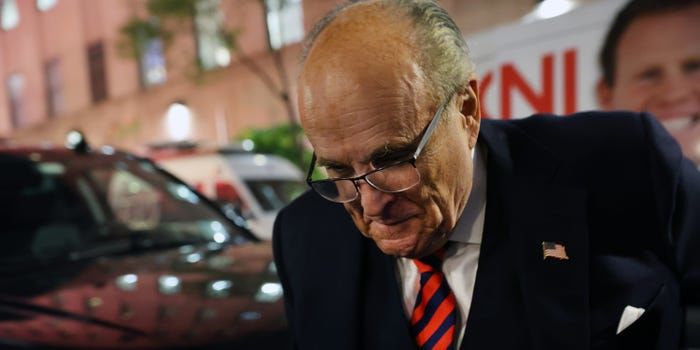 Local prosecutors in
Georgia have targeted Rudy Giuliani in their investigation into efforts
by Donald Trump and his allies to overturn the state's 2020 election
results.
Local prosecutors in
Georgia have targeted Rudy Giuliani in their investigation into efforts
by Donald Trump and his allies to overturn the state's 2020 election
results.
If Trump becomes a target of the investigation and faces state criminal charges, his only hope for clemency upon conviction would be from a Georgia pardons and parole board.
Trump gets indicted and acquitted following a trial
It's also possible that Trump will be criminally charged and opt not to cut a deal and that Biden won't step in with a clemency grant. If the case went to trial, a 12-person jury would have to reach a unanimous decision to convict, and Trump would be off the hook if just one juror broke from the others.
If he does sidestep the legal minefield he's in and makes it back into the White House in 2024, Trump and his allies have made clear that they intend to exact revenge on the Justice Department and the FBI.
It wouldn't be the first time Trump has interfered with the department's work.
He made headlines during his presidency for wondering why he couldn't have "my guys" at the "Trump Justice Department" do his bidding. He famously fired James Comey, the FBI director in charge of the investigation into the Trump campaign's links to Russia. Then he ordered the firing of the special counsel appointed to investigate Comey's firing (and backed off only when the White House counsel threatened to quit).
When he lost the 2020 election, Trump tried to enlist the Justice Department to overturn Biden's victory and attempted to oust the acting attorney general before backing off when top department officials threatened to resign en masse.
The former president has repeatedly posted op-eds to Truth Social suggesting that he'll seek payback if elected to office again.
Michael Caputo, a former top communications aide at the Department of Health and Human Services and one of Trump's most loyal lieutenants, also alluded to what could come next if Trump's reelected.
"At the end of this thing, the FBI is going to be four different departments spread across the federal government like seeds to the wind and probably based in Wichita," he told Insider.