0:00
0:00
Trump Repeats UK Claims That Diverge from Verified Facts Amid Diplomatic Strain
President Trump’s assertions on UK policy, energy, and legal systems are challenged by factual evidence as tensions rise over strategic cooperation
President Donald Trump has issued a series of assertions about the United Kingdom that diverge from verified facts, intensifying a diplomatic exchange with British leaders already strained over cooperation on international security.
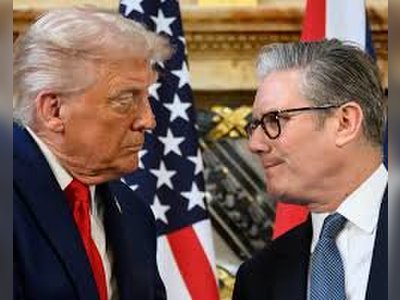
In remarks this week, Mr. Trump criticised British Prime Minister Sir Keir Starmer’s leadership, contrasted him unfavourably with Winston Churchill, and reiterated concerns about UK policy decisions on strategic territories, energy, and legal frameworks.
Mr. Trump’s comments on the future of the Chagos Islands — a British Indian Ocean Territory — described the UK as having acted improperly in conceding sovereignty to Mauritius while securing continued use of the strategically vital Diego Garcia military base.
In reality, the agreement does transfer sovereignty to Mauritius on terms that preserve the joint UK-US military presence, and the indigenous Chagossian population was displaced decades ago, contrary to the president’s suggestion that people unfamiliar with the islands are now claiming them.
The president also criticised the UK’s energy strategy, asserting that widespread wind turbines are ‘‘ruining’’ the landscape and implying that expanded North Sea drilling would yield economic benefits.
While debates over aesthetics and energy policy are inherently subjective, the British government’s emphasis on renewable energy reflects a broader strategic choice to stabilise prices and reduce dependence on fossil fuels, not the purely deleterious picture painted by Mr. Trump.
On domestic law, Mr. Trump claimed that ‘‘sharia courts’’ adjudicate legal matters in the UK. This characterisation misrepresents the role of sharia councils, which exist as voluntary arbitration bodies without judicial authority — akin to other community-based religious forums.
The cumulative effect of these comments has contributed to an atmosphere of tension between Washington and London.
The exchange follows broader disagreements over military cooperation, particularly in relation to the United States’ operations in the Middle East and the timing of UK support for defensive use of shared bases.
Despite these strains, officials in both capitals continue to affirm the enduring alliance and shared strategic interests.
Taken together, independent assessments show that the substance of Mr. Trump’s recent claims includes embellishment or mischaracterisation of the facts on key issues, even as underlying policy debates between the United States and the United Kingdom proceed in complex and evolving geopolitical circumstances.
In remarks this week, Mr. Trump criticised British Prime Minister Sir Keir Starmer’s leadership, contrasted him unfavourably with Winston Churchill, and reiterated concerns about UK policy decisions on strategic territories, energy, and legal frameworks.
Mr. Trump’s comments on the future of the Chagos Islands — a British Indian Ocean Territory — described the UK as having acted improperly in conceding sovereignty to Mauritius while securing continued use of the strategically vital Diego Garcia military base.
In reality, the agreement does transfer sovereignty to Mauritius on terms that preserve the joint UK-US military presence, and the indigenous Chagossian population was displaced decades ago, contrary to the president’s suggestion that people unfamiliar with the islands are now claiming them.
The president also criticised the UK’s energy strategy, asserting that widespread wind turbines are ‘‘ruining’’ the landscape and implying that expanded North Sea drilling would yield economic benefits.
While debates over aesthetics and energy policy are inherently subjective, the British government’s emphasis on renewable energy reflects a broader strategic choice to stabilise prices and reduce dependence on fossil fuels, not the purely deleterious picture painted by Mr. Trump.
On domestic law, Mr. Trump claimed that ‘‘sharia courts’’ adjudicate legal matters in the UK. This characterisation misrepresents the role of sharia councils, which exist as voluntary arbitration bodies without judicial authority — akin to other community-based religious forums.
The cumulative effect of these comments has contributed to an atmosphere of tension between Washington and London.
The exchange follows broader disagreements over military cooperation, particularly in relation to the United States’ operations in the Middle East and the timing of UK support for defensive use of shared bases.
Despite these strains, officials in both capitals continue to affirm the enduring alliance and shared strategic interests.
Taken together, independent assessments show that the substance of Mr. Trump’s recent claims includes embellishment or mischaracterisation of the facts on key issues, even as underlying policy debates between the United States and the United Kingdom proceed in complex and evolving geopolitical circumstances.